Manit
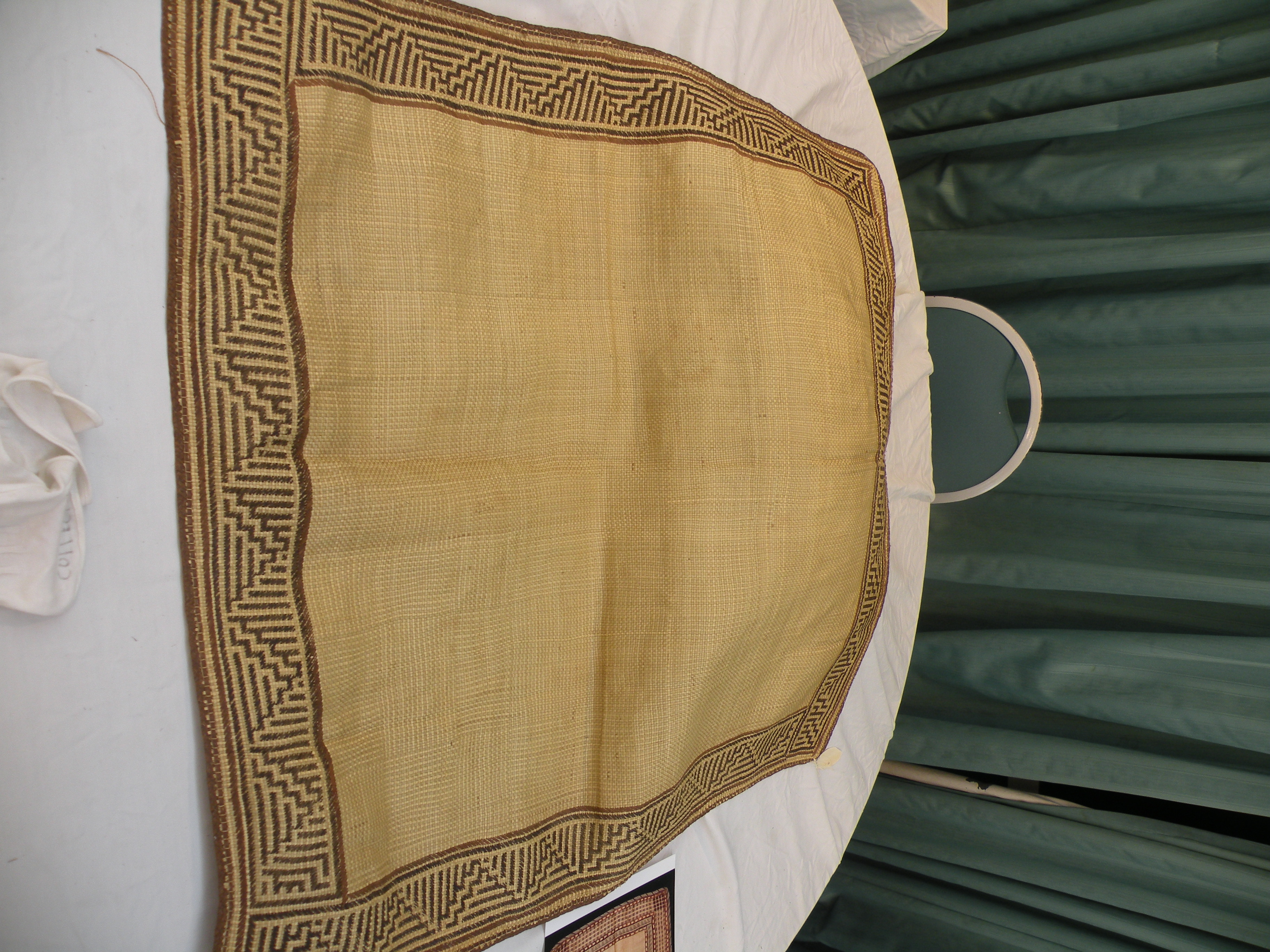
Bishop’s Museum matt – 1830’s
Okay, what’s Manit? Manit is a national holiday in the Marshall Islands and specifically is a chance to celebrate the culture of the country. The schools are focused on centering their activities that celebrate the arts and culture and include the making of traditional foods, parades and whatever can be supported with their limited budgets. Other activities take place around town and the one main event we joined in on was a celebration of traditional mat making.
There has been a lot of effort put into teaching and learning some of the lost weaving skills. With the support of the Bishop’s 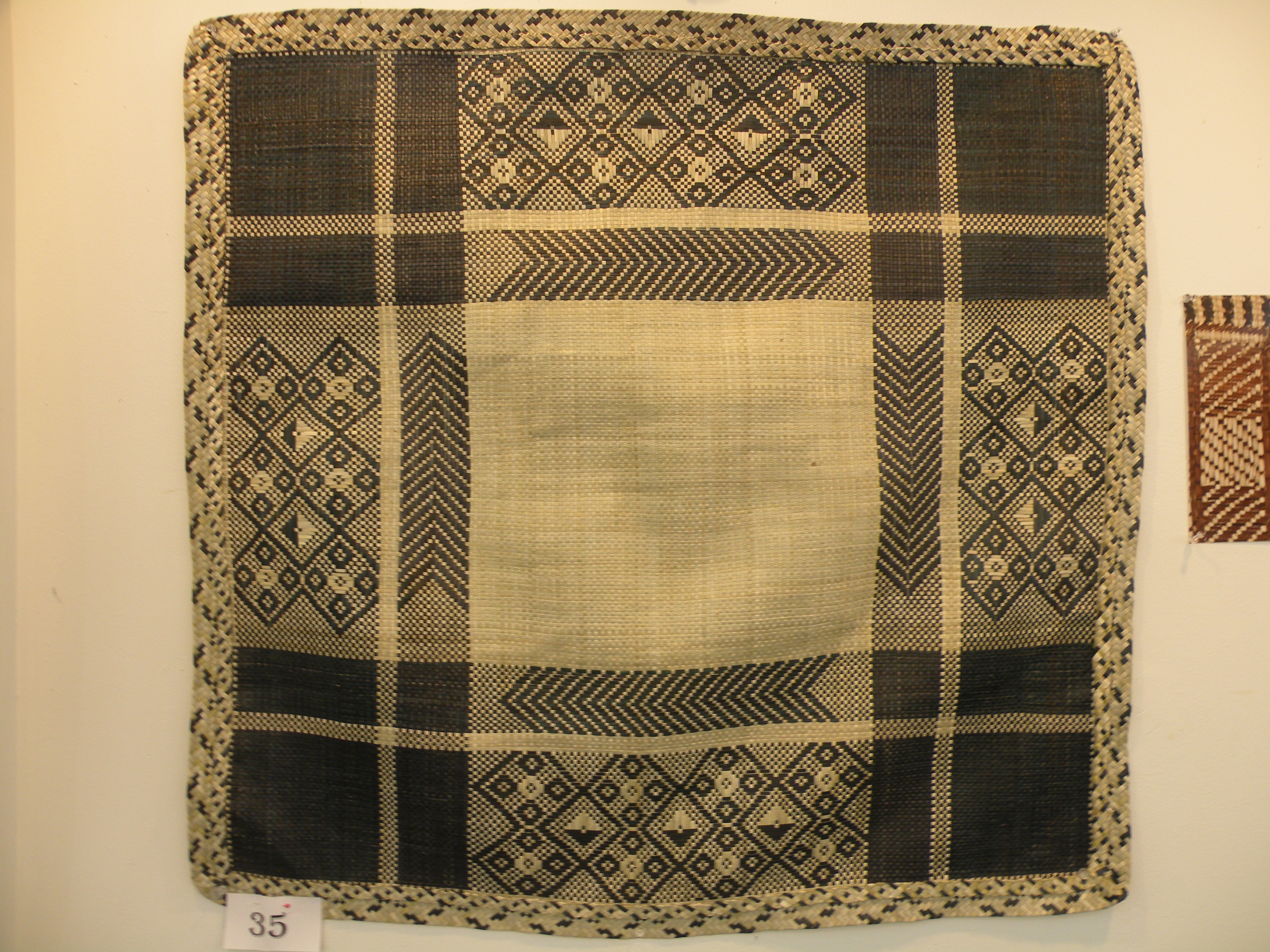 Museum, and associated trust fund, and the work of people from across the Marshall Islands, they have been attempting to understand how the mats were made and working to improve the current standard of workmanship. For the last 6 years there has been a national competition in mat making. The main criteria for judging the mats are: traditional material i.e. pandanus, must be in made in black or white or brown (i.e. no coloured threads), and symmetry i.e. made as square or rectangular as possible.
The culmination of the competition is the exhibition held each year at the Marshall Islands Resort. This year there were approximately 40 mats of varying quality. The judging was conducted during the day and then in the evening there was a silent auction. 100% of the funds raised at the sailing auction went to the individual weaver of each mat. For everyone attending there was a $5 entry fee. We decided to attend and glad we did. It was a great evening providing a chance to not only see all of the mats on display but also a chance to actually handle two mats that were brought in from the Bishop’s Museum and dated back to the early 1800s. Amazingly there were gloves provided and attendees were able to actually handle the mats with gloved hands. They were quite amazing – finely woven, supple and in fine condition.
The silent auction generated a lot of interest. With about 80 people in the room and about an hour in which to bid on a mat there was lots of interest generated. In the end the highest bid received was $260 and the lowest at $60 (this is the mat we bought!). We thought the prices were low for the quality of the mats. In previous years prices for the top mat have gone up close to $500. However, this year both the judges and particiapants were in agreement that this year the quality was the highest and there were more participant weavers than ever. So for Manit that’s great.
So, this is where we say good-bye to Richard and Lee. We are off tomorrow heading westwards and Richard and Lee
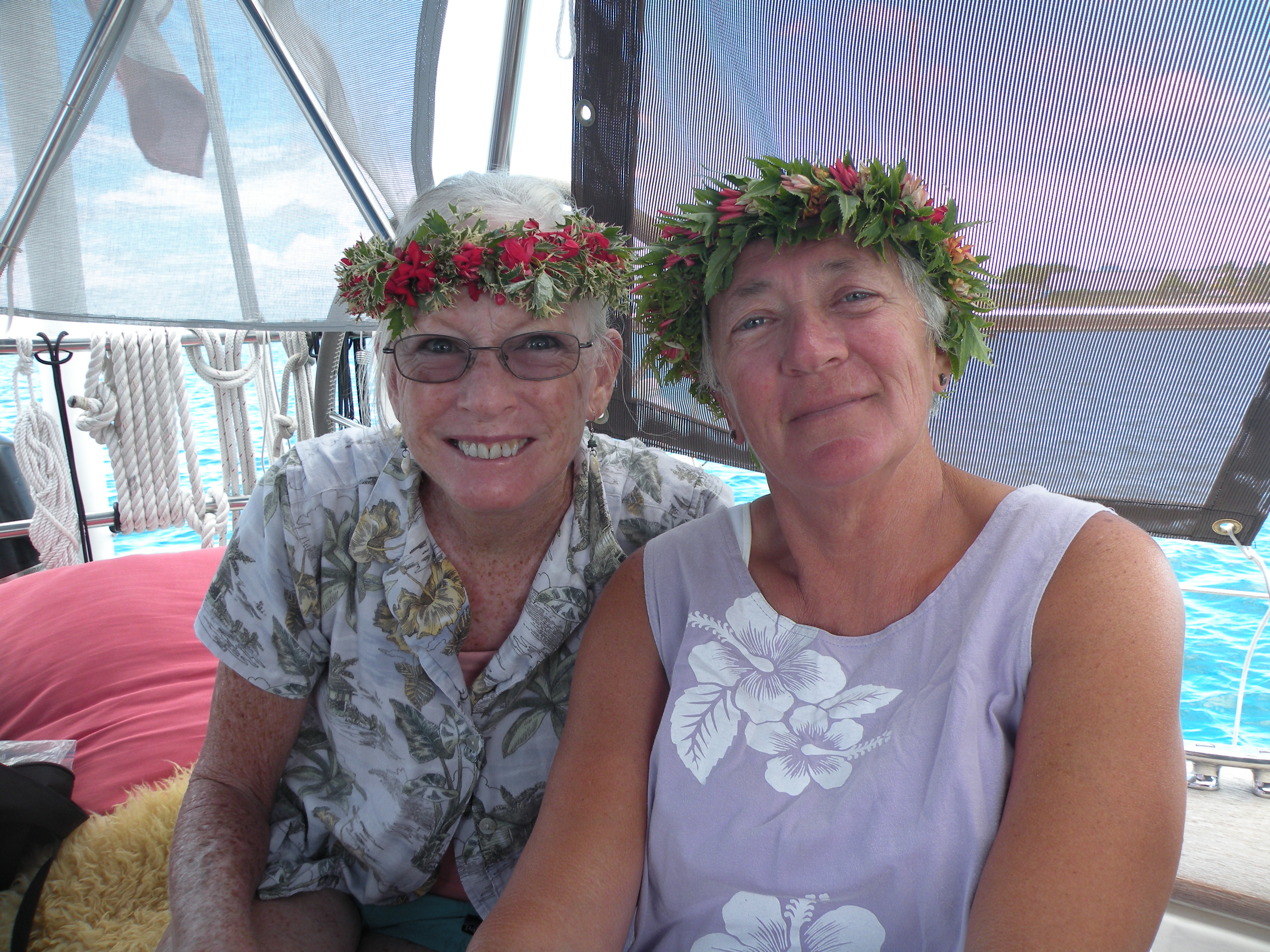
Lee and Connie
are staying behind to do a little more exploring of the Marshall Islands. We’re not sure where we’ll meet up again but it may

Kazeko, Lee, Tony, Connie and Richard
WordPress – wish I had someone who knew more about this software as can’t seem to format the slideshow so that it doesn’t cover the last two photos in this blog. Interestingly enough I’m reading a book written by a Cuban blogger called Havanna Real: One Women Fights to Tell the Truth. It’s story of her experiences blogging using WordPress. It’s an interesting perspective and an insight into the power of how open the internet is in allowing people in countries like Cuba to finally have a voice. It’s a quick read and worthwhile to see what one persons life is like who decides not to hide behind the rhetoric and take the risk of speaking out – a brave woman and an innovator.
What`s happening

Welcome to Laura
We`ve been quite quiet for a while but that`s not because of being inactive. We`ve done our fair share of lounging in the cockpit, taking walks around some of the islands in the atoll and even rented a car to drive the total 50 kilometres of road

Lee, Desay and Connie on the beach at Laura
in the atoll and down to a picturesque town at the southwest end called Laura. Laura was the original settlement and remains today as the location where agricultural activity thrives. They have more irrigated land and a Taiwanese agricultural station that supplies a few of the needed fruits and vegetables to Majuro.

A work in progress?
From there is just worsened – we got wet, cold and started making bad decisions. We kept going – why? We could have very well taken all sail down, tied the helm to the leeward side and retreated below to dry out and take a break. But, no, we decided to keep going. You would not have believed the amount of water that was pouring into the cockpit as we tried to make our way northward against a NE wind. Water, both fresh and salt, was pouring into the cockpit.
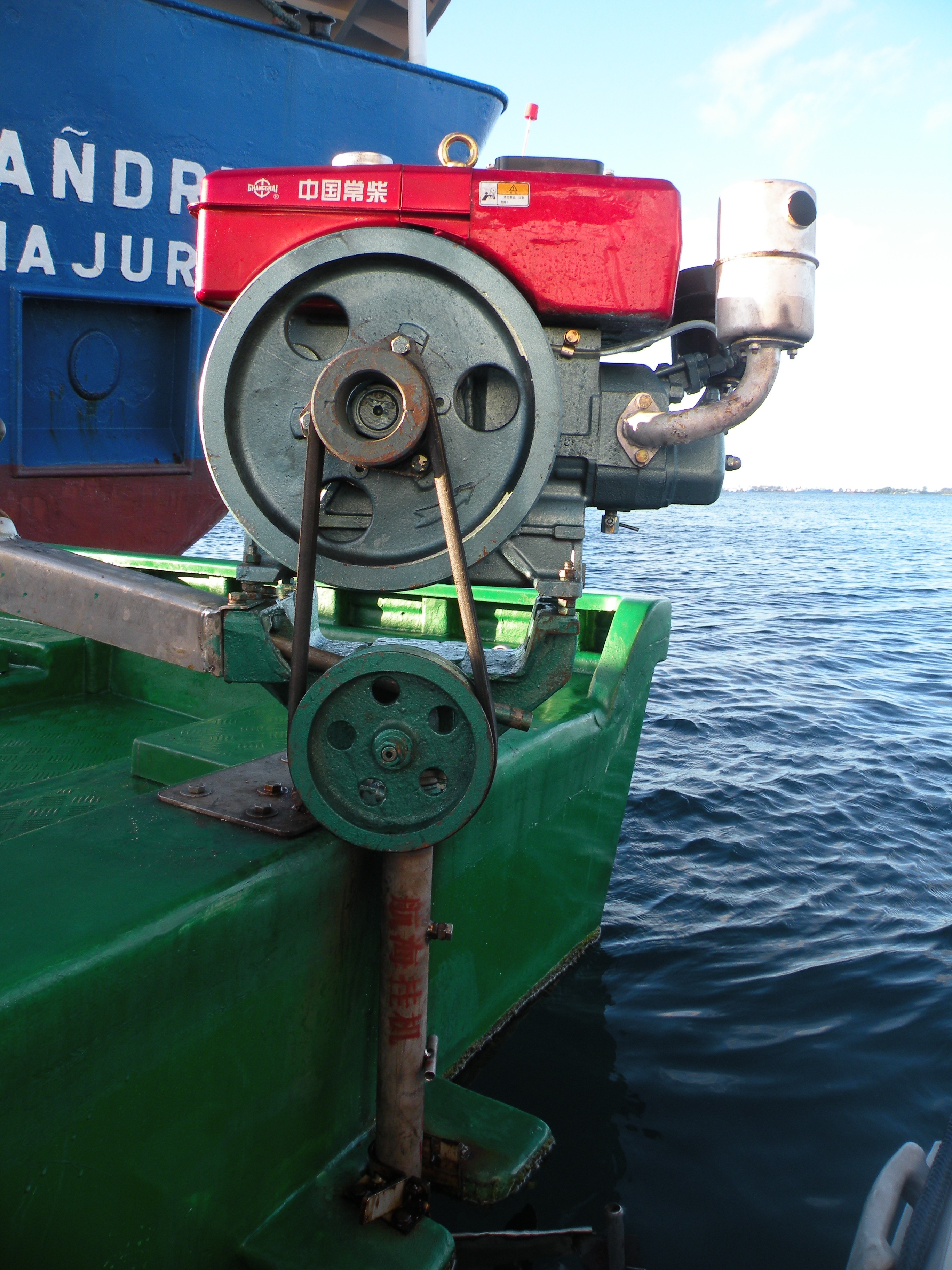
Yes, a new style of outboard available only in Majuro
Ah well, a lesson learned – the ITCZ is not a sailors friend. In the end we kept sailing until early morning and with the situation worsening we turned back to Majuro within only 20 miles from Aur. Going from the sublime to the ridiculous as we entered into the pass at Majuro, just passed the first marker, wegot hit by 45 knot winds, no visibility (couldn’t even wear my glasses) and looked at the chart plotter to realize that the previous tracks had been deleted and we had no idea where we were

ITCZ in action in the anchorage
in the pass. We were sailing in but had little control with just the mainsail up and so turned on the engine to help keep us in one place within the pass and wait till the visibility improved. It was frightening and made a dramatic end to the trip. There are many memories from sailing but this is one of the one that will stand out for a very long time.
So we’re back in Majuro. The ITCZ remained in place for the next 5 days and brought buckets of rain which brought the temperature down to a very cool 26 degrees and for the first time since leaving Victoria we’ve had to turn off the fridge as our solar panels cannot keep up to the electrical needs on board. I know this may sound funny to those of you entering into a Canadian falls season with cooler temperatures and shorter days but here in what should be tropical skies we have no sun. So the fridge is off (gives us a chance to clean it finally!) and we’re using an ice box and letting the batteries regenerate once the sun comes out.
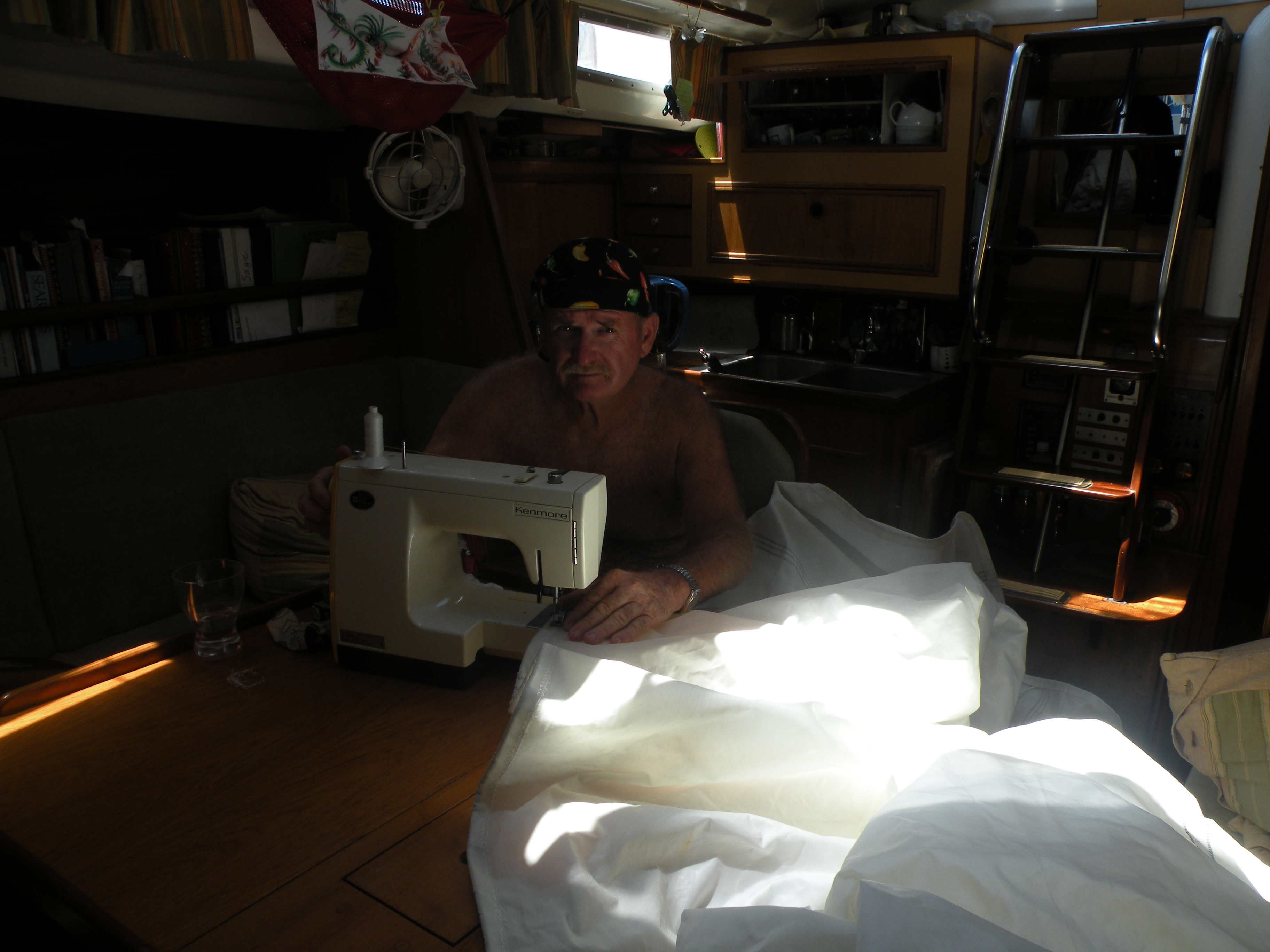
Tony repairing sails
We also need to repair the sail we tore apart on our trip to Aur and dry out and rinse off all the salt water gathered from our trip. We’re in the planning stages now of moving west on to Jaluit and then Kosrae in the Federated States of Micronesia. Different islands and different territory. We’re looking forward to sailing downwind!
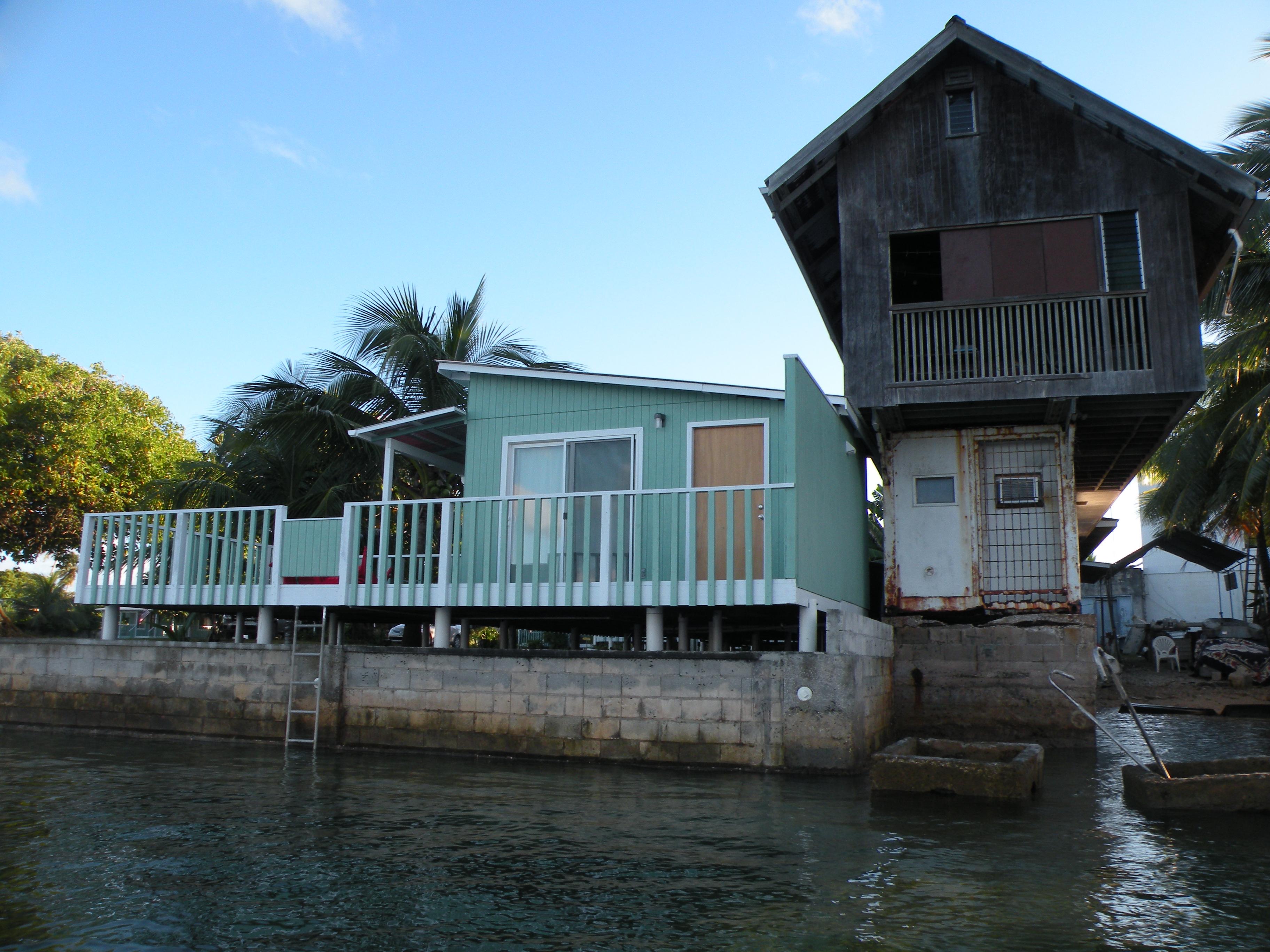
Do you have a building permit?

Kayaking in the atoll
Majuro – cont’d
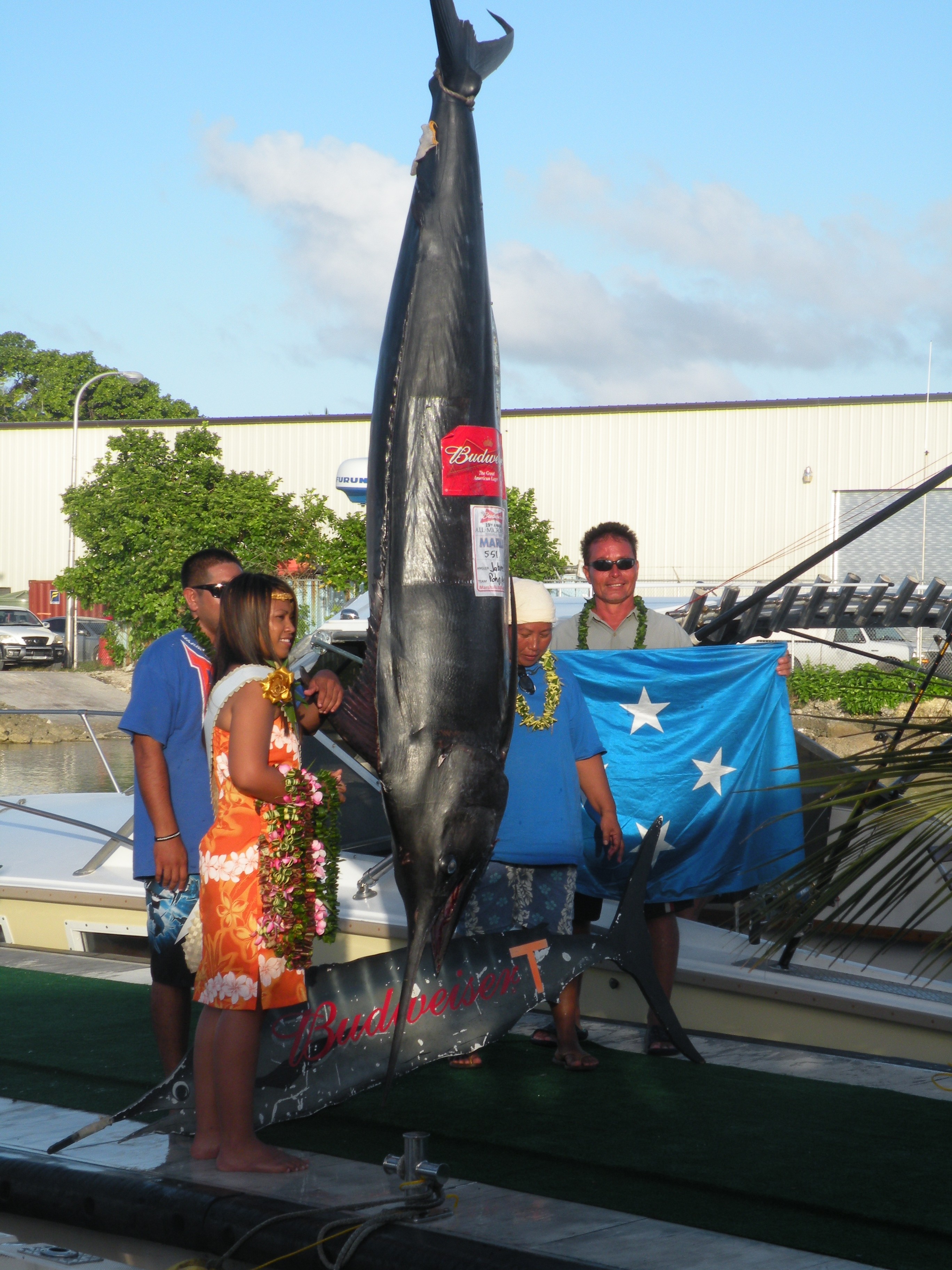
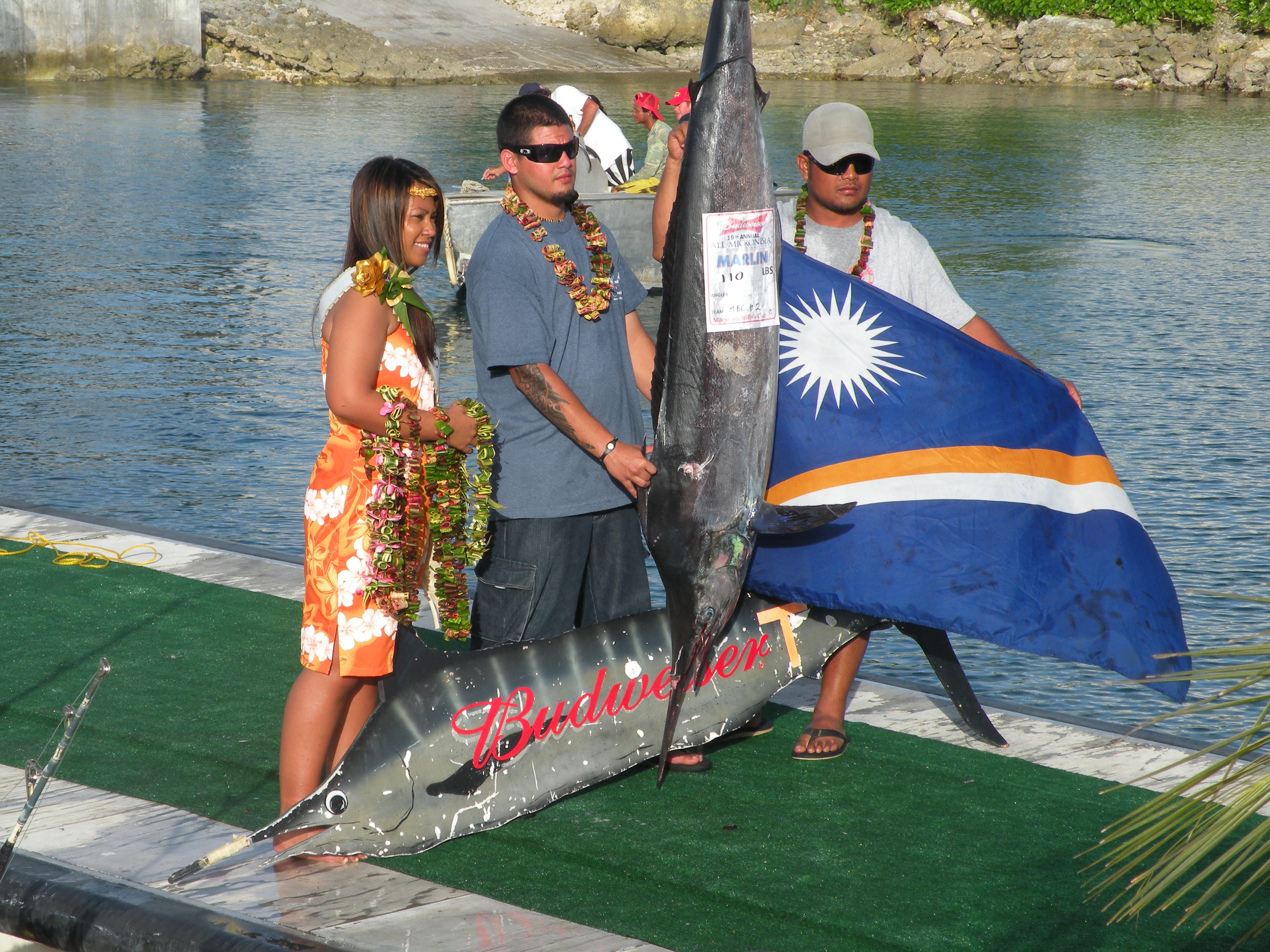
551 lb marlin – Bill Fish Tournament winner
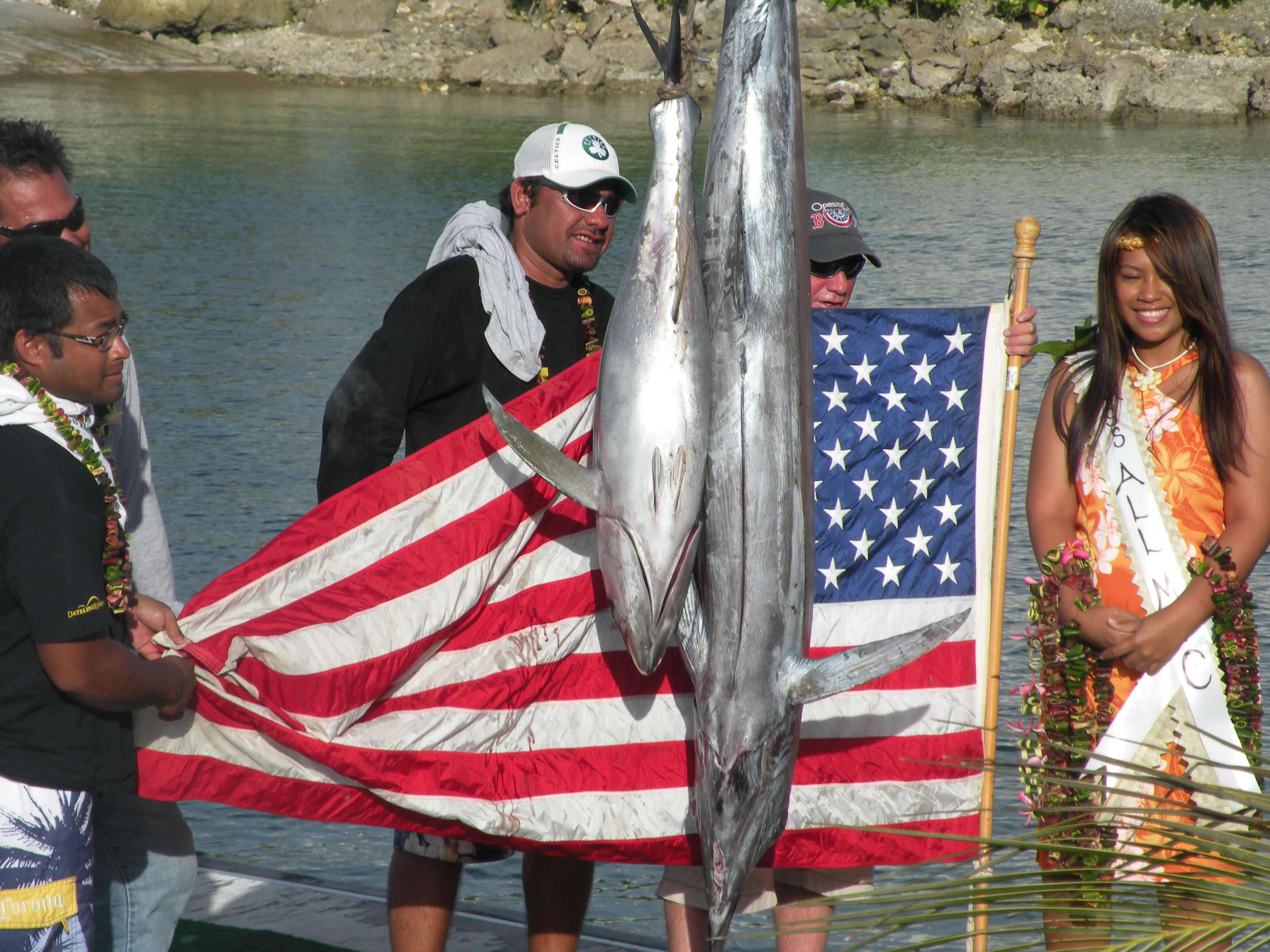
Am sure many are wondering why we haven’t moved on from Majuro. Can’t say it’s a paradise but there are some things going on that we’re staying around for. Of course there’s always the fishing. Can’t say we caught this monster tuna but sure helped consume some of the 551 lbs. This was the overall winner for the Marshall Islands Bill Fish Tournament held last weekend. Lots of tuna, mahi mahi, wahoo and marlin caught by teams from Japan, Marshall Islands and the U.S. An exciting day for fisherman but a sad day for vegetarians!
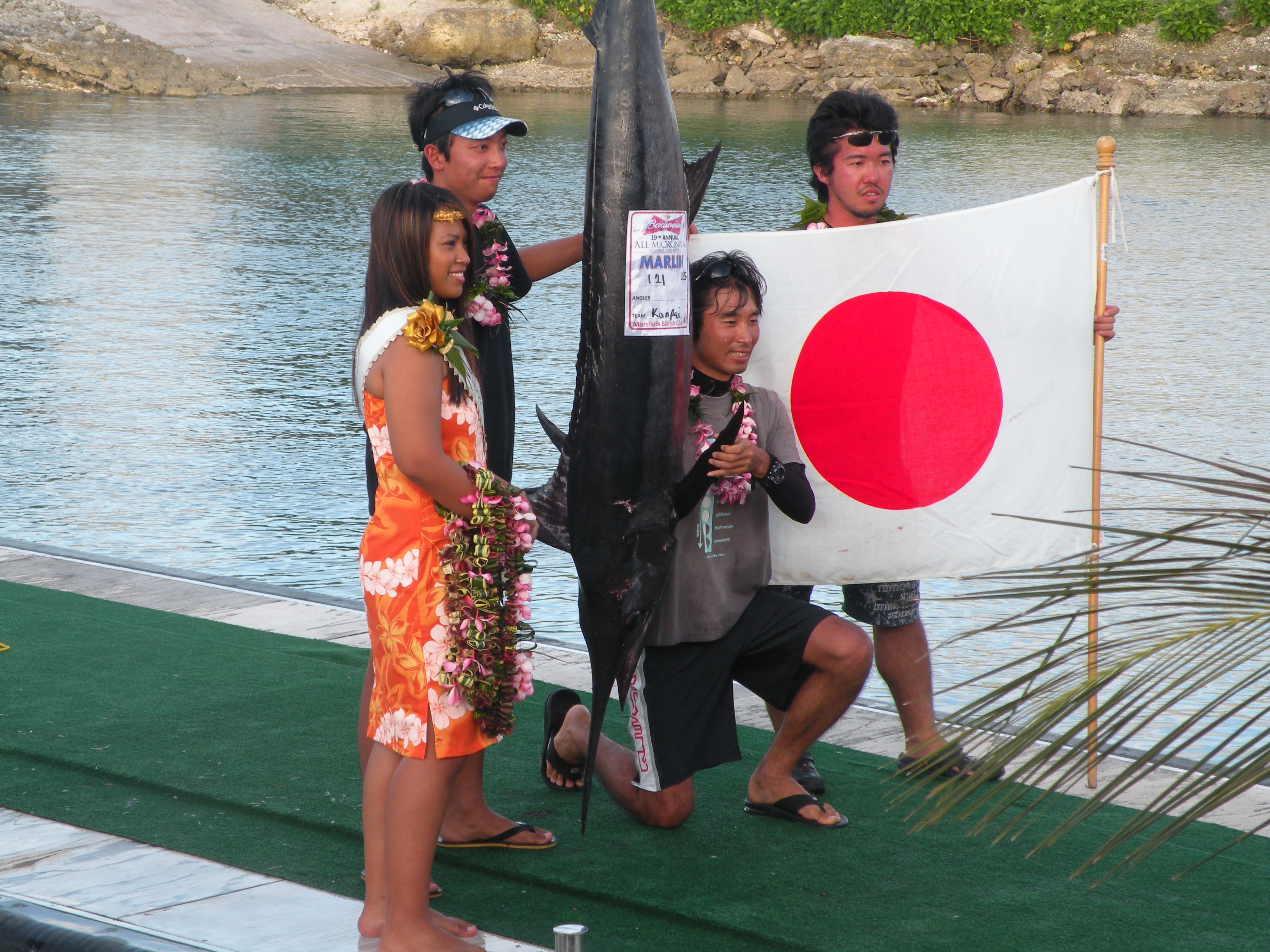
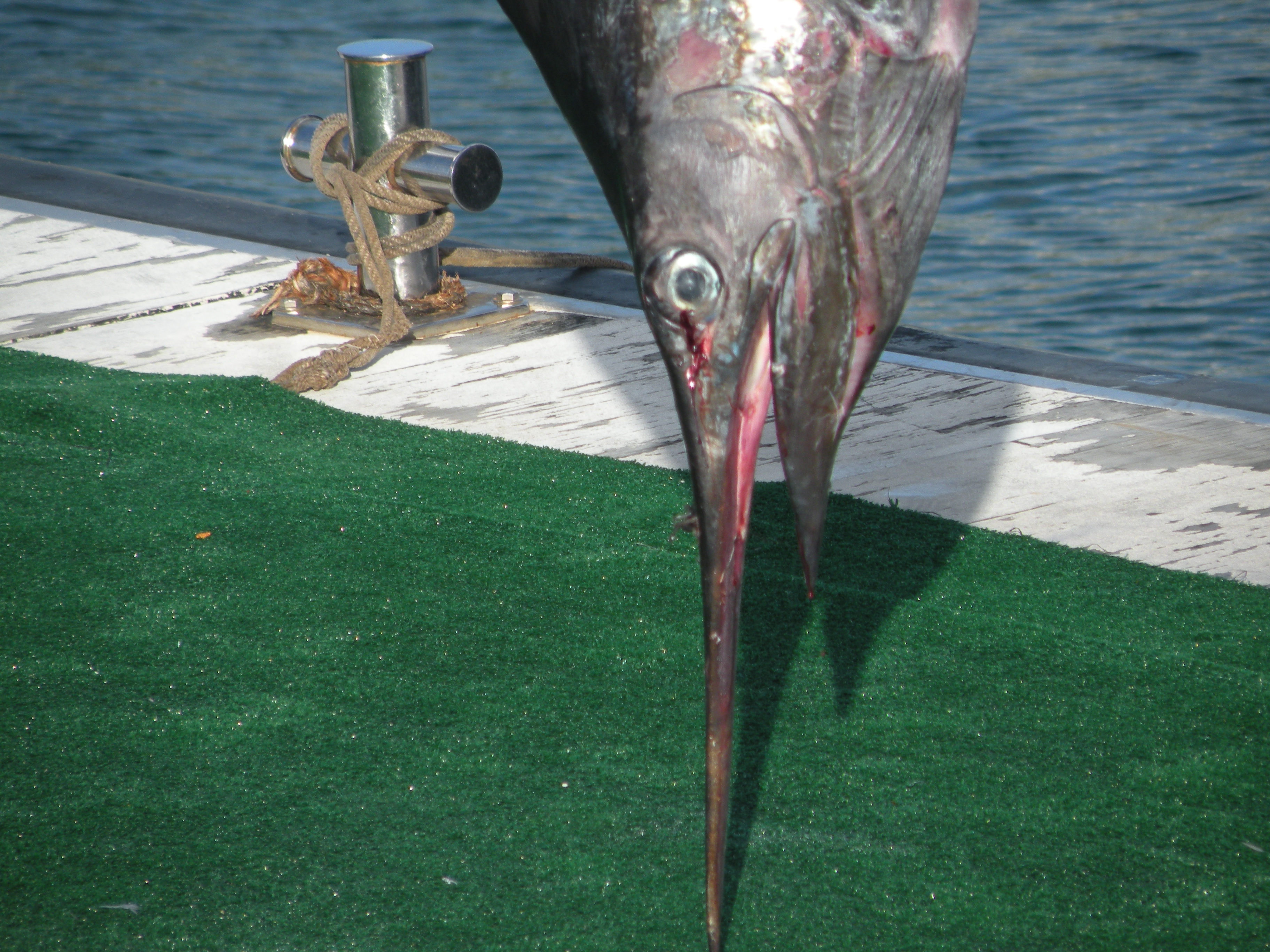
Here’s the head – where’s my body?
The other reason for a delayed departure is due to the fact our cruising buddies Richard and Lee on Before are here and it’s great catching up to all our sailing since last seeing them in San Francisco last November. Once we leave here we may or may not see them as we move eastwards. Saying goodbye is always the hardest thing to do so I guess we’re just reluctant to say good-bye.
The ITCZ continues to plague the anchorage. Today, while ashore one squall with rain shower went by and in the last 4 hours it’s gone from beautiful sunshine with a nice breeze to black and blasting winds and tropical downpour 3 times. Routine is to put on the bathing suit, go out in the rain for a shower after closing all the hatches and then wait 10 minutes and open it all up again. Of course, this changes again in about 30 minutes as the clouds start to gather again and move across the lagoon. One of the best activities here is to watch the proas making their way through the anchorage. There is a ‘Canoe House’ where they train young Marshallese in the fine art of canoe building.
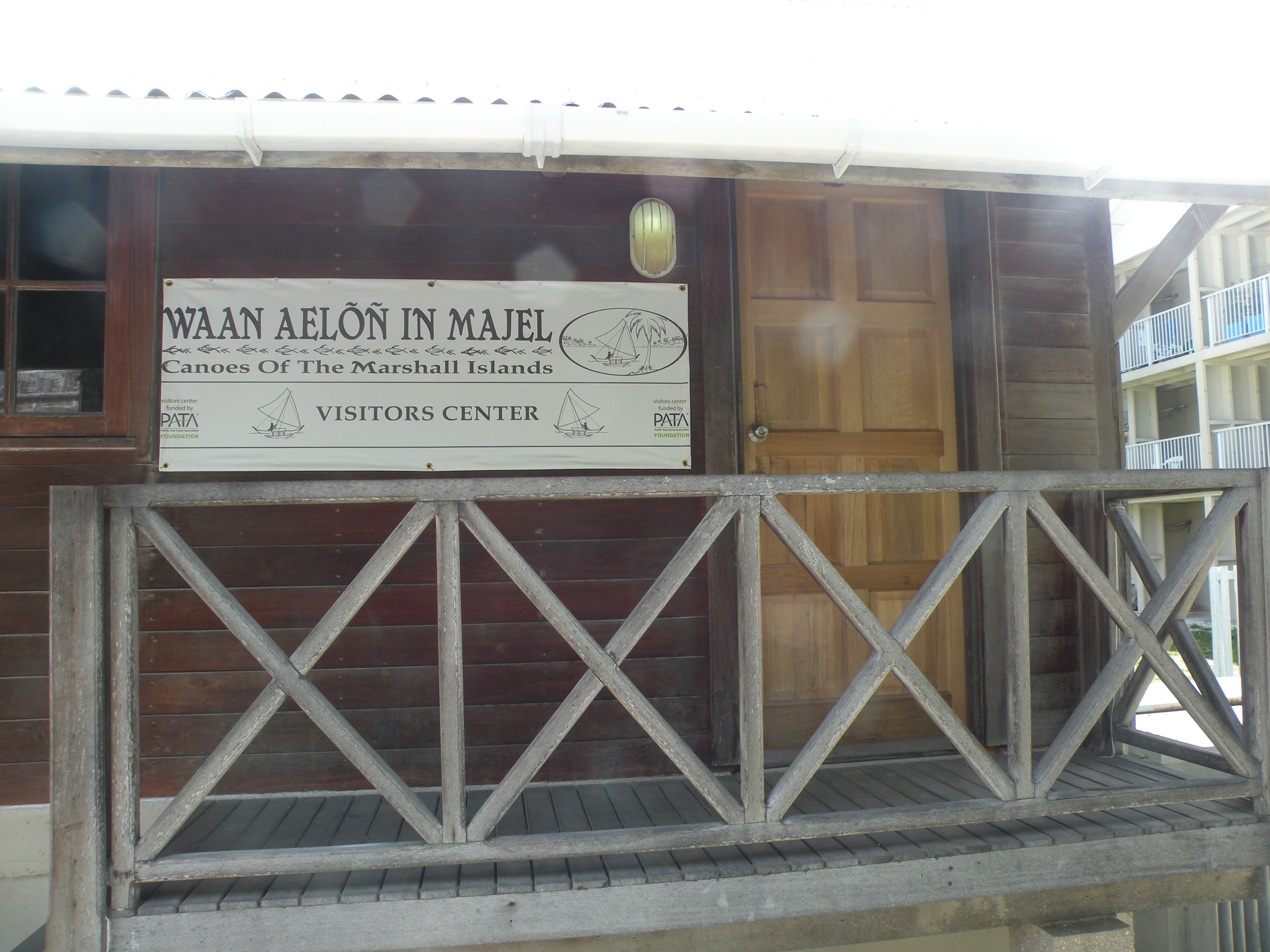
Canoe House
There are many types of canoes and I’ve only got pictures of a few here.
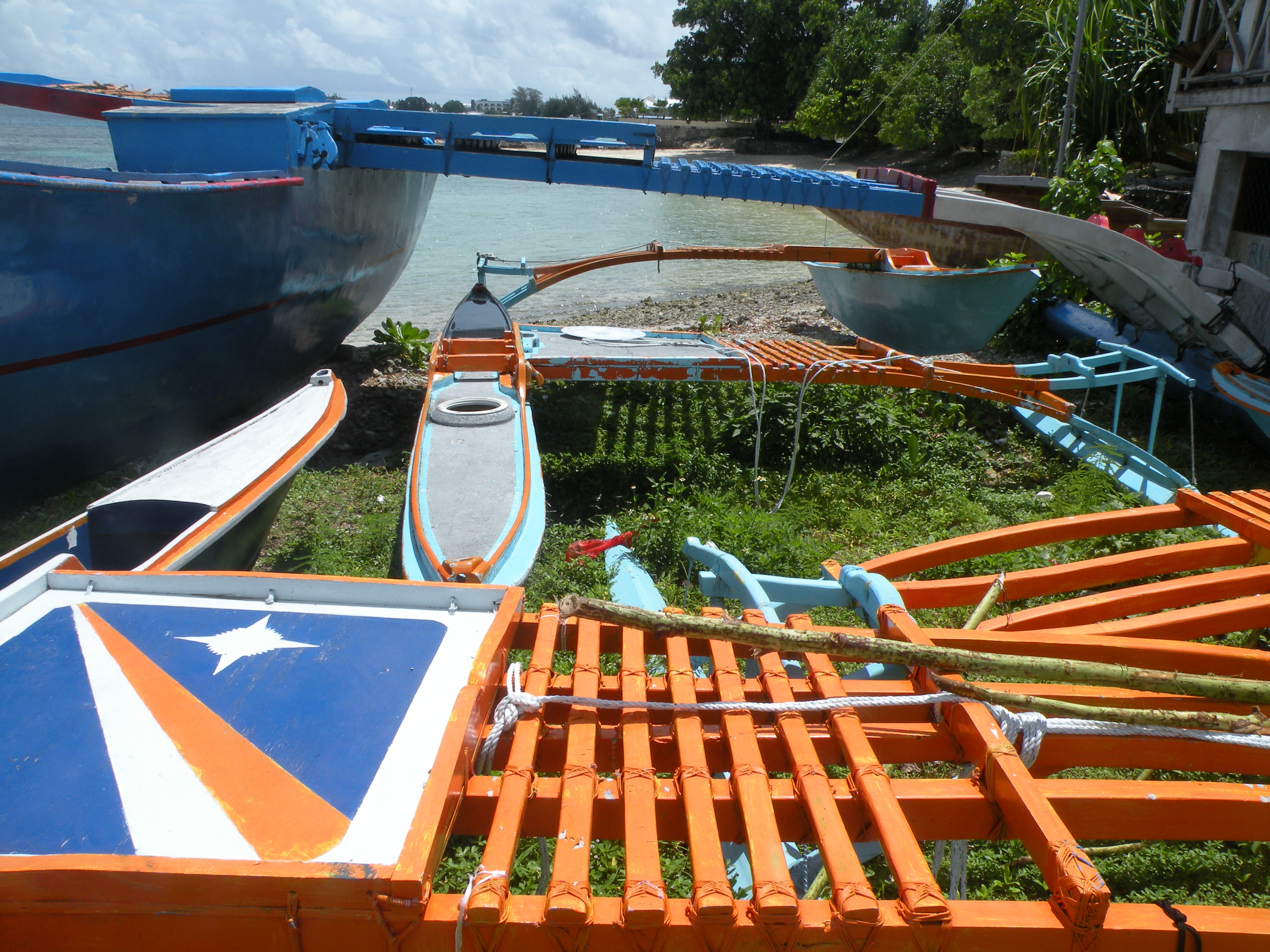
More proas
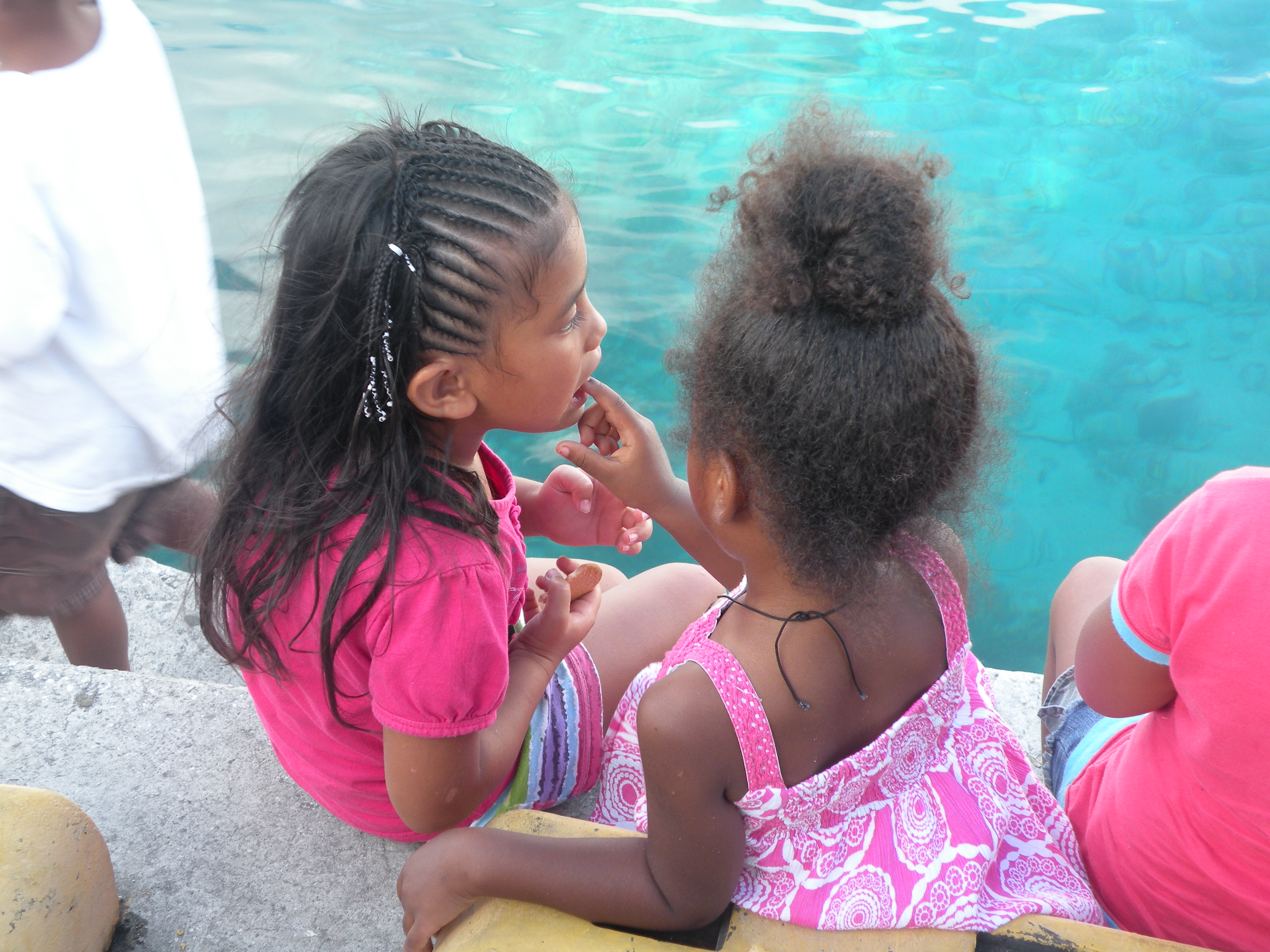
Playing at the docks
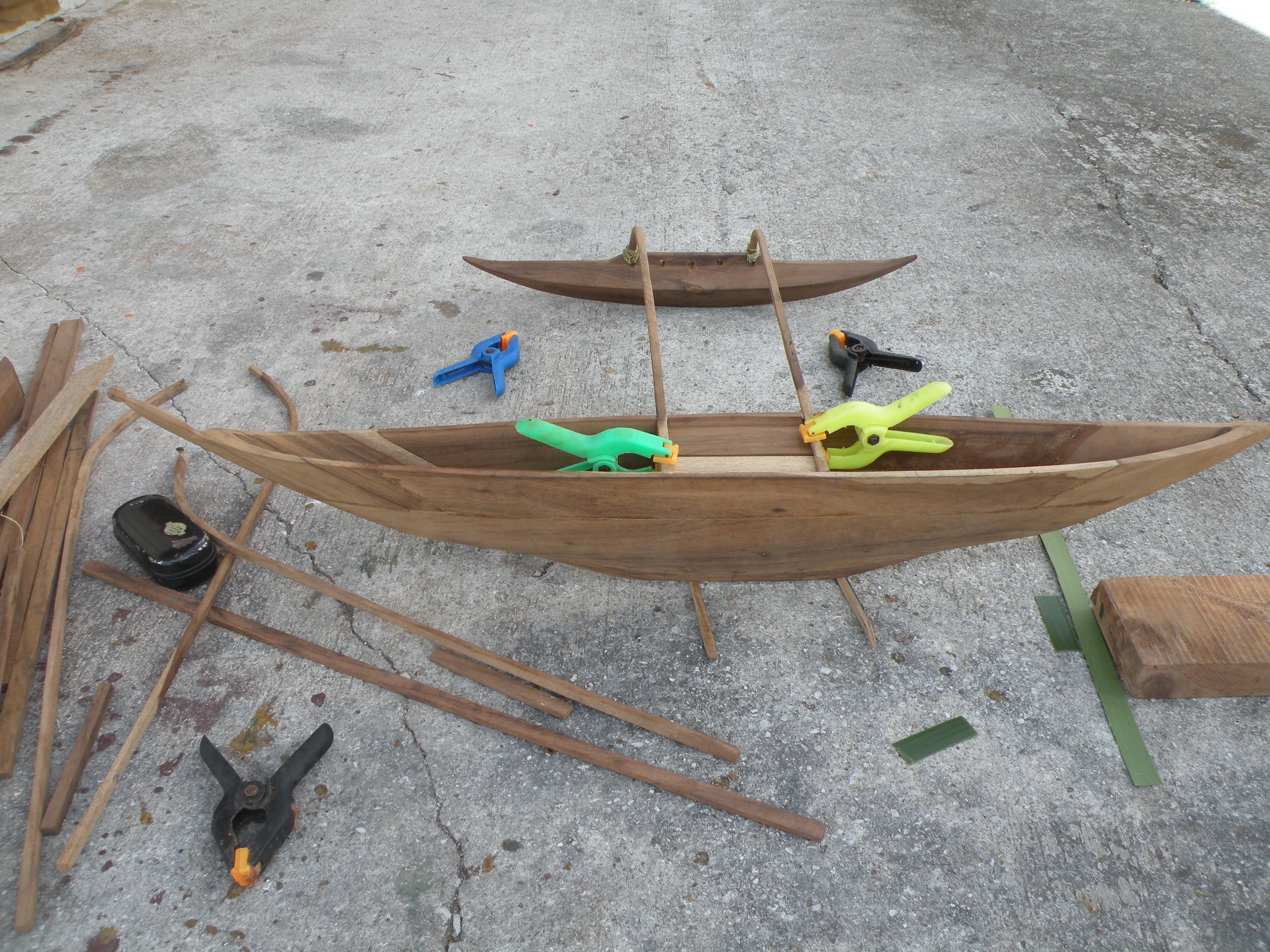
Model proa under construction
ITCZ – Inter Tropical Convergence Zone

Waiting for the deluge
Yes, the ITCZ is where we live most of the time. The ITCZ is a fluctuating band of weather that hangs out either north or south of the equator. It’s kind of like a cat – moves quickly, is sinuous and can strike with ferocity or just roll over and pass by.
Many times the ITCZ covers the entire horizon from one side to the other and at sea is an ominous reminder that one can be easily crushed. Usually accompanied by large black clouds it contains untold lakes of water ready to pour down on unsuspecting boats or atolls. Here in Majuro one only need look to the east to see whether one is coming or not. It’s usually preceded by an increase in humidity and unsettled skies for sometimes days on end. We’ve just come out of a period with the ITCZ for the last 5 days. The temperature was in the low 30’s and the relative humidity hovered at around 85-90%. One never felt dry, everything dripped inside and outside and the rides ashore would be between squalls and rainfall that filled the dinghy. No, not a nice picture but it is stunning to watch. The pictures accompanying this blog show a little of the black sky, a proa (local sailing vessel)
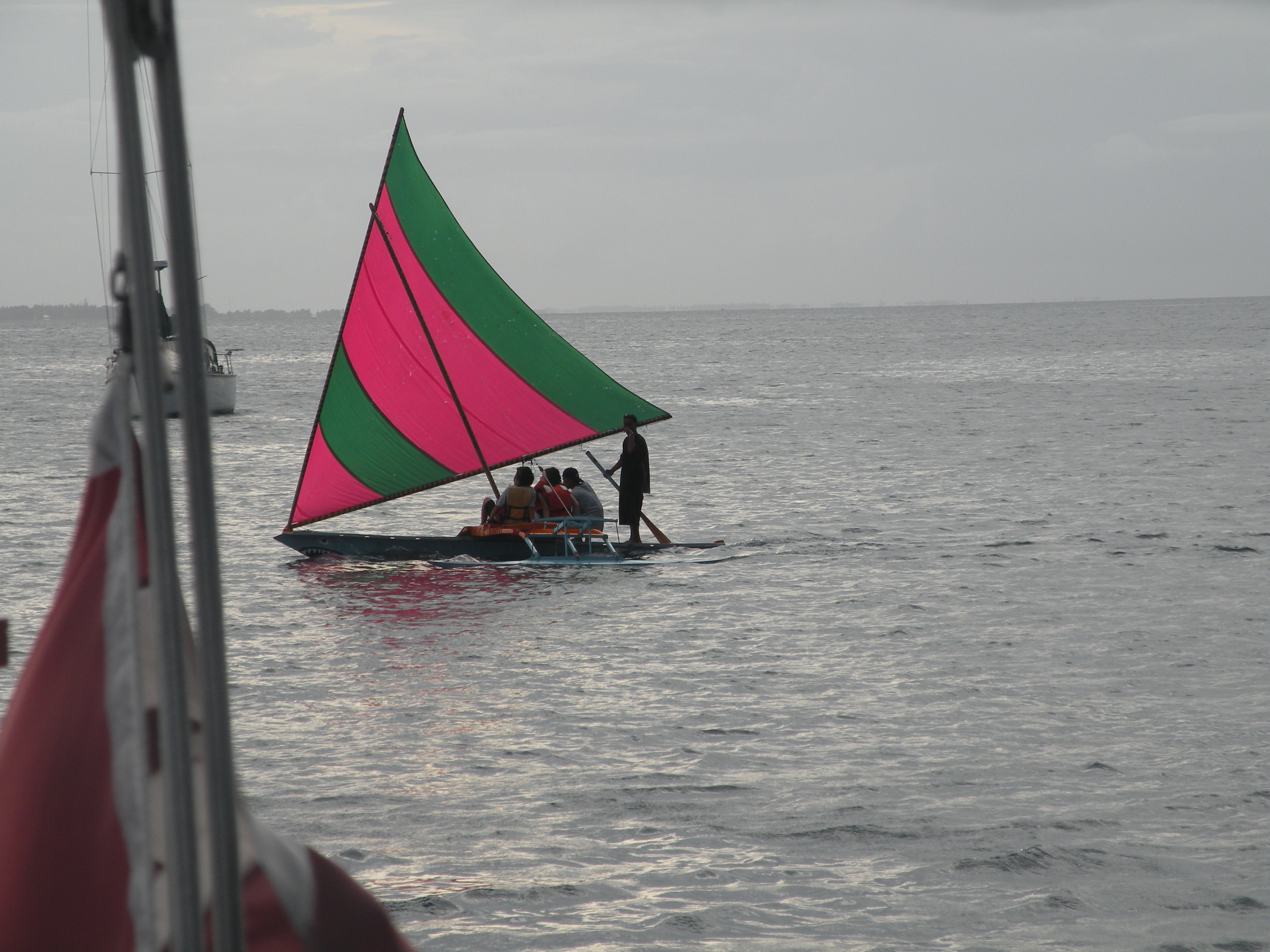
Running with scissors
racing for home as the sky darkens and finally a shot out to the west passed the anchored tuna boats and where the sky is considerably different.
One benefit of the ITCZ is that one can collect rainwater to replenish water tanks. Both on boats and on shore people have concocted ways in which to collect the rainwater. There is no central water system in Majuro other than rain catchment or purchase de-salinated water at $4/gallon. What with minimum wage being $1.50/hour there are few people who can afford not to collect rainwater. (On an aside there was a job posted for a driver – 35 hour work week starting at 0500hrs and ending at 2300 hours (!?) with a starting wage of $2.50/hour and one week paid vacation. Any takers? ) Back to water – yes, we collect rain water onboard Sage and believe me we need it. What with the temperature and humidity the way it is we need more for showers than we need for drinking!
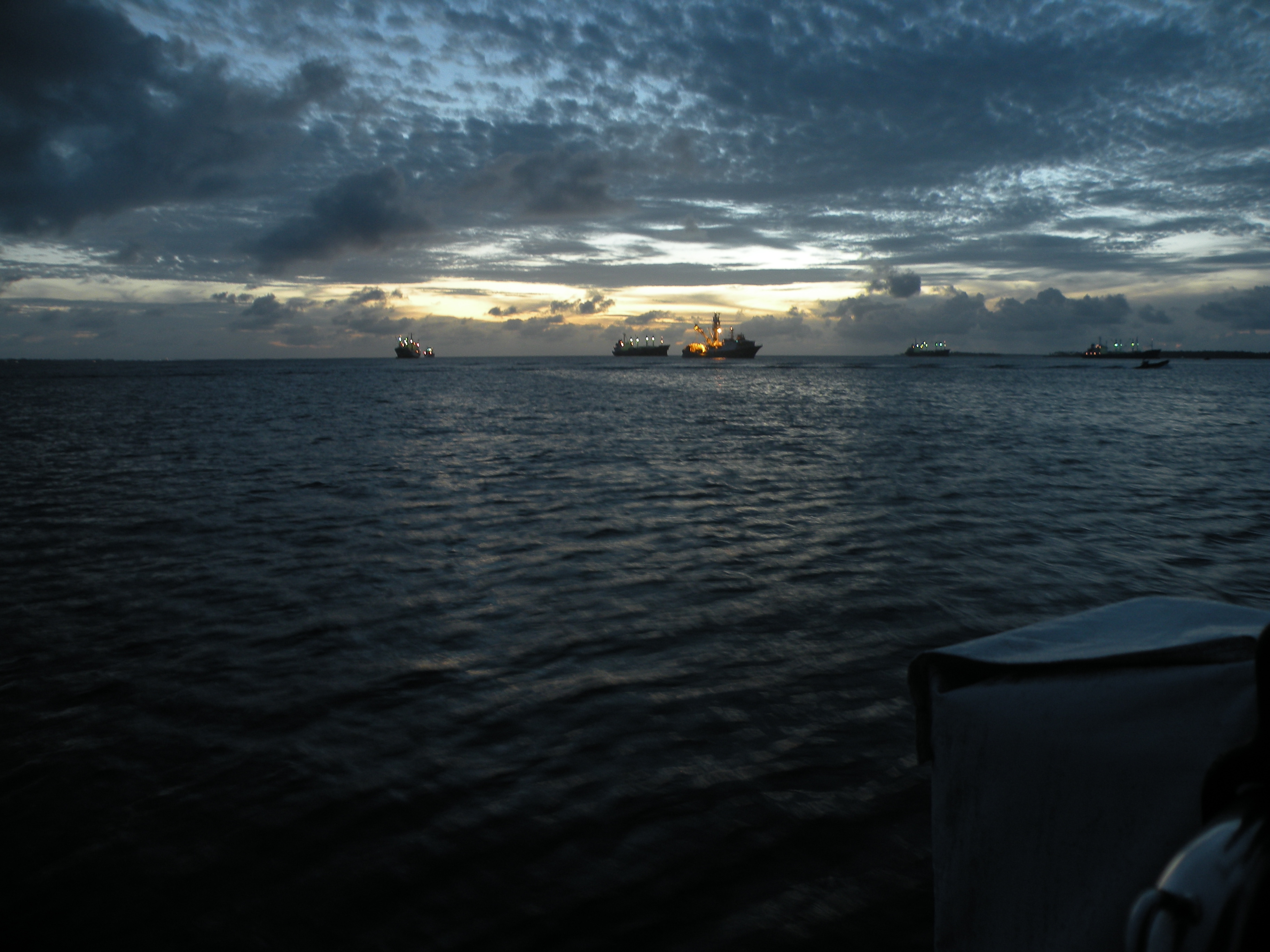
A more peaceful view to the west
Well, last night the ITCZ scampered off to the south, the east wind returned to blow cool evening air down the hatch and over the V berth. I returned from sleeping in the cockpit to the V berth and we woke up this morning to humidity of 68%, temperature of 28 C and a clear sky. Finally, we can now dry ourselves and everything else and the solar panels can return to replenishing the batteries with power we lost from the last 5 days. What a glorious day – this is what the tropics should be like every day! OK – now off for a swim….
Majuro, Marshall Islands
It’s a long way back home. Yes, we now feel like we’re cruising.
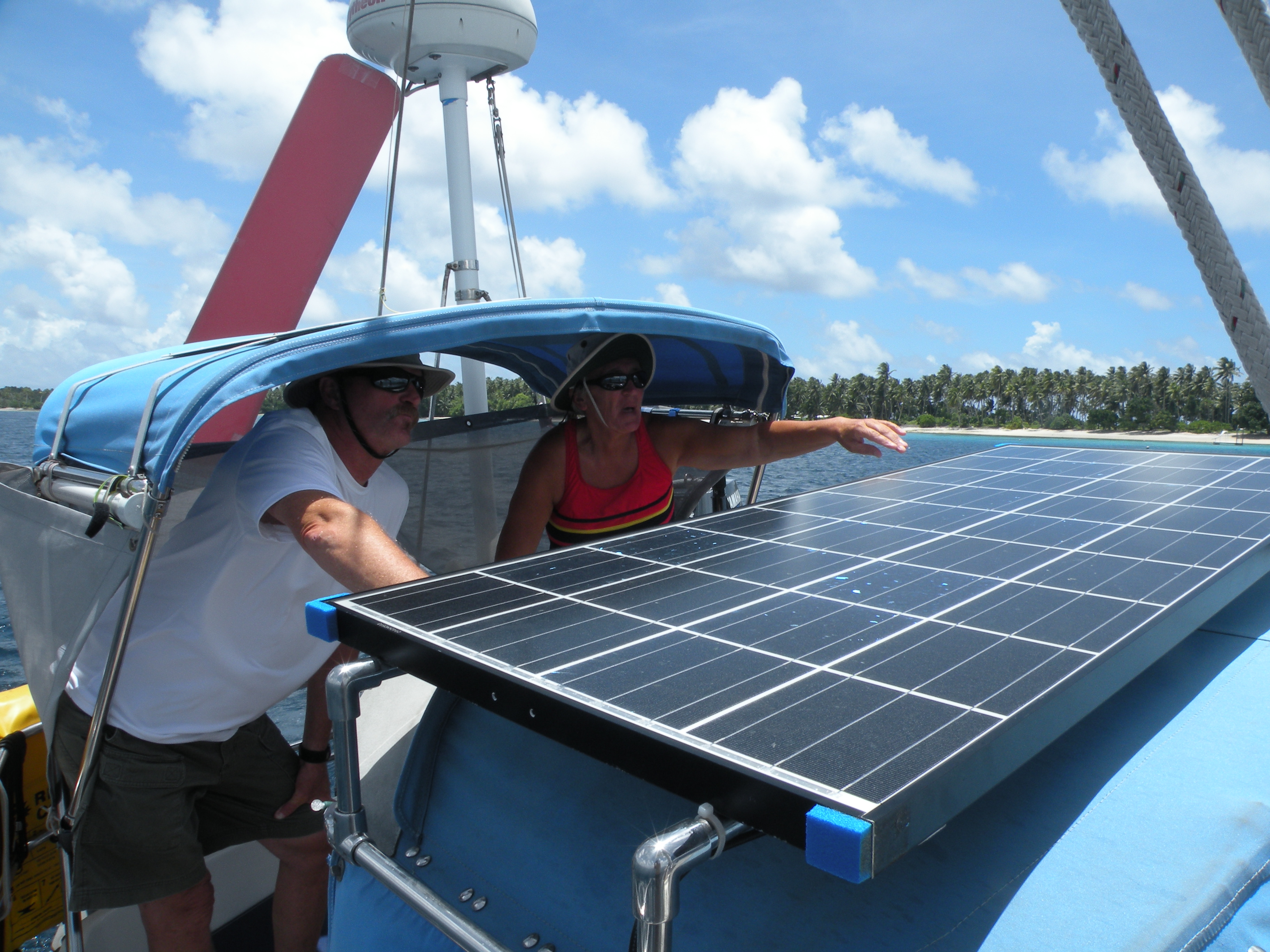
Navigating through the atoll to the anchorage
We’re now ‘on the hook’ – sailors language for being at anchor. We now have to be self-sufficient; at least self-sufficient in terms of electricity, water and making repairs. Water and electricity are the biggest items on the list. We’re trying to collect enough water to sustain ourselves but it means waiting for the rainfall which is hit and miss at this time of the year. We wait for conditions to change and for the Inter Tropical Convergence Zone (ITCZ) to bend northwards from the equator and hope they bring moisture laden clouds from the south to drop here in Majuro. It’s a hit and miss proposition. We’ve only managed to collect 1 X 20 litre container so far and that’s not really enough. Today it’s threatening enough but having waited all morning expecting rain we’ve got nothing. So, what do I do? Head to shore and find the desalination plant, buy 2 X 20 litre containers of water and head back out in the dinghy to the boat to fill up. What do other boats do? Well, most of them seem to have water makers i.e. desalinators onboard so they start their engines and crank out the fresh water. How lucky for them! Ah well, we decided to go without one and we’re doing OK.
The other challenge is electricity. How do I run the computer? Yes, off our battery bank. However, there are other demands as well i.e. the fridge, entertainment radio, navigation lights (at anchor an anchor light), and fans to try to keep us cool. On a normal day we use about 50 amps and right now and the average sunny day we manage to produce about 65 amps. This way we keep ahead of the demand but we have to watch all the time so recording both consumption and production is important. Today we probably won’t manage to produce enough seeing as it’s mostly cloudy and we only have 3 solar panels. We just consider ourselves lucky to have refrigeration. I think that’s the biggest luxury onboard since we were out sailing in the 1980s.
So what’s Majuro like?
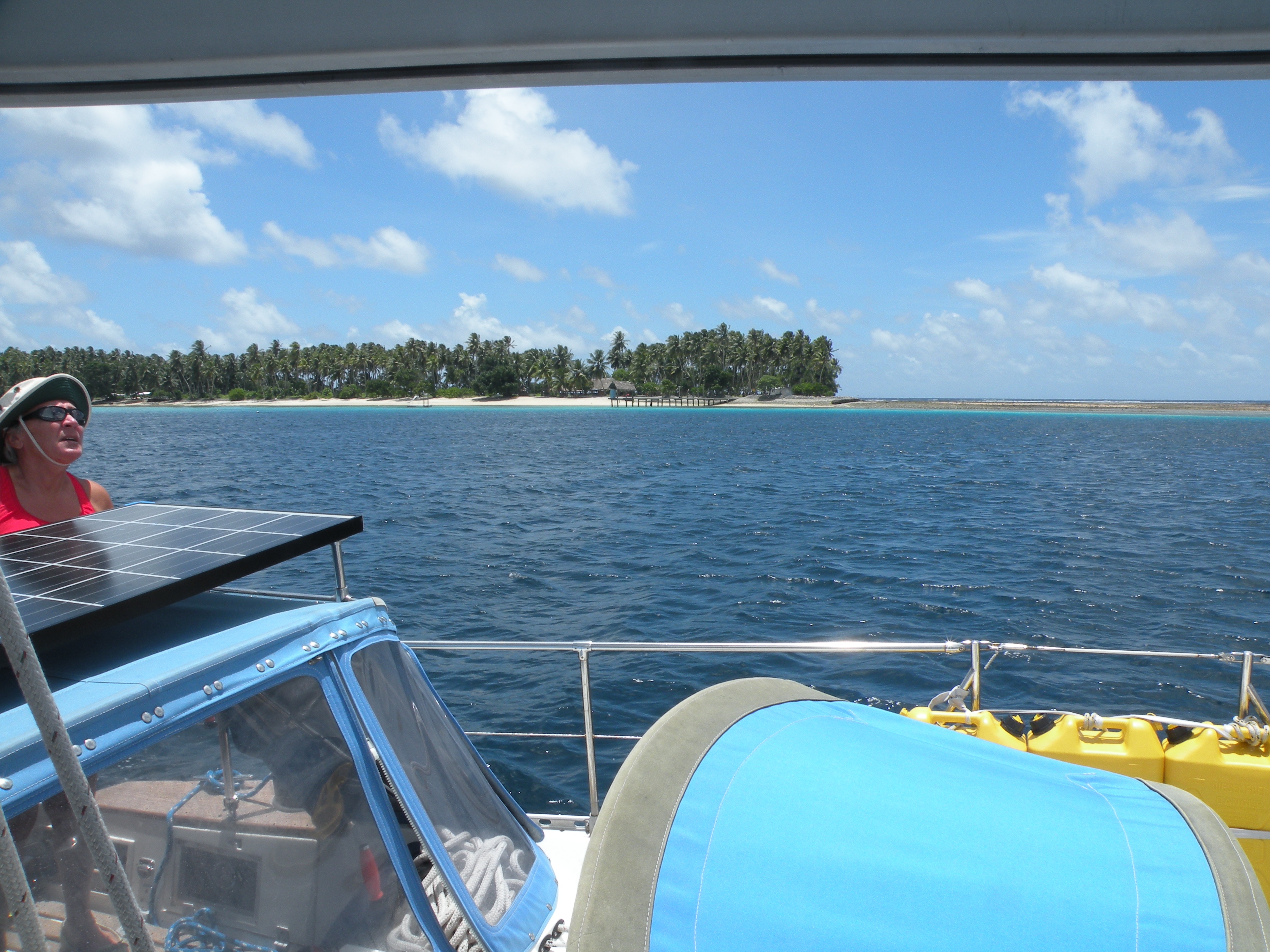
One very pretty anchorage
It’s an average sized atoll running at about 25 miles long and about 5 miles across. There’s 35 miles of road on which a constant stream of taxis runs along. To hail a taxi hold up the number of people in your party, the taxi stops, climb in and go up to 5 miles for .75 cents/person. A great system – there are so many of them you never have to wait more that 30 seconds and you’re off. Of course, with an island population of only 40,000 people there’s a not a lot here. There’s only the one road as the widest land is only about 200 metres from the outside edges to the inside lagoon! Yes, compact and the town itself runs along an 8 mile ribbon of land with the town of Laura at the western end which is about 20 miles away. The shoreline is a ramshackle collection of tin roofed buildings perched out over the
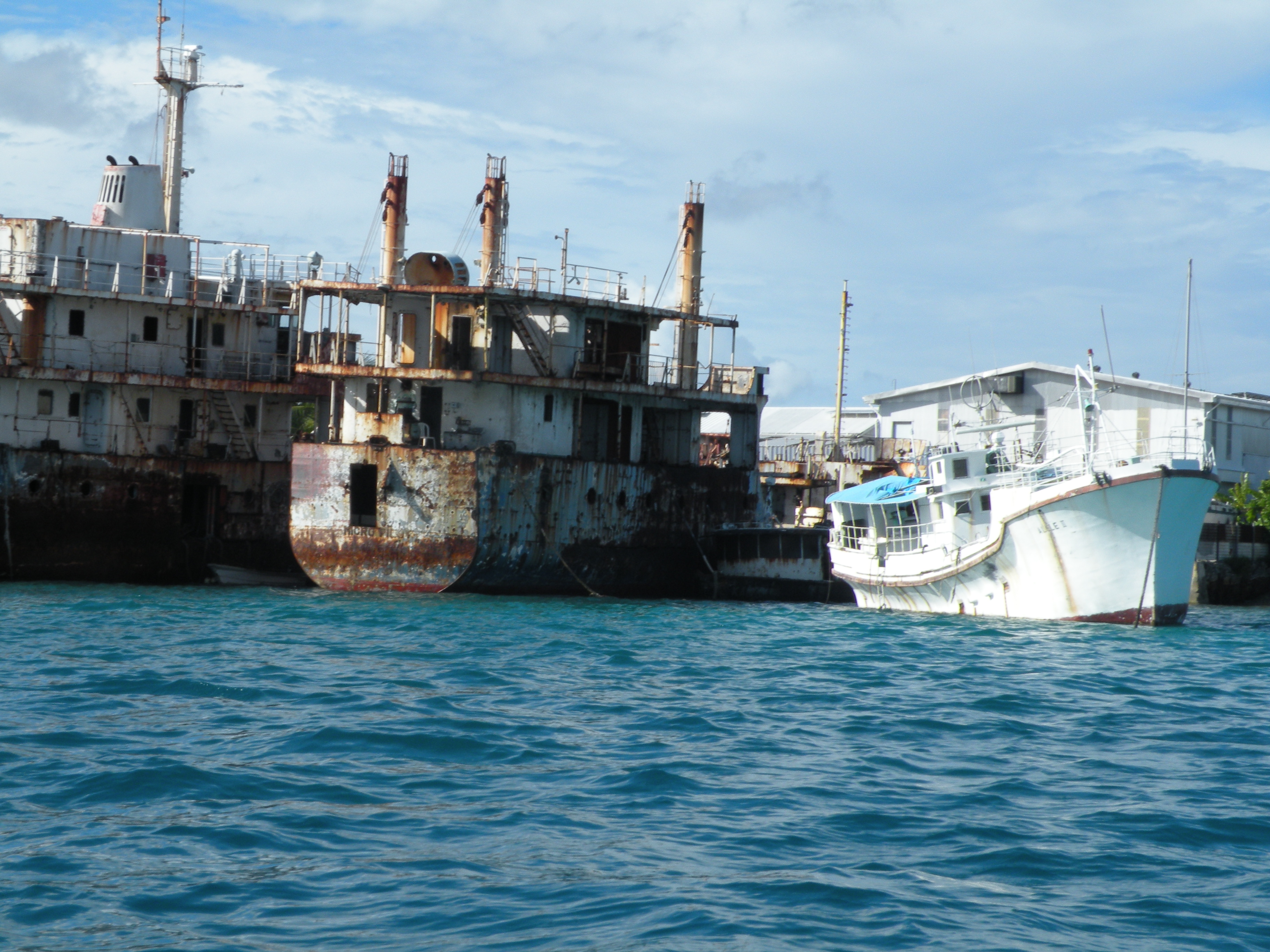
Majuro anchorage shoreline
water, derelict ships and deserted wrecks. Once out-of-town though the scenery improves with the occasional sandy beach with lots of coral for snorkelling around.
The harbour has only about 15 sailboats anchored in it of which 12 of them are people who live and work here. There’s one cruising boat which was just sold by their owners and the new owners came in a few days ago and are heading off on a nonstop trip through to Singapore, a trip of approximately 2,900 nautical miles. Also in the harbour are cargo ships from Taiwan, China, the U.S. and Japan. They’re loading up with tuna caught by 100 metre long fishing boats that are scouring the local seas for whatever tuna remains. It’s a wonder how much longer the seas are going to continue to produce this quantity of tuna.
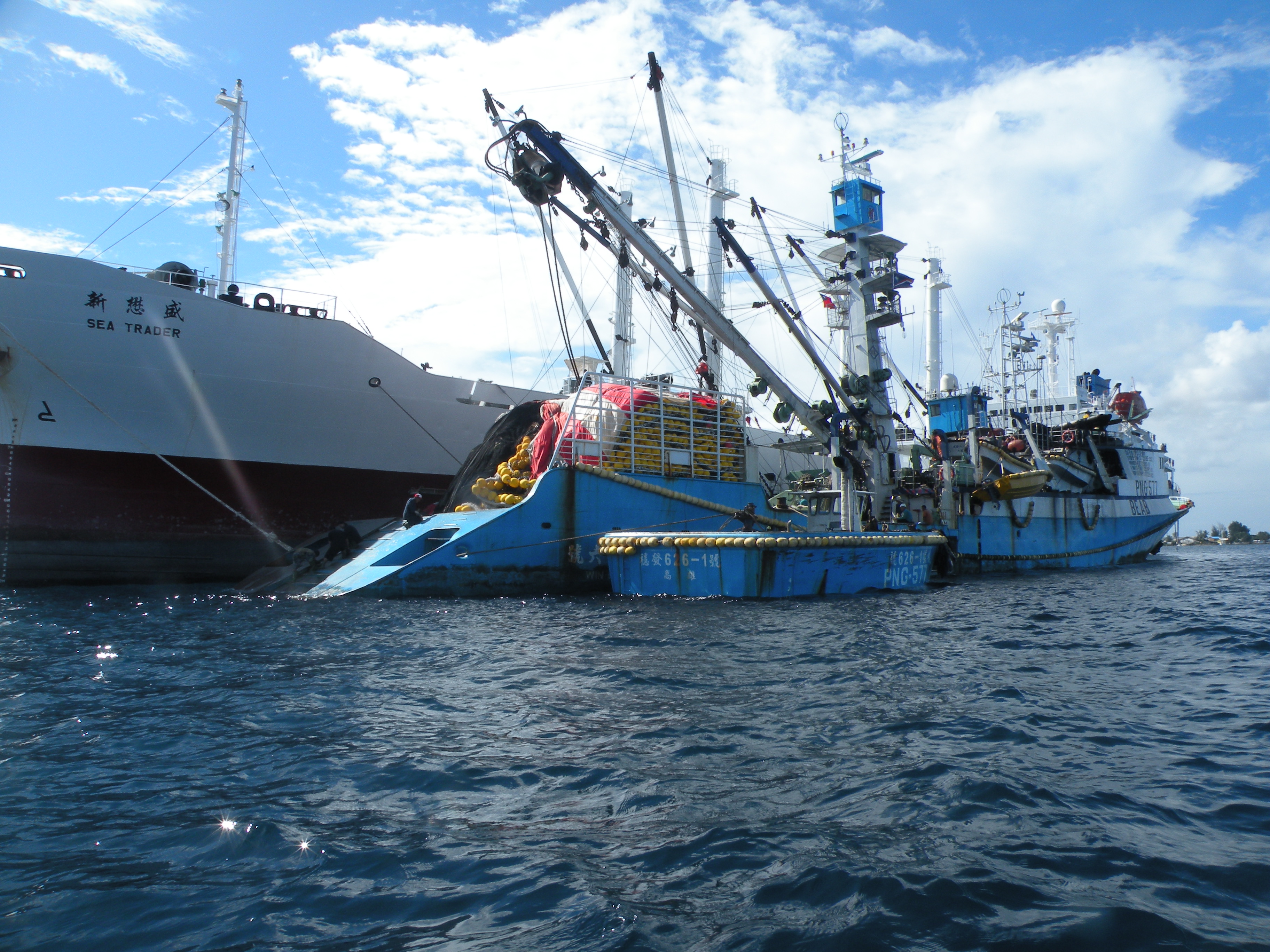
Loading the mother ship – tuna, tuna, tuna
For today this is it. Our internet access is limited to the shore. I only take the computer ashore a few times a week so communications are a little slower than I like but at least we can pick up e-mail. The United States postal service does work here and mail from here to the U.S. takes about 6 days – not bad.
Today it’s hot and humid once again. However, the sun is finally out after 2 days of intense ITCZ
activity. That means squalls with winds up to 50 knots, rain hurtling down and filling the water tanks, everything inside damp from the rain and humidity. Doesn’t paint a very nice picture but this morning the sun is shining and thank god a breeze blowing. As long as there is a breeze is bearable. Without a breeze the humidity kills us and we head for the bar and the wi-fi!
Expensive wi-fi here – $10 for 80 minutes. Means we don’t often head to shore with the computer! Can hardly wait till the Philippines when we can get an internet stick and compute from the boat and have access to communications and information
24/7. Onshore there’s not a hell of a lot going on other than the island trading boats coming and going. People are friendly enough but certainly not gregarious. I think it’s the tropical lassitude that is the predominant characteristic. Slop around in flip-flops, sit under a tree and if you feel like a little variety in the diet then perhaps a trip to the reef for some fishing or head to the store for turkey tails. Yes, turkey tails – haven’t seen those since Pago Pago in the 1980s! What you do with them I have no idea. Perhaps we should ask a famous chef to come down here for a competition and see what they can do with the diet on offer here! Interested? Fill in the following application form and we’ll see you here.
Hawaii to Majuro, Marshall Islands
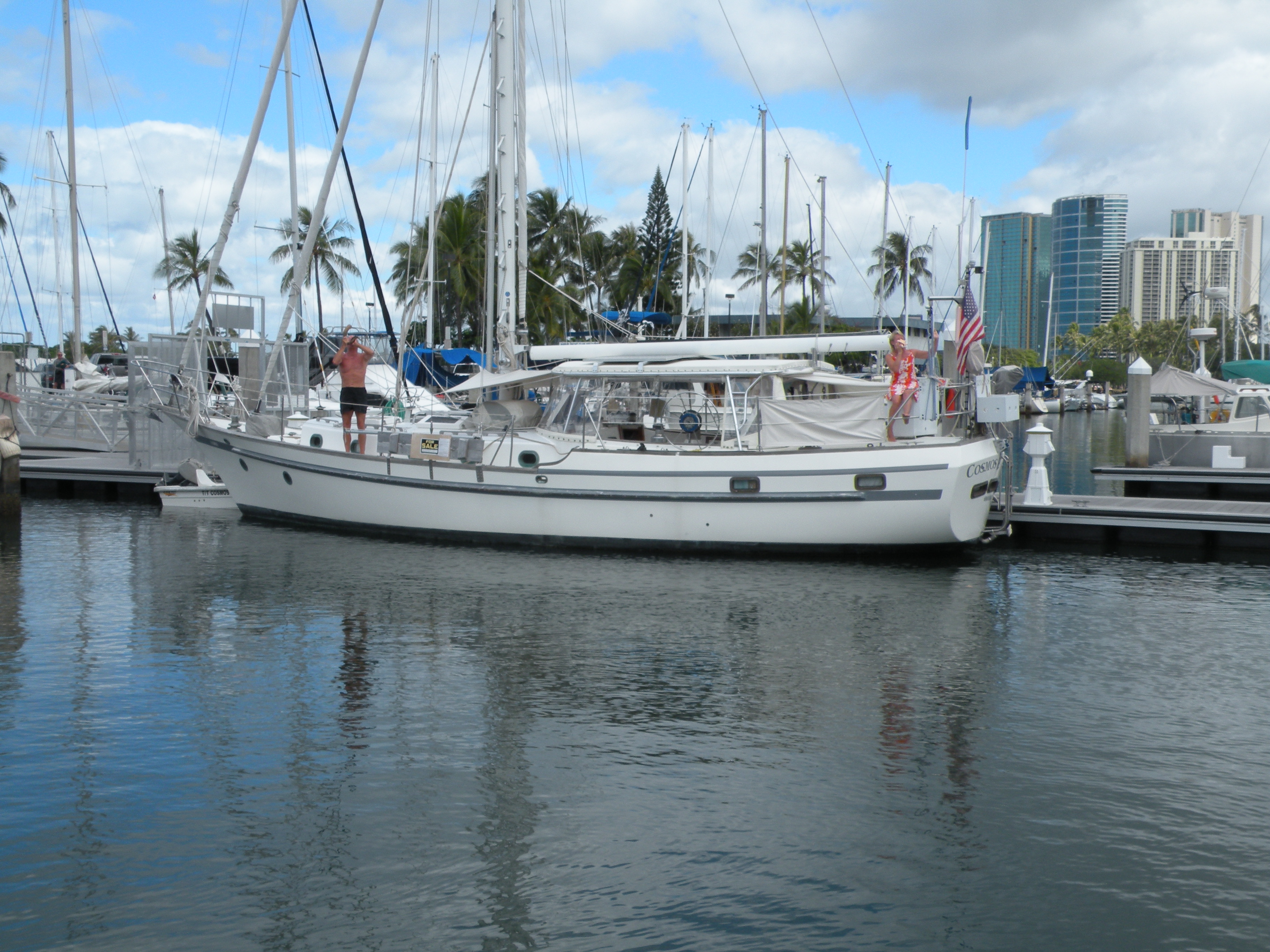
Goodbye from Charlie and Sunni
Part 1 – Hawaii to Johnston Atoll
We left Hawaii on July 31st after a slight delay caused by concern over a developing hurricane off the coast of Central America. Once we got clearance that this was not a threat to us we quickly untied the dock lines and bid a bittersweet aloha to Hawaii. Of course, the wind was up, as the trades normally are, and being on the lee side of Oahu they were also gusty. A rollicking ride took us south east as each of us tried to manage the new environment of rolling and pitching. Uncomfortable, yes; energizing, no; exciting, in retrospect!
Three days later saw us adjusted to the new environment and a certain sense of routine and purpose kept us moving. Daily mileage was great varying between 147 and 118 nautical miles. Not much by the land yachties but for us very good going and we were pleased by the way Sage was handling the trade winds. Every hour of the day brought change in wind and sea. One minute smoothly pushing aside the waves and the next being over exuberant by picking up her skirts and doing the do-se-do across the waves. Not exactly, comfortable but we’re moving in the right direction.
If you’ve ever looked at a detailed map of the pacific you’ll notice an atoll somewhere between Hawaii and Majuro called Johnston Atoll; once an American military installation and now a protected area for birdlife. However, prior to this “the United States military converted this former idyllic atoll into one of the most toxic places on the planet, first by nuclear testing then by storing tons of mustard gas, nerve gas, and other chemical warfare weapons”. There was some talk of using this location as a central collection spot for all of America’s nuclear waste but there was enough of an outcry that now the island can almost return to its natural habitat.
Our stop at Johnston was a result of some needed repairs we did to the self steering gear and a few other minor problems not the least of which was no water coming out of the engine exhaust. We managed to repair both these problems and our entrance and exit was accompanied by thousands of sea birds which have begun to re-populate the island since the military departed. It’s a tricky entrance and not exactly the most protected of places. One would not like to be there during a hurricane!
We quickly departed Johnston Atoll seeing as it felt like we had only just begun the trip to Majuro. The next 11 days were fairly routine what with trying to make Sage move as efficiently as possible, keeping up on our watch system (4 on, 4 off during the day and 3 on, 3 off during the night), eating and of course picking out those spots that needed a celebration. Of course, there’s always the halfway point but we also crossed the date line. Crossing the date line meant we jumped ahead a day and thus feel a little ripped off not having August 15th as part of our history. I suppose as we keep going west, if we go far enough, we’ll finally gain back a day – not sure how that works. Anyway, celebrations are always welcome and any excuse to have one was accepted .
Moving further south along the route we encountered a little more unsettled weather. The lower the latitude the closer to the ‘ITCZ’ (inter tropical convergence zone) we got. The ICTZ is notorious for squalls, rain, contrary winds and generally innerving conditions. For us we got the rain, a few squalls but most of all just a greater feeling of uncertainty especially at night. We had timed our trip to coincide with the full moon but there were nights that if felt like someone had turned out the lights as large dark cumulous nimbus thunderheads loomed up behind us and overcame Sage. Luckily this time they weren’t often accompanied by higher winds but just the thought of the possibility made us reduce sail. Yes, lots of sail work and I will say the Dale has finally convinced me that wearing a life harness attached to the boat to go up on the foredeck at night time is a good idea. It took him almost the whole trip to convince me but he finally succeeded and his prudence will hopefully pay off!
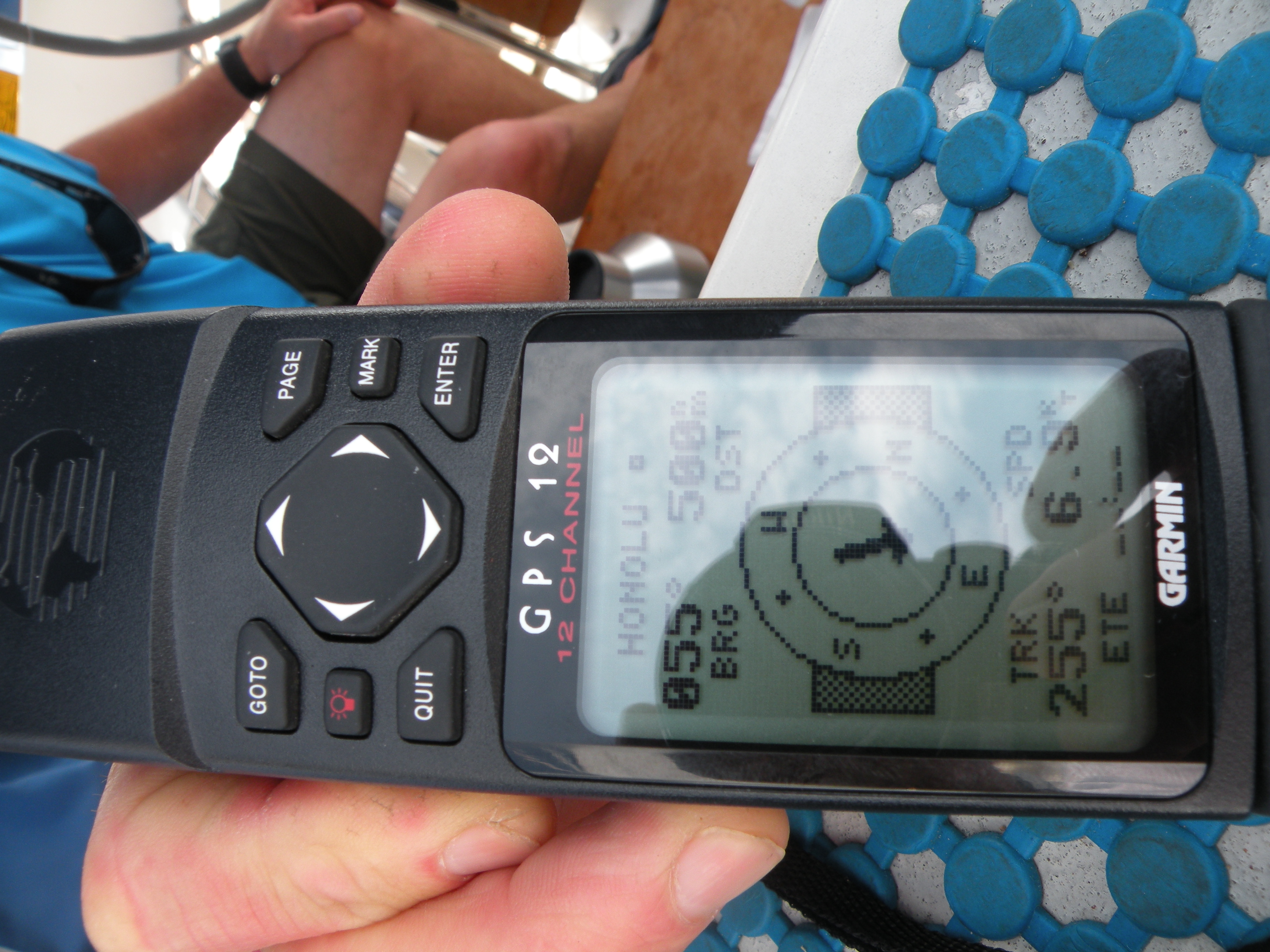
halfway across
We’re now at anchor in Majuro. SPOT will be turned off and removed from the website as it belongs to Dale. Majuro is an atoll of some 40,000 resident of which the harbour is covered in tuna mother ships loading up from the smaller foreign owned tuna fishing craft to head back to places like the U.S., China, Japan and Taiwan. How much longer can the seas sustain the removal of the tuna in this quantity?
There are only about 18 cruising boats here out of which 10 are crewed by people working here. It’s much quieter than we expected but we’re not complaining. We’re getting into the slower pace of being at anchor, fighting off the constant rain, finding ways to cool off from the 30+ temperatures and high (80%) humidity. We haven’t determined our next steps yet so stay tuned and am sure we’ll work something out as we snorkel amongst the reef fish and dodge the sharks.
Aloha, Hawaii
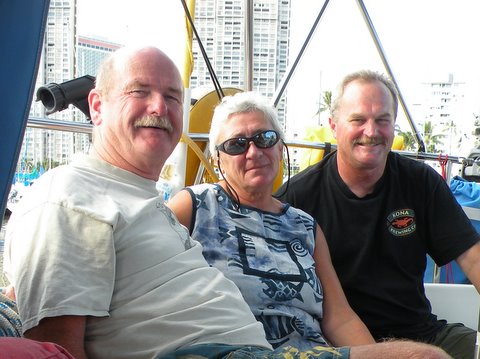
Tony, Connie, Dale – preparing for the Marshall Islands
This will be our last posting for a while. We are departing for the Marshall Islands on Sunday morning. It’s approximately 2,300 nautical miles to Majuro, the capital of the Marshall Islands. This will take us about 20 days as long as the winds remain and the storms avoid us.
Once in the Marshall Islands we have no idea what internet capacity we will find so posting something to the blog may not happen even once we get to the Marshall Islands. However, I will try to at least get some text blog up once we arrive.
Again, there will be three of us onboard as Dale Chandler from Victoria will be joining us. If you’ve been reading the blog from the beginning you will recognize Dale’s name as one of the crew who left onboard Sage for our first attempt at Hawaii. Dale will be bringing along his ‘Spot’ locator which may or may not work on our trip across to the Marshalls. I am putting in the link to the website where the Spot should show our location – http://share.findmespot.com/shared/faces/viewspots.jsp?glId=0gYlXEHeqf6bYD52pncRieahn0zgixHD2. However, don’t get worried if the SPOT either puts us in Singapore or shows us as non-existent. It’s a new instrument which doesn’t have the best worldwide coverage. So, don’t call the coast guard if we’re nowhere to be seen!
Till we’re able to add more to our blog I hope everyone has enjoyed reading a little about our Hawaiian adventures. Until then have a great summer or, if you’re in the southern hemisphere, have a great winter.

Pointing to Majuro from top of Diamond Head
Transpac 3
Want to know what the inside of one of these hybrid racers is like – see the photos.
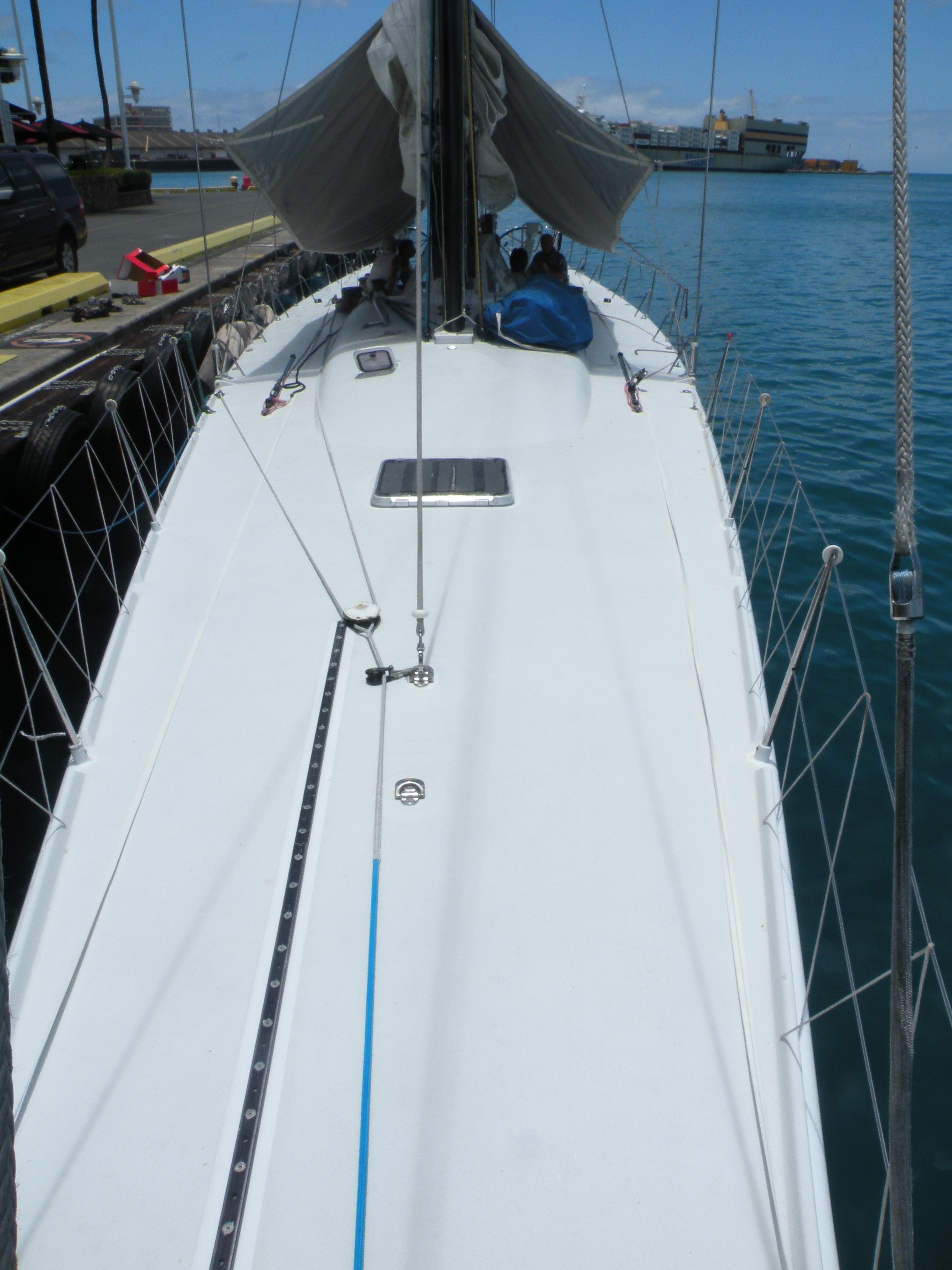
Who’s going forward to change sails?
We got onboard one called Magnitude, an 80 footer with 20 foot draft.
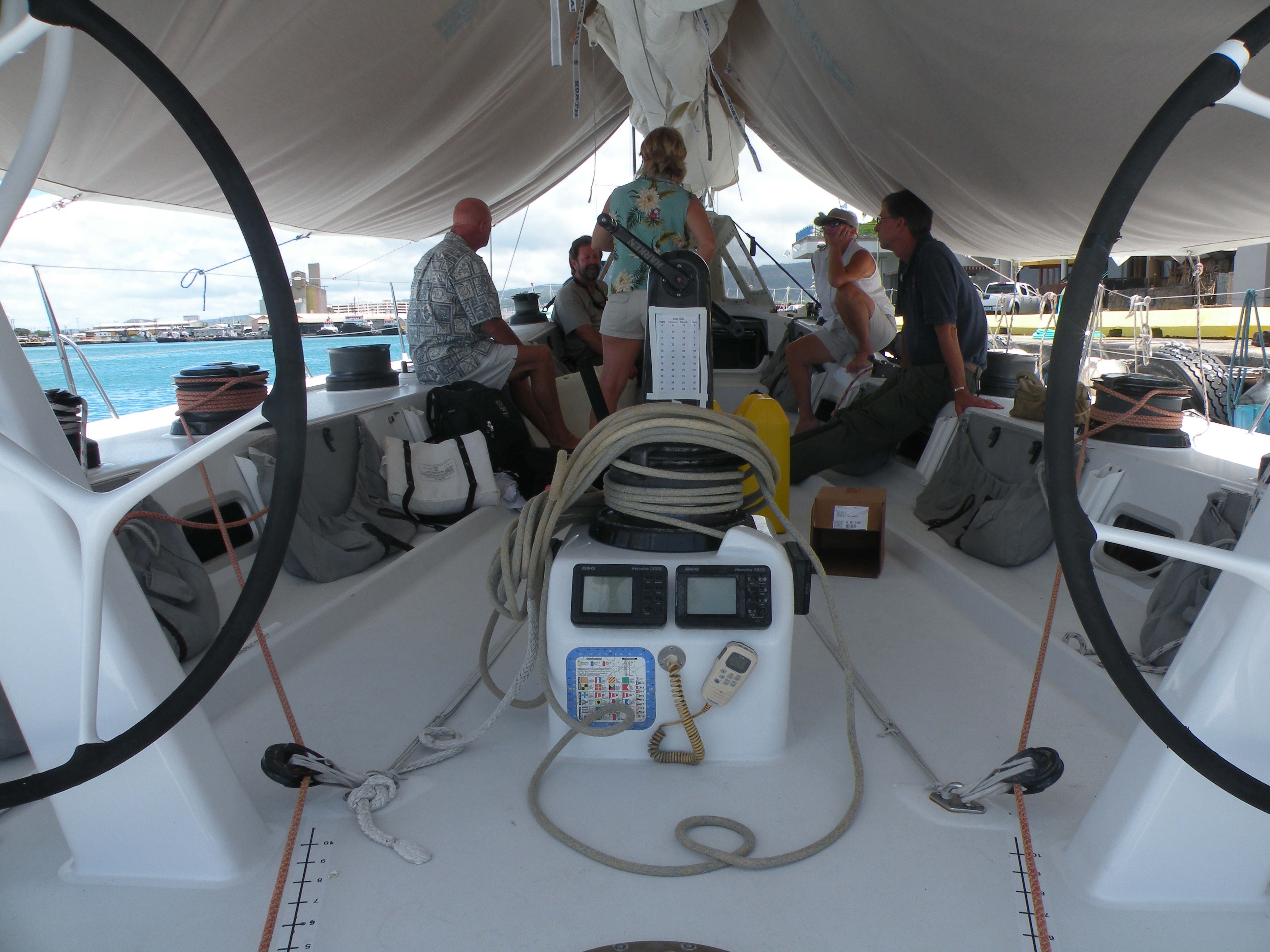
Great – one wheel for me and the other for Connie
Not exactly a cruising boat but certainly interesting from the perspective of racing across oceans. She couldn’t even get into the Ala Wai Yacht Harbour due to her draft and had to moor in the commercial port.
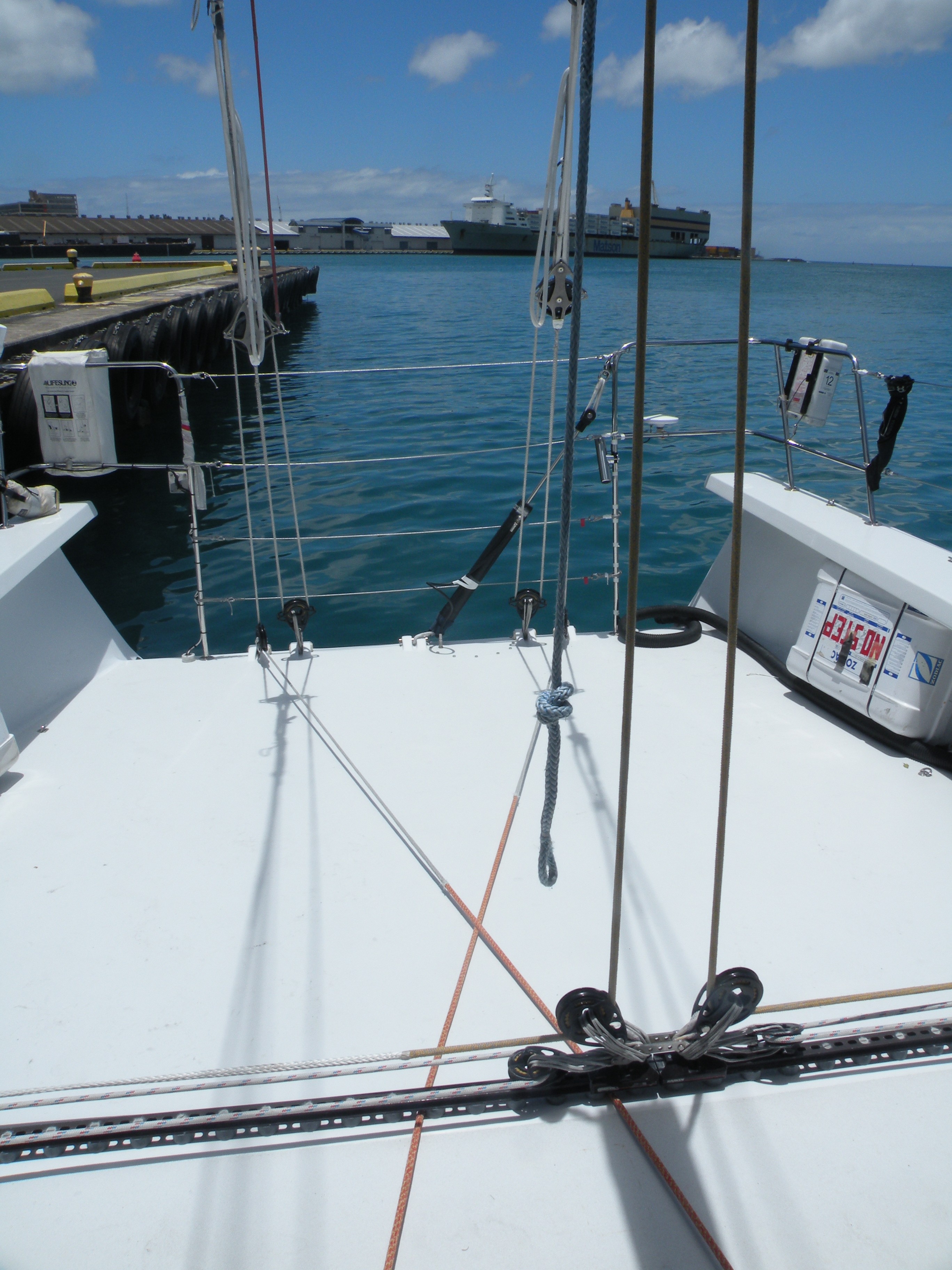
Ooops – did we lose someone off the back deck
Definitely not a toy for the average sailor with a small wallet. However, it’s always interesting to look at these boats as they test the limits of a boat at sea and much of the equipment on cruising boats these days come from experimentation on offshore racing sailboats that push all the limits. The big difference is that these boats come with professional crews that sail these boats year round in races around the world.
Anyway here are a few pictures of the interior. I have nothing under sail as haven’t yet had the opportunity of sailing onboard one of these machines but perhaps sometime in the future may get a chance!
Going down below all one can think of is how far am I going to be thrown across this boat when it’s doing 18 knots?

OK – which sail do I use
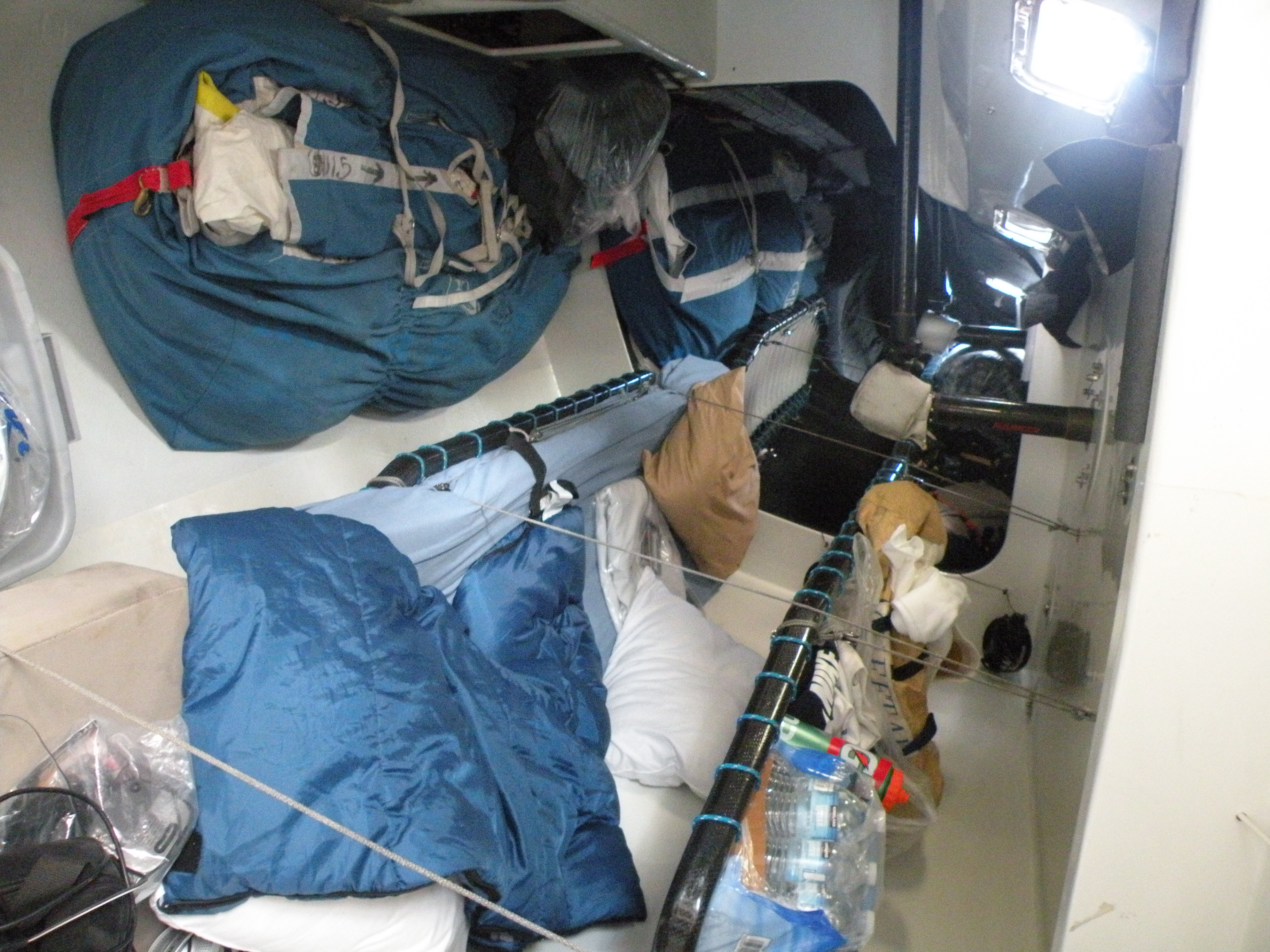
where do you sleep?
Or how do I find a place to sleep? It would also be quite noisy. These boats are made out of hi tech fibres of carbon and epoxy and I think it would be like living in a drum.
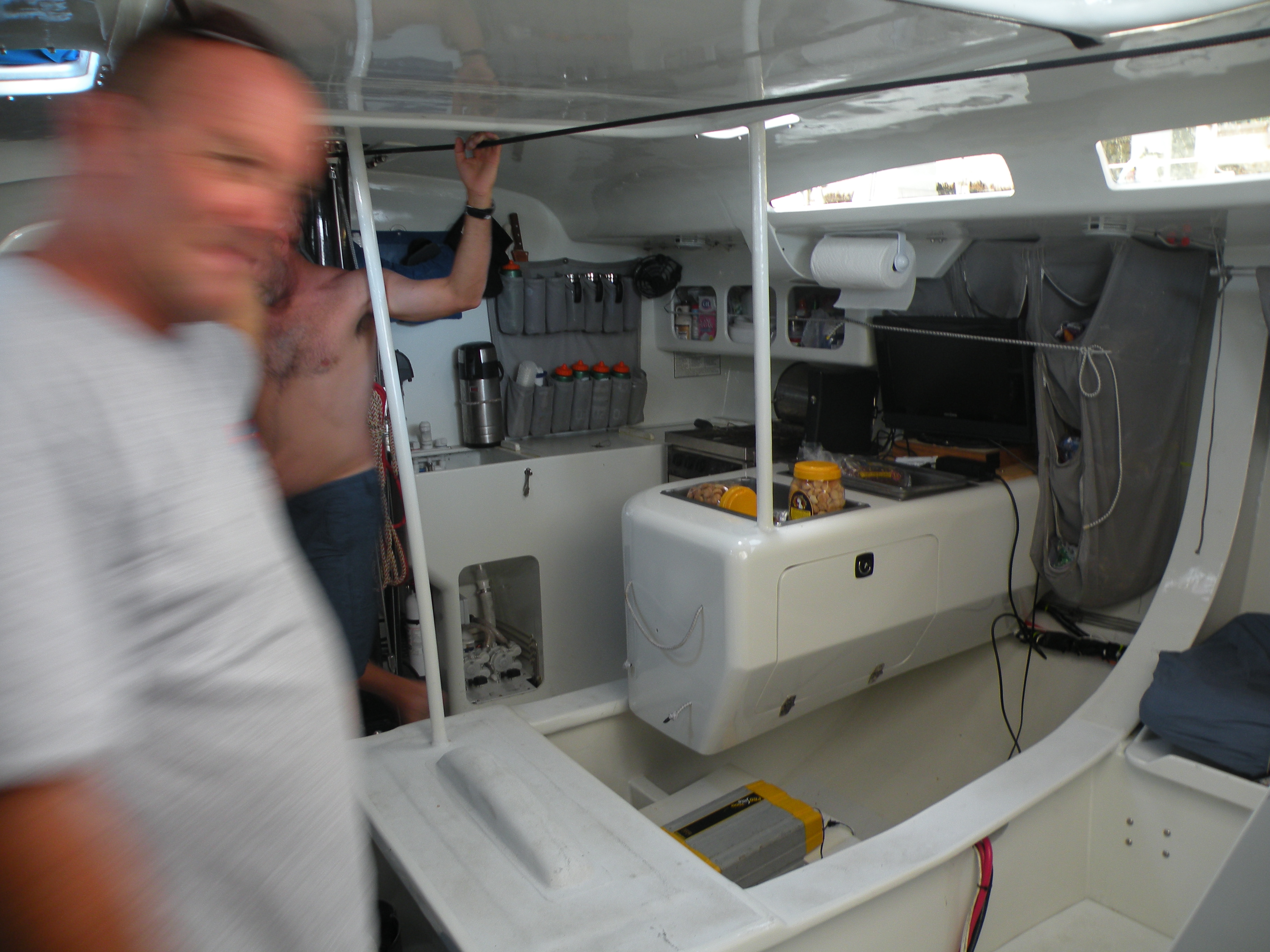
So how can I cook when I’m sailing at 18 knots
However, there are spaces to go and hide and the galley is certainly well equipped for sailing offshore.
That brings us the end of transpac. Most of the boats have now left and are returning to the mainland. A tough trip as they have to go north for about 800 miles before turning east to the mainland so as to avoid the pacific high. Some of the boats strapped on a lot of fuel and imagine their plan is to motor through the north pacific high thus shortening the total distance needed to go.
It will be another 2 years before the transpac returns. Next year is the Victoria to Maui race….
Transpacific Race – 2
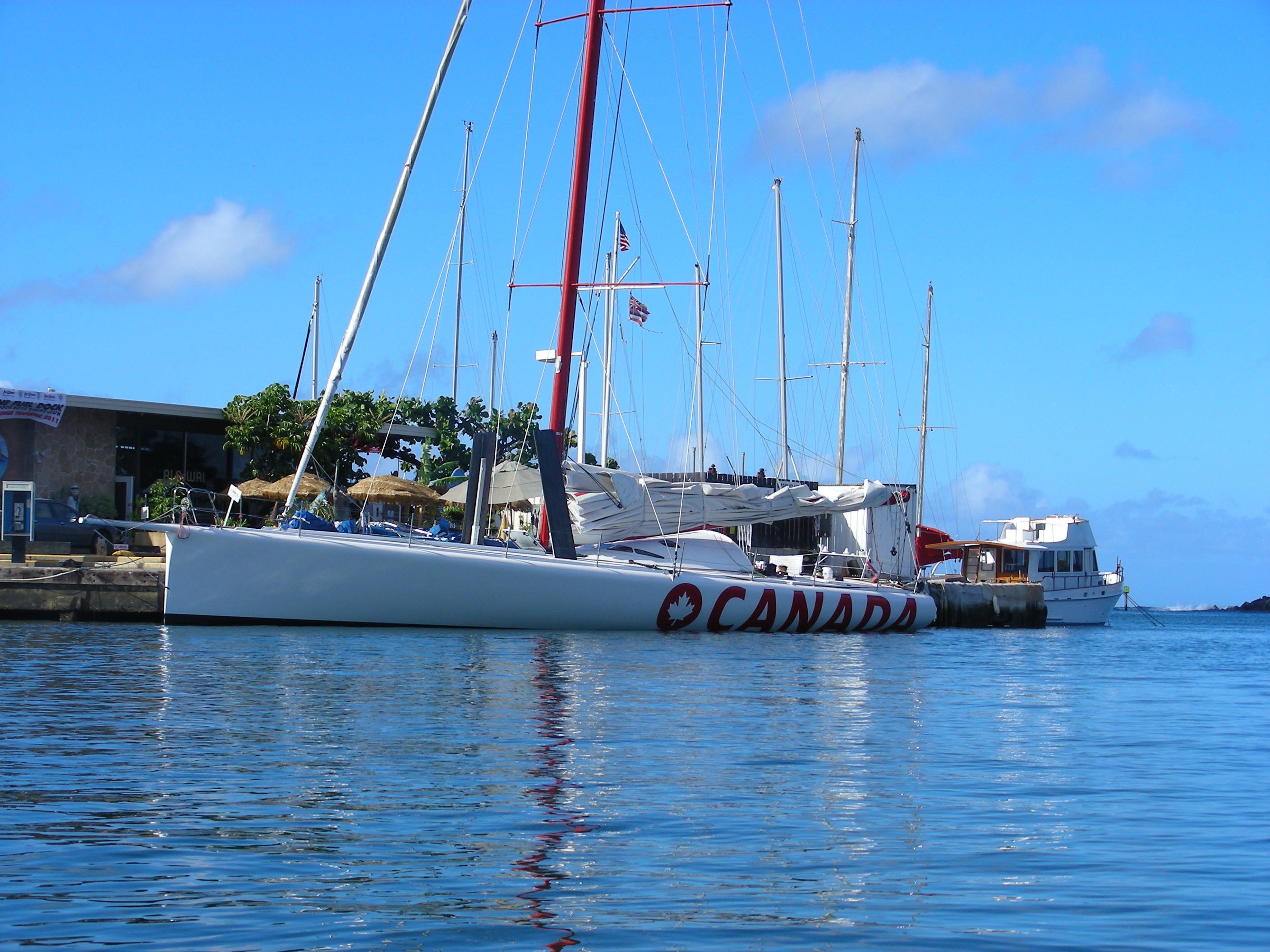
Tied up at the fuel dock
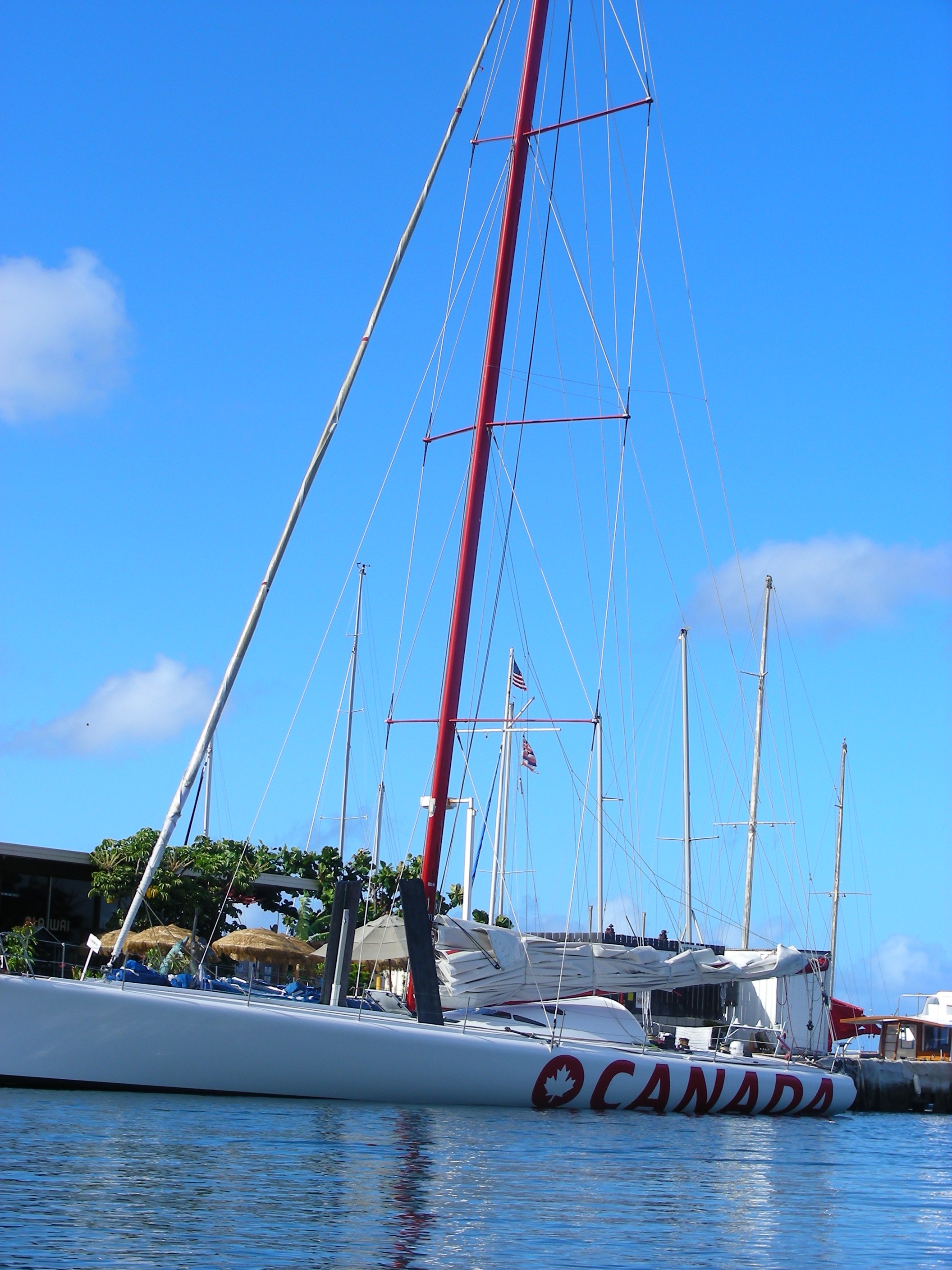
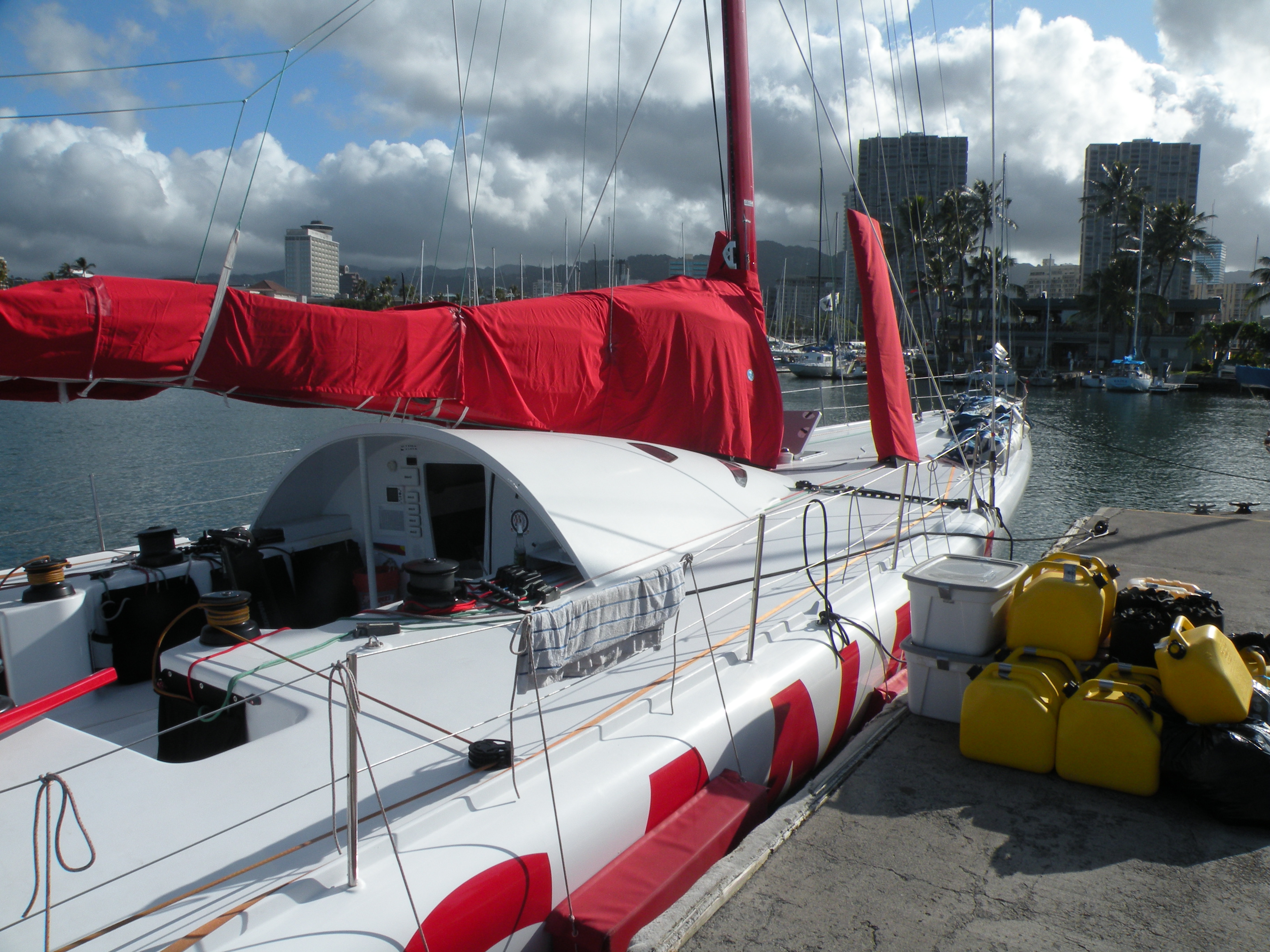
The first boat across the line is Bella Mente closely followed by Magnitude. These are both 80 foot boats and are not that far ahead of a 60 foot Canadian boat called ‘Oh, Canada’ (average speed = 11.7knots). Time to increase the size of our boat and get something that can really sail!!Time to increase the size of our boat and get something that can really sail!!
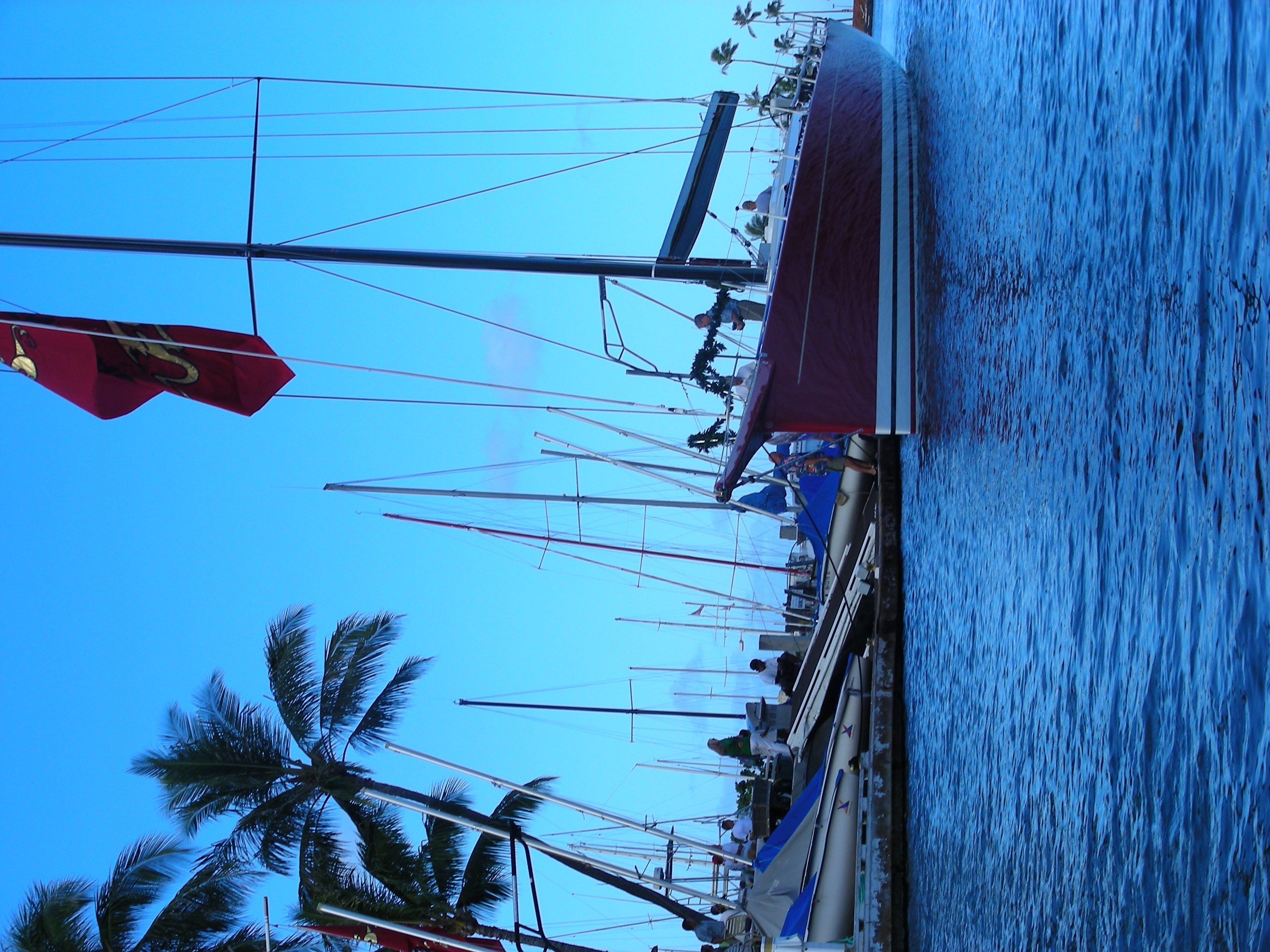
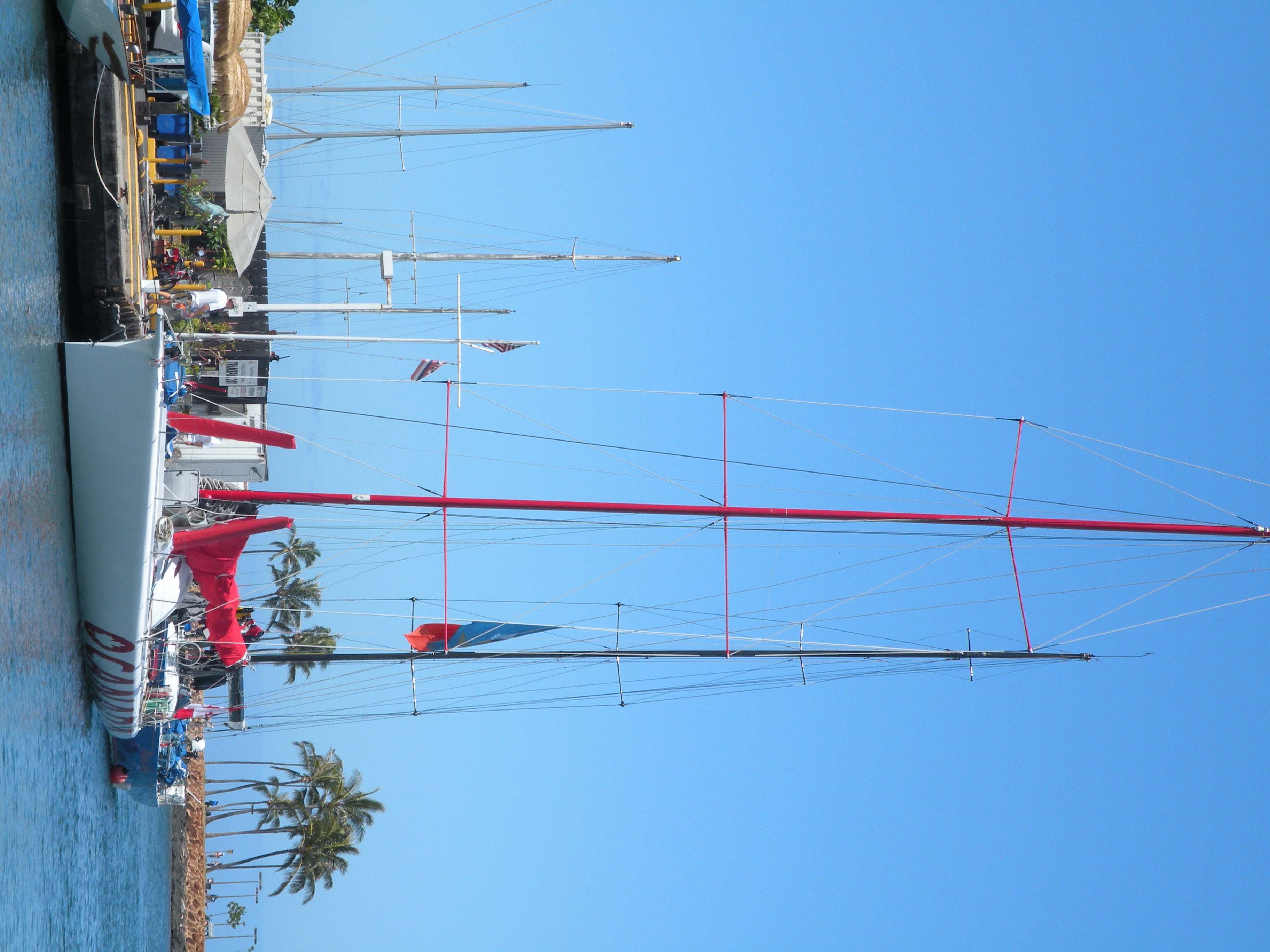
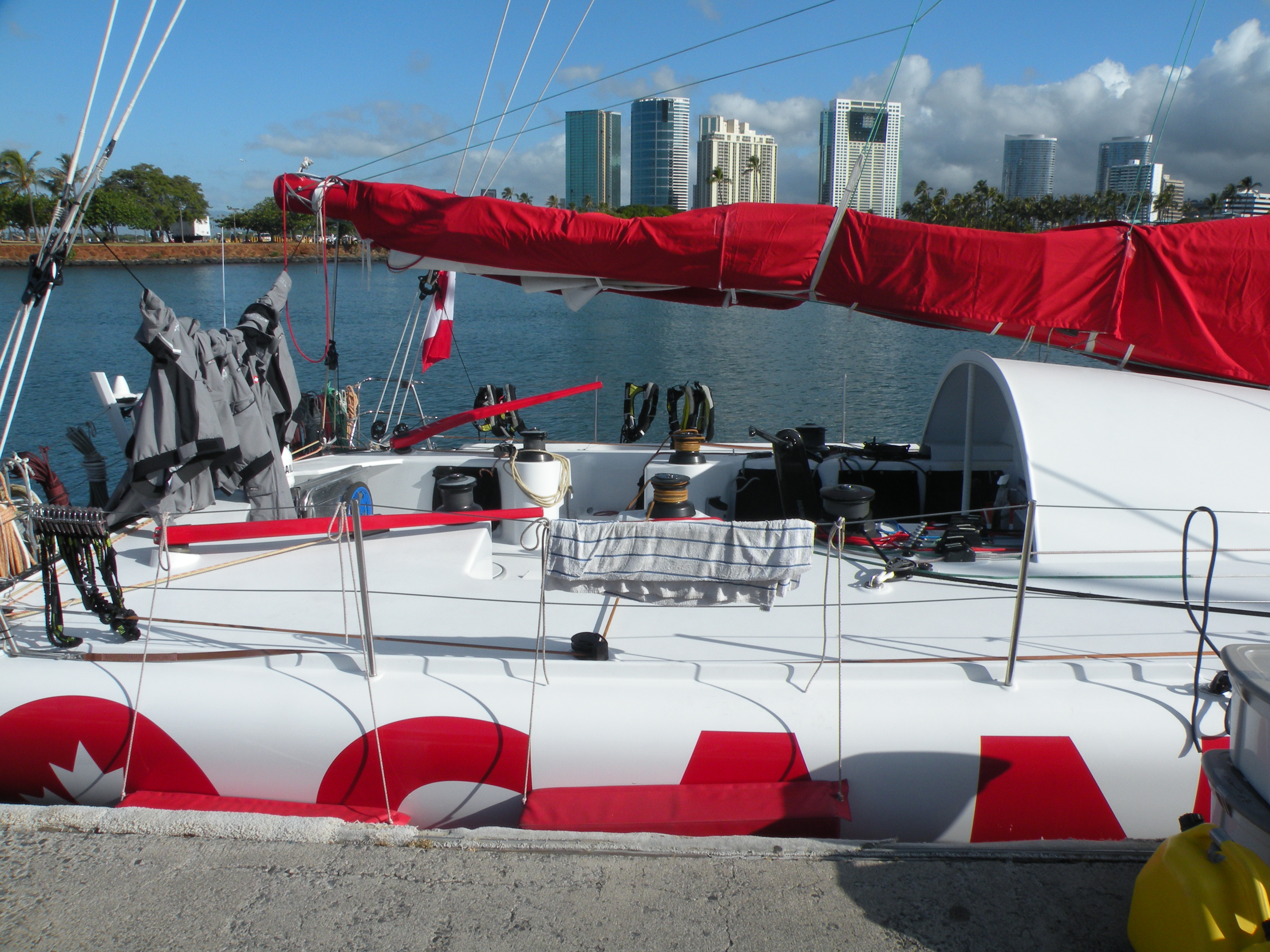
None of these boats is able to fit into the Ala Wai Yacht Harbour due to excessive draft. However, Oh Canada arrives and not realizing she has too deep a draft she enters the harbour and 75 metres from the dock she goes aground in 12.5 feet. Her only alternative is to cant her keel a little to reduce draft and get dragged over to the closest dock which is the fuel dock where she is staying for the duration of the celebrations (hence when you look at the pictures closely she does seem to be leaning over and that’s due to the canted keel).
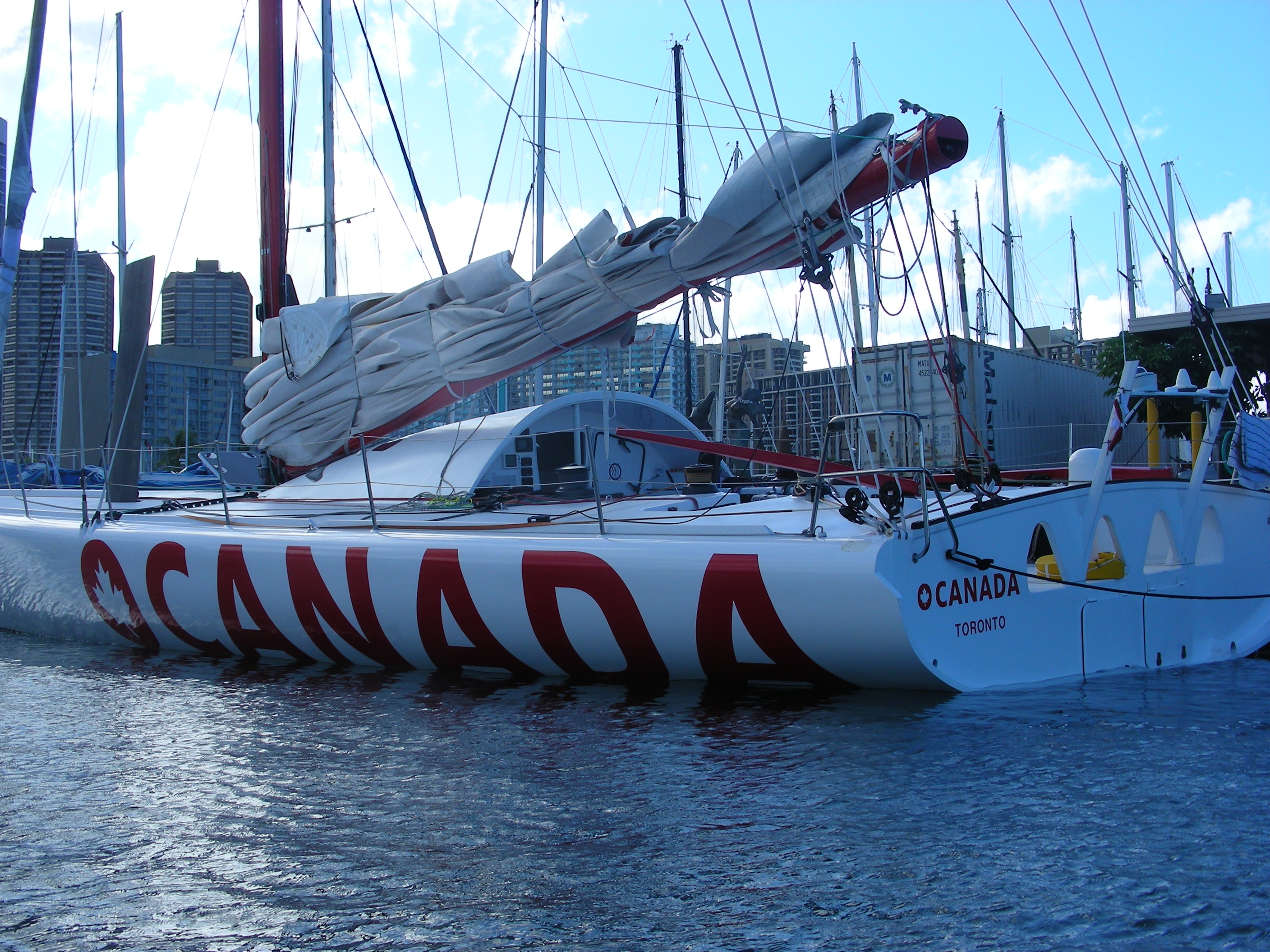
Oh Canada – Transpac 2011
So, boats are coming in slowly but surely. 53 boats expected to follow and successfully complete the race. As each boat arrives, regardless of time, a local committee greets the boat and puts on a host party complete with Mai Tais, food etc and helps the crew settle ashore.
One of the two big party nights for the boat happens at the Hawaii Yacht Club on July 20th. A chance for most of the boats to get here and participate in the celebration and be part of the awards ceremonies.
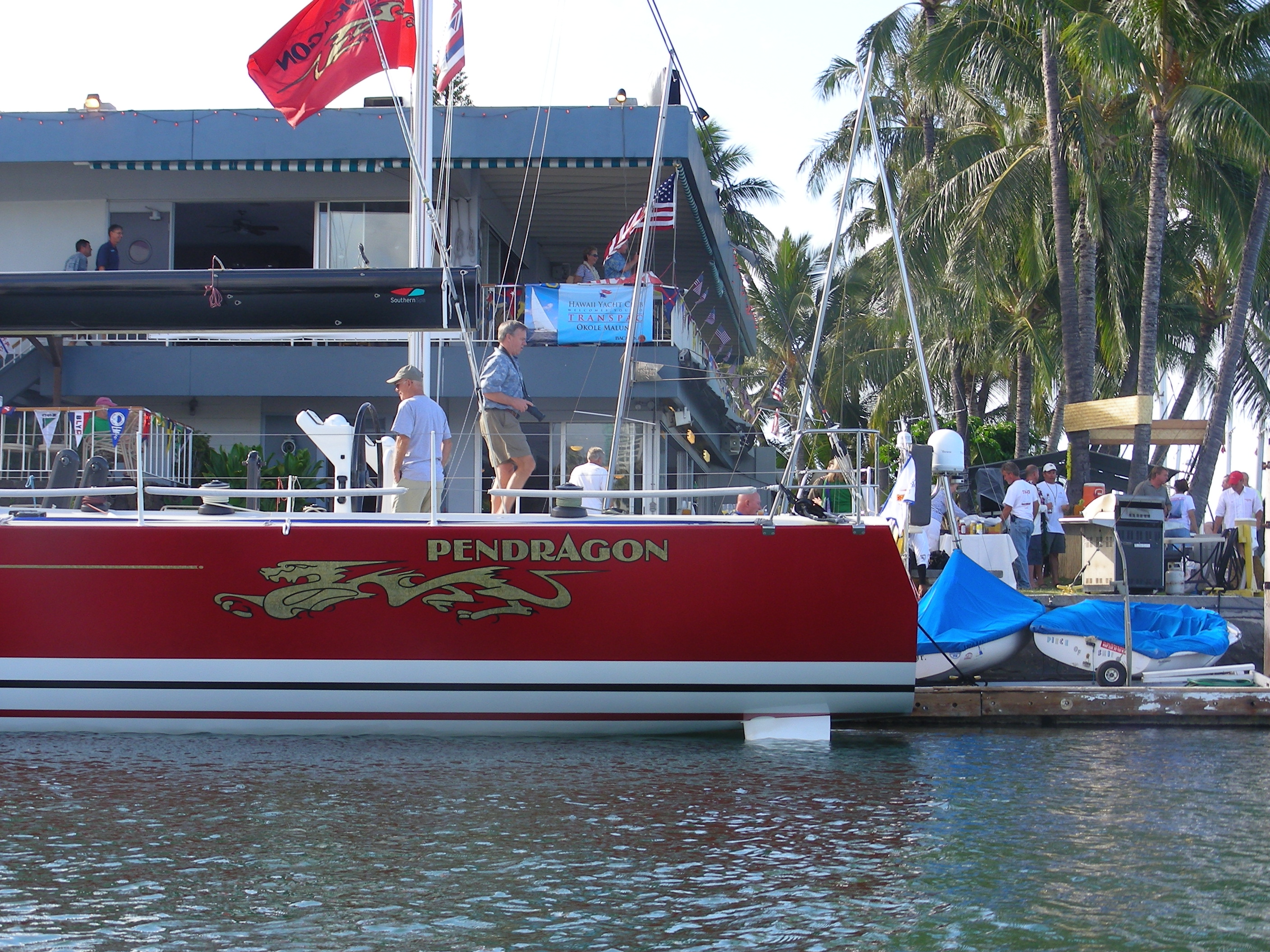
Pendragon at Hawaii Yacht Club Aloha dock
Pendragon – Transpac 2011

Oh Canada – Transpac 2011
Transpacific Race
The big excitement here is the impending arrival of the Transpacific race boats. The Transpacific Race is a biennial sailing race from Long Beach, California to Honolulu, Hawaii.  It’s run on alternate years to the Victoria, BC to Maui, Hawaii race. Here in Honolulu, the Hawaii Yacht Club is the hosting club. Hence, we’re volunteering!
So what are we doing to help out? First off Connie is working in the ships store at the yacht club selling t-shirts, hats, souvenirs etc. She’s doing everything except the hula. I’ve started off working to make the offices a little more presentable. There is an office in the middle of the parking lot that is a permanent structure. It’s only used for the transpac race and hence tends to deteriorate when not in use. Have to say now it looks pretty good  with a new exterior paint job, new ceiling tiles and new interior paint.
Right now the boats are about 3/8ths of the way across from California and are making anywhere from 8 to 23 knots depending on wind, time of day etc. Meanwhile at the Hawaii Yacht Club everyone’s madly building makeshift bars, decorating the rooms, getting paperwork in place, tending the garden, clearing out space for the boats and generally throwing a hand in wherever it’s needed.
More reports to be made as the boats arrive…
 Sage on sail