Madagascar Remembered
Amazing. I think that word best sums up Madagascar.
For quite some time we had been hearing about how wonderful Madagascar is and that we should plan on giving Madagascar plenty of time. We miscalculated!
We got to spend approximately 6 weeks along the coast, ducking into bays, anchored in exposed offshore islands and sitting in river mouth entrances as well as spending time in the discos of Nosy Be! We loved it. From a boating perspective it can hardly get better. The winds are constant and predictable on the northwest coast, the anchorages are secure, the food is excellent and the people friendly.
From the chameleons to the lemurs to the crocodiles you have to love Madagascar for the wildlife. The countryside probably hasn’t changed in decades. Land transportation along roughly hewn roads takes hours to get anywhere and thus its boats that run everywhere. Not fast ferries but rather the old dhows with a occasional outboard powered pirogue or a very small coastal steamer.
Try flying. Or better yet try booking a flight within the country. Everything is booked solid and even though you may have a ticket in your hand it’s not uncommon to hear your seat is gone when you get to the airport. Air Madagascar does not have a reputation for courteous, friendly and efficient service.
So, that’s why the best way to see Madagascar is by water. Venturing off and away from Nosy Be, a small but popular tourist area, takes you into places that still have no electricity, residents move by sailing dhow or pirogue and life moves at the pace of the changing cycles of the moon. There are still plenty of fish in the sea to sustain the family, land available for small-scale cultivation and just enough rainfall to support their basic needs.
What we loved most were the sailing dhows both big and small. There was always a smile and an enthusiastic wave between ourselves and the dhows as we each measured up the others boat. The locals know the winds and shoals as well as the currents and inevitably, if going the same way, can sometimes out-sail our modern boats. But whenever we pass close there are always big smiles and it seems to be when the locals are out on the dhows they provide a little bit of a break in an otherwise hard scrabble life.
Here are a few pics from our Madagascar picture book:

The modern and the old.
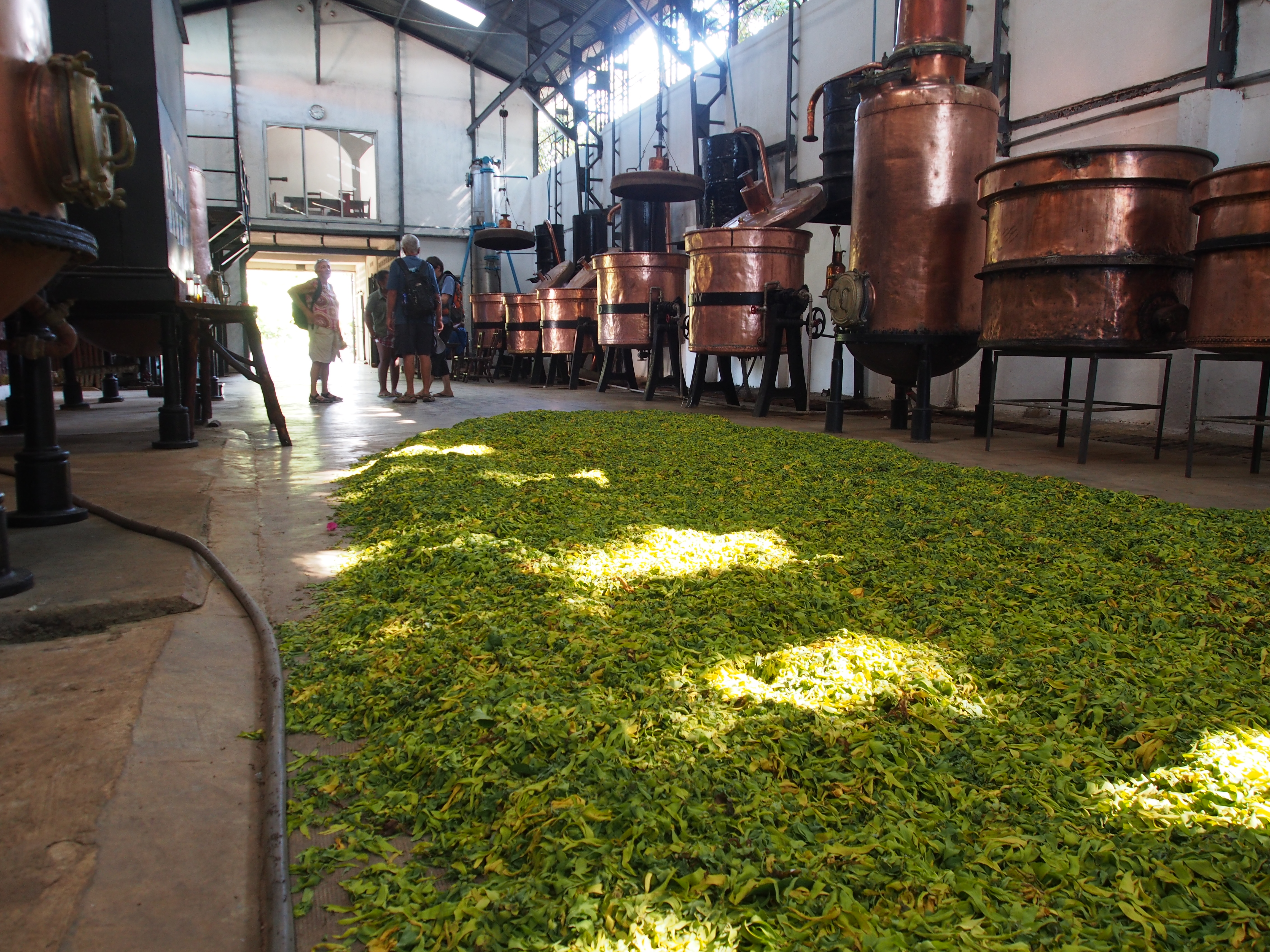
The ylang yland factory/farm. Used as the bases for a lot of perfumes. The copper kettles used to extract the oils are over 100 years old

These guys are everywhere

Chameleons come in all colours

More chameleons

I know. It’s not a chameleon but I couldn’t resist

Slow, old and wise
And then there are the lemurs – irresistible

Our favourite lemur

No-one is going to take my banana
And then there are the people:

The people were friendly, helpful and stylish!

It’s a very young country. Average life expectancy is 45.

Always friendly faces
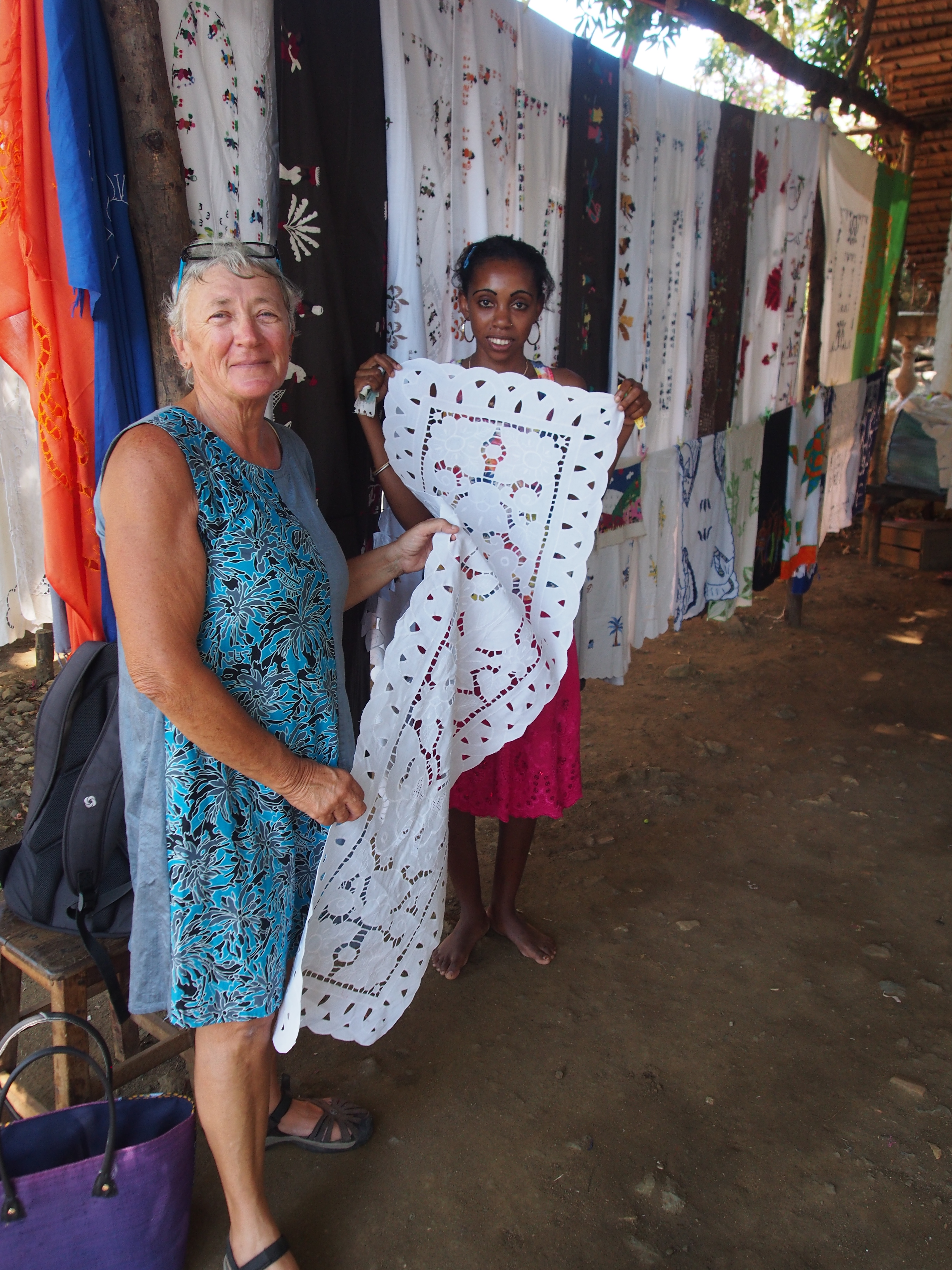
Great handicrafts

Incredible old house that once belonged to one of the early traders from India
And I leave you with an iconic Madagascar picture of a baobab tree.

Baobab Tree – Marumba Bay
Books of note recently read:
Muddling Through Madagascar by Dervla Murphy – a wonderful travel story about Dervla and her 14 year old daughter walking through a large section of Madagascar in the 1980s. Reading this just emphasized that things have changed very little in the last 30 years.
The Orphan Master’s Son – a chilling novel set in modern day North Korea. It doesn’t instill much desire to visit/experience North Korea. A kafkaesque nightmare of life and survival in an autocratic regime. It’s a Pulitzer prize winner.
Hardboiled Wonder and the End of the World by Haruki Murakami – for Murakami fans, and I am one, a wonderful stroll through the baffling and strange mind of Murakami.
Looking for Lovedu by Ann Jones – a saga of overland travel by two young adventurers who travel from northwest Africa to Capetown by Land Rover passing through Morocco, Western Sahara, Senegal, Mali, Nigeria, Zaire, Tanzania, Kenya, Zimbabwe, Mozambique and finally Sputh Africa.
Fashionable sailors
One of the essentials not paid much attention in mainstream sailing media is fashion. What do long distance cruisers wear? At least, when we do wear clothes. Now we don’t always wear clothes but in port and anchored close to other boats and/or local villages we do try to aspire to be respectful and cover up. But when we don’t, what clothes do we wear?
So, one day in the Seychelles Yacht Club we were all having lunch and decided to take a few photos of what people were wearing. Of course, the women were far more discerning about what they were wearing compared to the men. You judge with the following pictures.
THE WOMEN
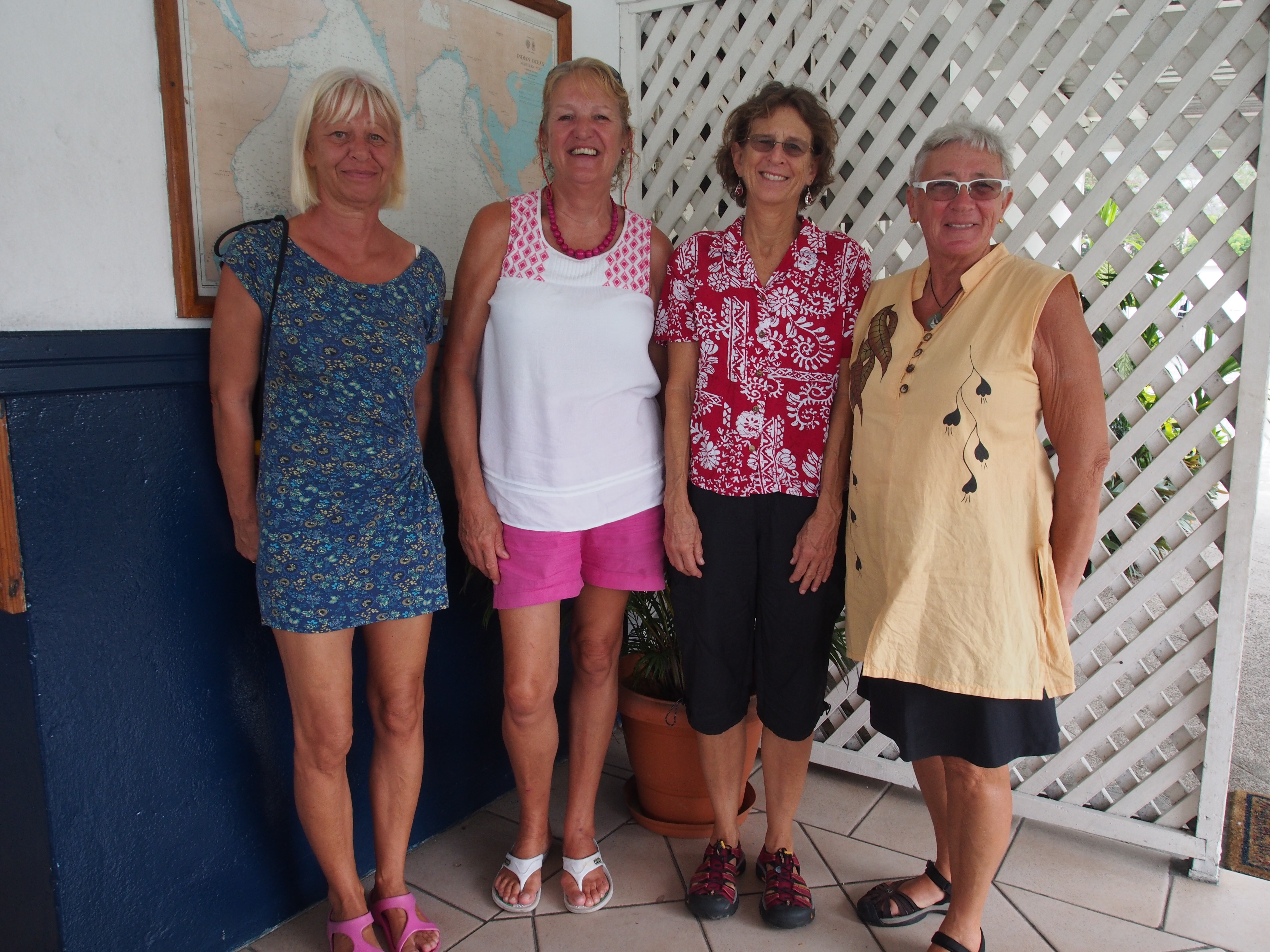
Sunday Brunch finery with Utta from Imagine, Davina from Divanty, Marcia from Strider and Connie from Sage

Marcia dressing very tropical with Fijian cotton print shirt, REI capris and Keen shoes

Davina is wearing a matching short set with croc shoes to match
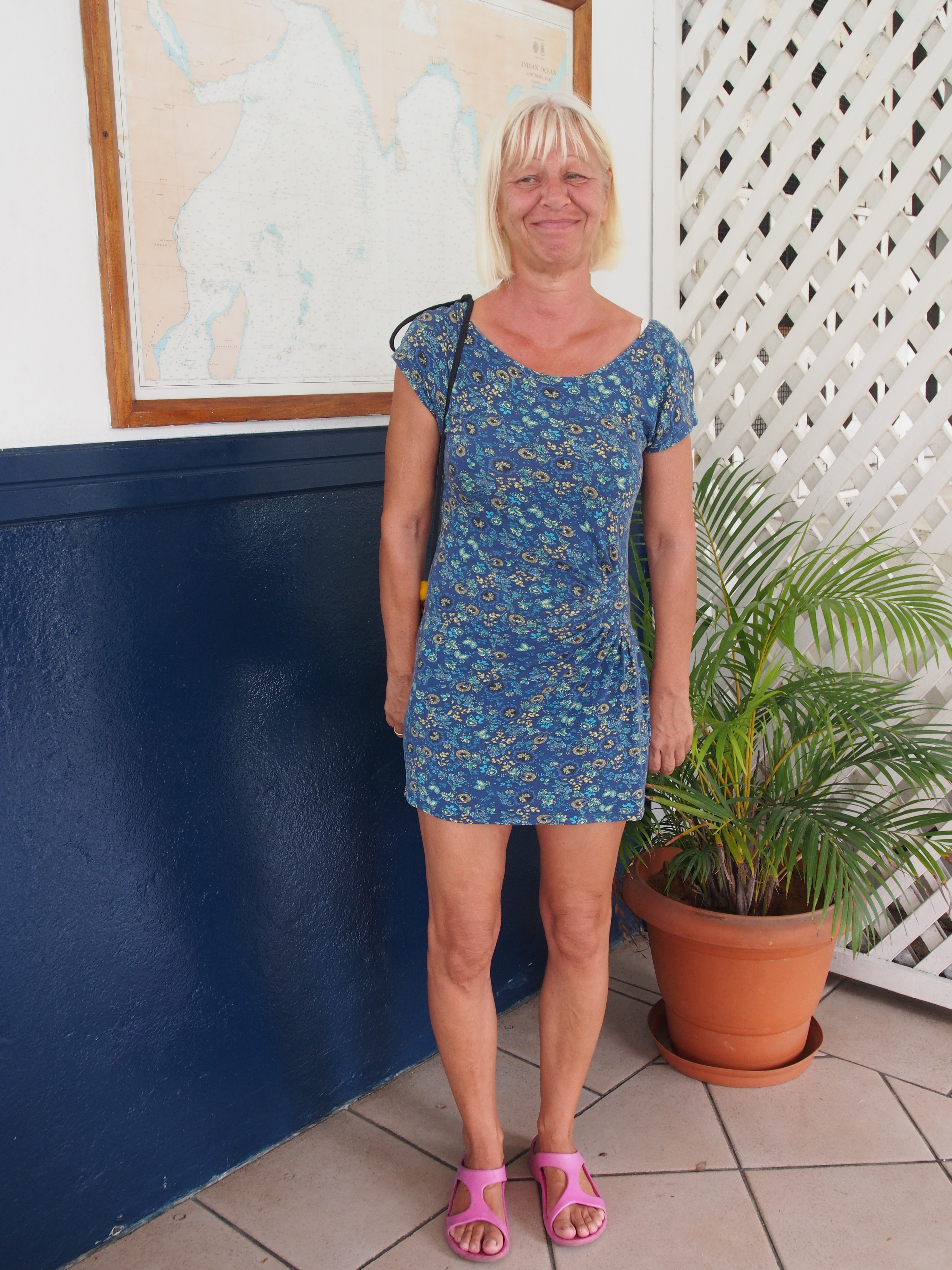
Utta is most fashionable wearing a dress by Isayake (?)

Connie fashions a hand embroidered top from Sri Lanka and shoes by Keens
Of course there are always those moments where hi-fashion has to be put aside for practical reasons:
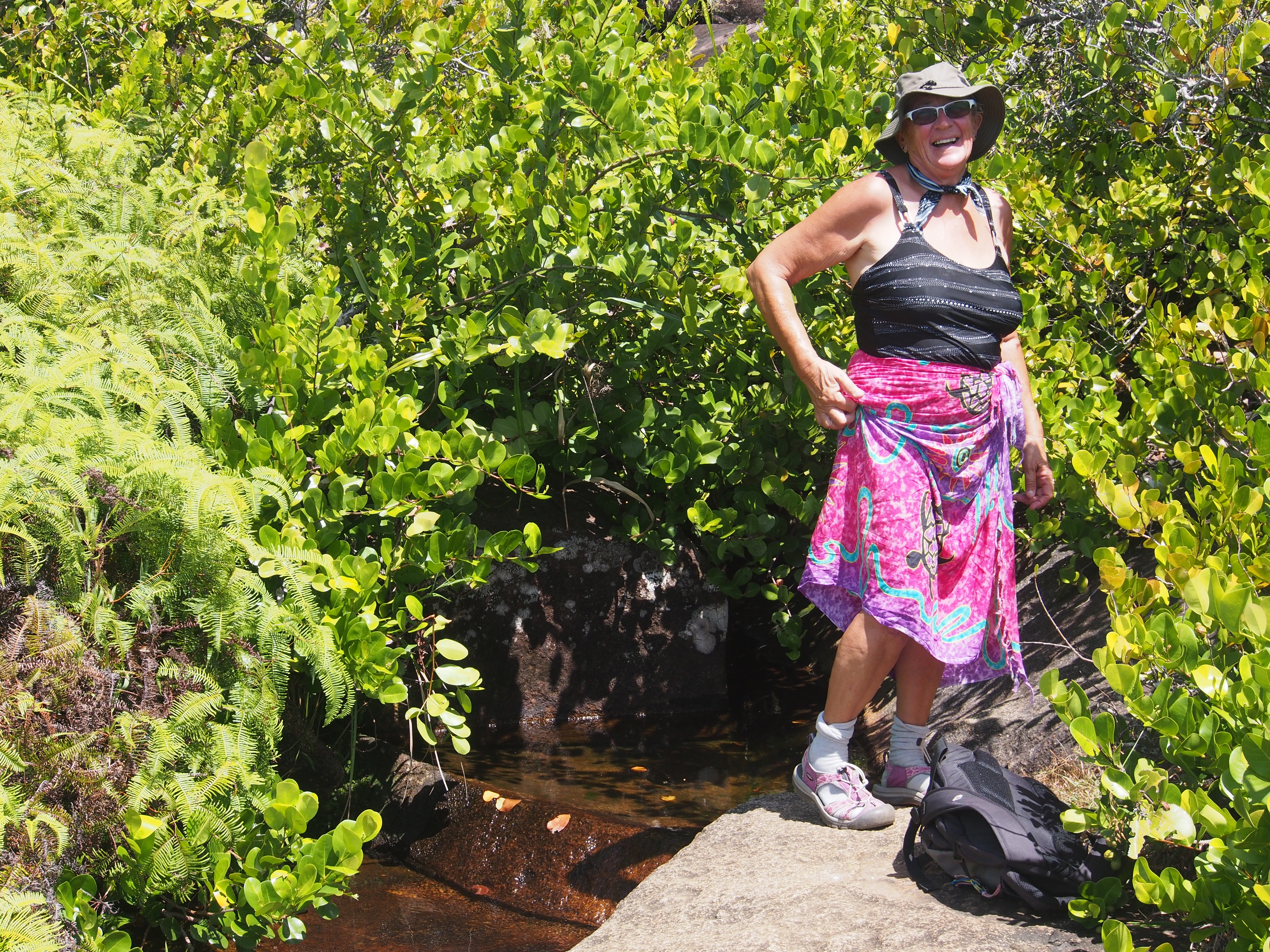
For those hikes where cool waterfalls or streams are available it’s always handy to have a wrap to use after bathing. Connie hard on the slopes

Nives, our Seychelles crew/guest, sports the latest in Seychelloise millinery fashion with a hand-woven husk hat

Looking good in the dinghy is important – here Kirsten from Lop To and Connie from Sage display the latest in dinghy wear
THE MEN
Men haven’t caught on to the importance of fashion wear in the cruising community but there are some great displays and attempts at trying to fit in to the highly competitive world of cruisers fashion
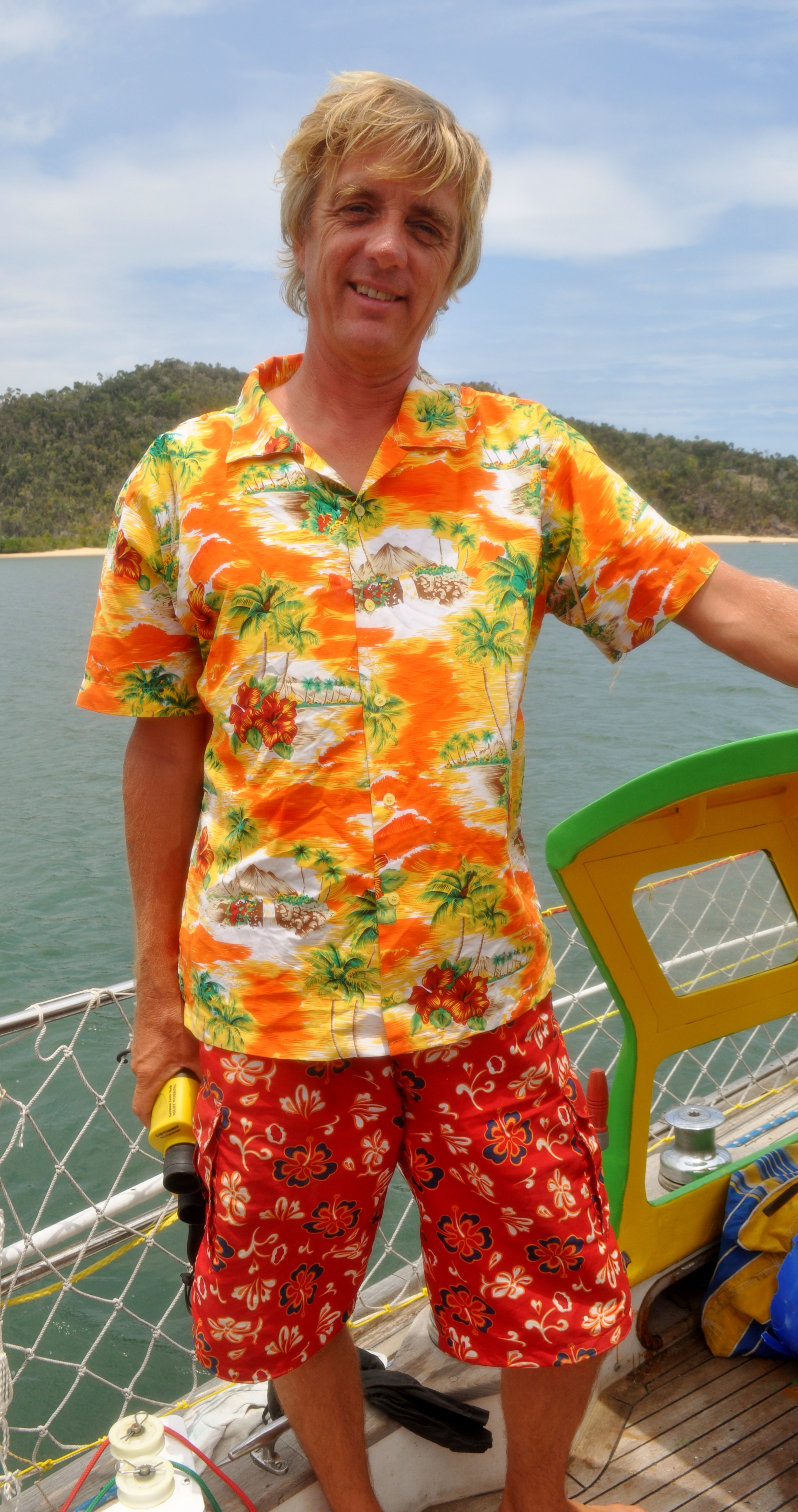
Leading the men’s pack is Bernie onboard Momo

Second in the ‘men’ pack is Dave sporting a Fijian cotton print with Tilley shorts
And then there is the group attempt to fit in.

For visiting the sacred banyan tree in Nosy Be one has to be appropriately dressed. Standing from left to right: Kirsten (Lop To), Peter and Utta (crew on Pipistrelle), Helmut (Lop To), Bob (Pipistrelle), Rose and Steve (Emerald Sea).
And then there is yours truly:

Tony at rest – hat by Tilley, scarf by Enoki and shirt from a thrift shop in Victoria
Madagascar to Mozambique

Morumba Bay – point of departure from Madagascar
If the sail from the Seychelles to Madagascar was an exercise in physical stamina and endurance the trip from Madagascar to South Africa was a test of mental stability edging towards insanity.
The stretch of water I refer to lies between 15 and 25 degrees of south latitude and between the east coast of Mozambique and the west coast of Madagascar. Most waters of the world in these latitudes usually offer gentle sailing, consistent winds and generally pleasant experiences. However, the Mozambique Channel offers a number of challenges and sailors are wary of these waters especially south of 20 degrees south latitude.
The group of sailors who have moved across the Indian Ocean this season are a cautious lot and as with many sailors leaving for a crossing there are a great number of conversations about weather and tactics.
Modern technologies and access to weather sites are numerous. Most weather sites use grib files to make predictions for future wind patterns. These are great guides to sailors planning an ocean crossing but they are fallible. As I write the prediction for our particular location calls for south-east winds of 10-12 knots but we have 12-15 knots of north-west wind! Not to belittle the grib but it’s best to understand they are built on models and love it or hate it nature always tends to surprise us.
Well, the Mozambique channel was a surprise. We made our departure a day after two or three boats making the same passage, Morumba Bay, Madagascar to Richard’s Bay, South Africa. The grib files showed southerly winds but the channel was a few days sail away and first was getting off the coast of Madagascar to turn south.
The winds along and close to Madagascar near Morumba Bay follow a daily pattern of easterly winds in the late evening until early morning turning to westerly during the late morning as the land mass heats up. Getting off the coast and into open water is a matter of timing so we left in the early hours of the morning and by late evening we were clear of shallow water and out in the open ocean. Great, step one accomplished.
In the meantime one can listen to boats on passage by tuning in to a scheduled radio broadcast twice a day. Again modern technologies are in play as people continue to download grib files and watch the weather. Most interesting and telling for us is to listen to the position reports of other boats. At this time of the year there are usually 10-15 boats participating in the broadcast and they are scattered throughout the Mozambique Channel and the stretch of water from Reunion to South Africa.
Our main struggle became the adverse current at play. Sailing south became a cat and mouse game with the current, and, we lost many times. The contrary current mixed with southerly winds was a deadly combination. Just trying to make forward progress became a mental challenge to a boat and crew used to making good 120+ miles to a destination. There were days where forward progress was hard-fought against headwinds resulting in daily runs that amounted to 60 miles!
It soon became apparent we needed a break. With a storm forecast to be overhead in a few days

Hiding from the coming storm
we headed towards Bazaruto. Bazaruto is a large bay on the east coast of Mozambique.

Bazaruto National Park
It’s a stunningly huge bay protected from the ocean with sand dunes rising 250 metres.
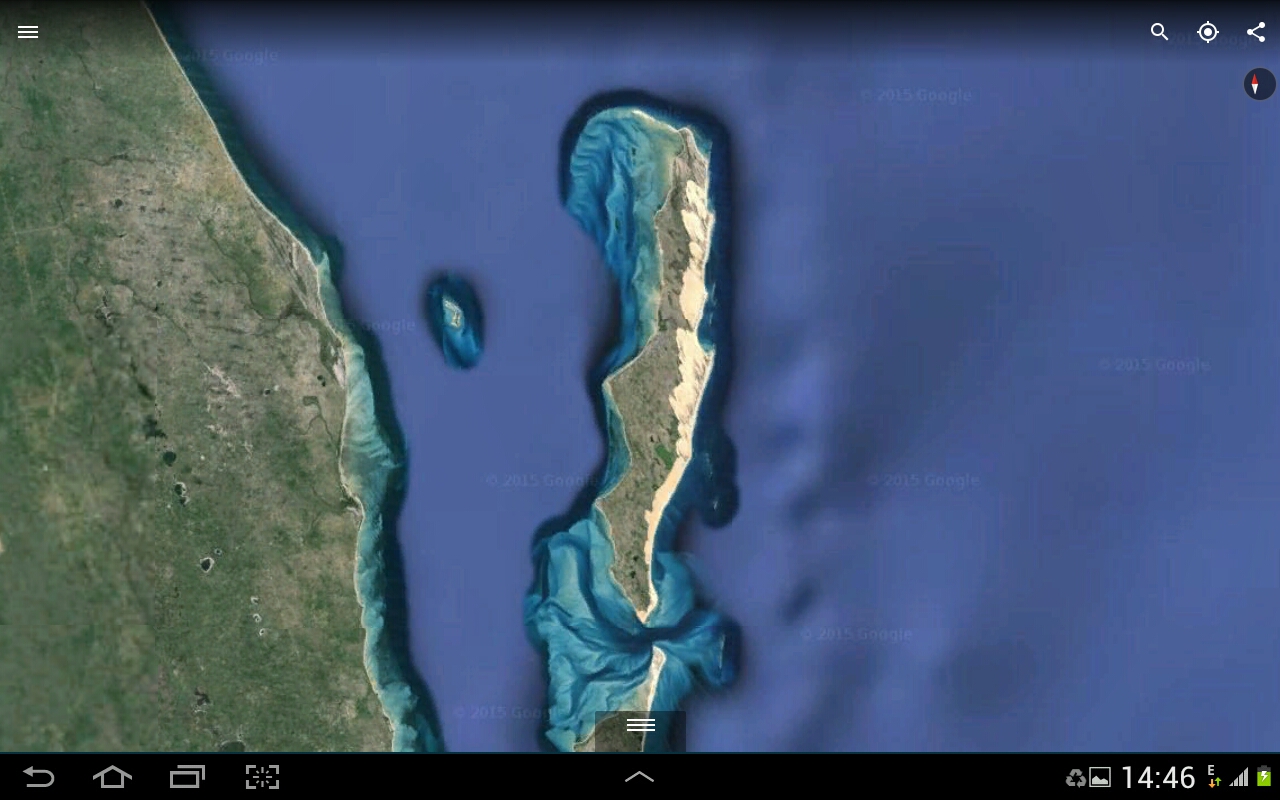
Ilha do Bazaruto
The bay is shallow with numerous sandbars but with careful navigation one can maneuver into anchorages none of which offer 360 degree protection. However, we did find a location which in the end accommodated 8 other sailing yachts each seeking shelter from the storm.

Under tow by Crystal Blues in Bazaruto Bay. This is another story
Leaving Bazaruto was a real nail biter. An uncertain engine, an incoming tide, a storm swell, a shallow (2.5 metre) bar with breaking waves to manoeuvre and 8 boats leaving at the same time made for some tense moments. We made it through and headed south with an ever-increasing wind from, can you believe it, the east and shifting north-east. Yahoo, and on top of the good wind direction over the next two days we caught the occasional exhilaration of a current that moved south at upwards of 4 knots. We thought we were home free.
55 miles from Richards Bay the wind died, the motor broke down and for the third time in two months we were towed into port. This time though we sailed to within 6 miles of Richards Bay. We were within VHF contact of cruising friends and support from the local volunteer organization here called the NSRI, National Sea Rescue Institute.
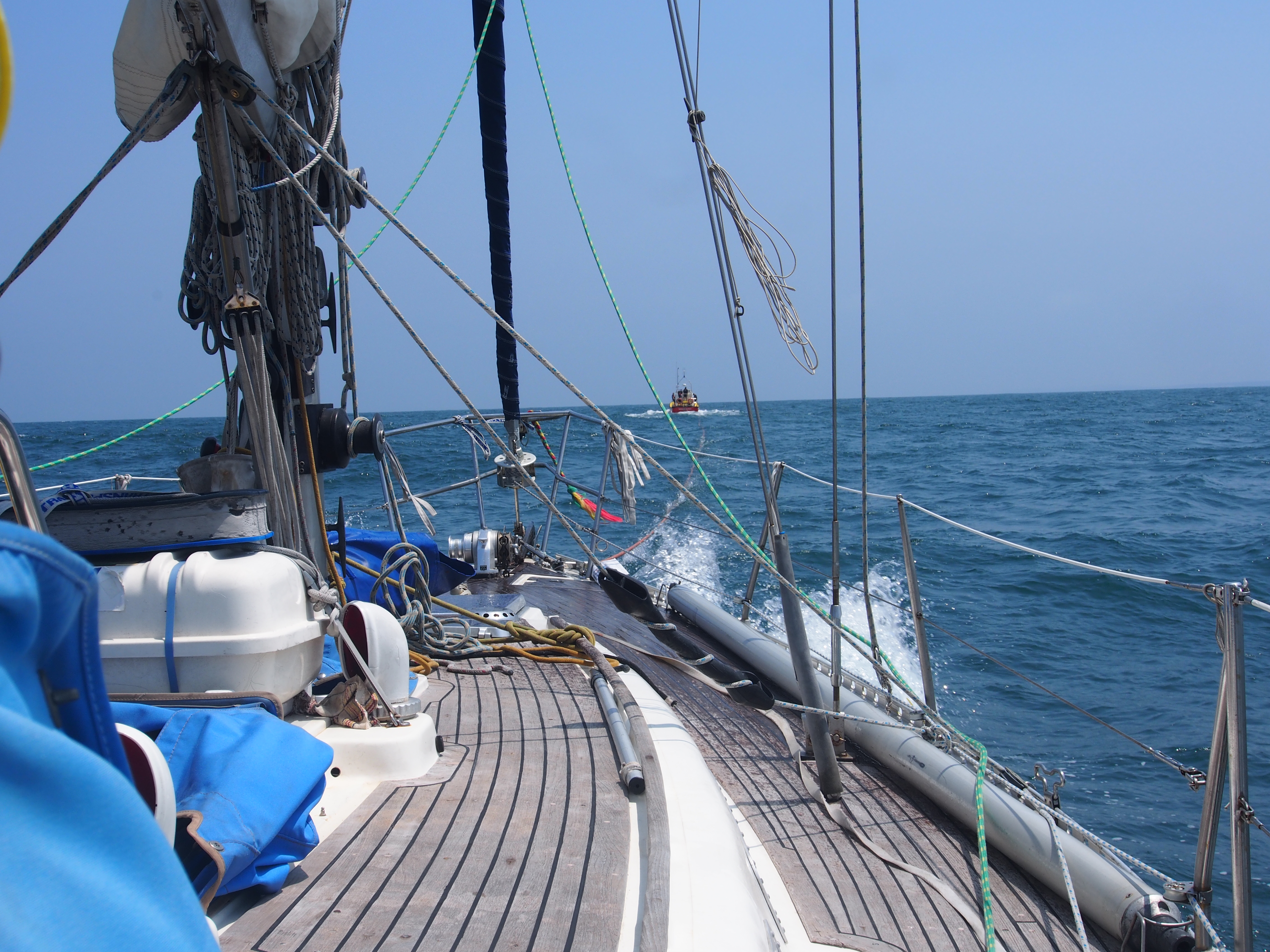
Under tow at 6.5 knots and all to windward

towing bridle
They needed some practice, put a team together and within a few hours we were comfortably tied up to the dock in Richards Bay and collapsed.
The rhythms of life in Madagascar
Magical is the first word I can think of on the first few days after clearing in to Nosy Be. Here the rhythms of the wind dictate the work and movements of people and goods.
The afternoon brings a lovely breeze pushing the dhows out-of-town and suddenly the bay is alive with lateen rigged dhows carrying both cargo and passengers back and forth amongst the islands.
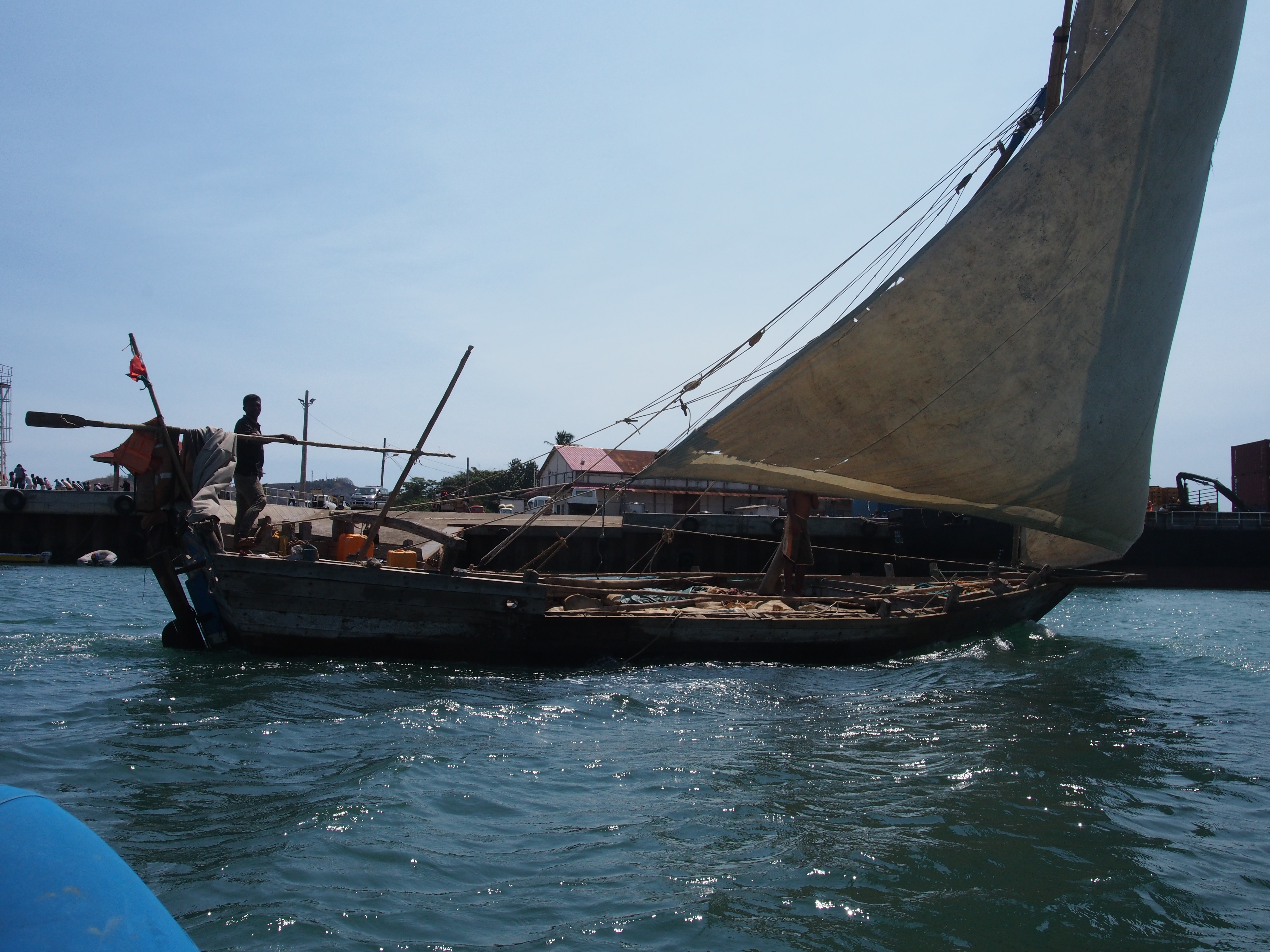
Rushing to get to port

Coming back after a day of fishing
Old and new
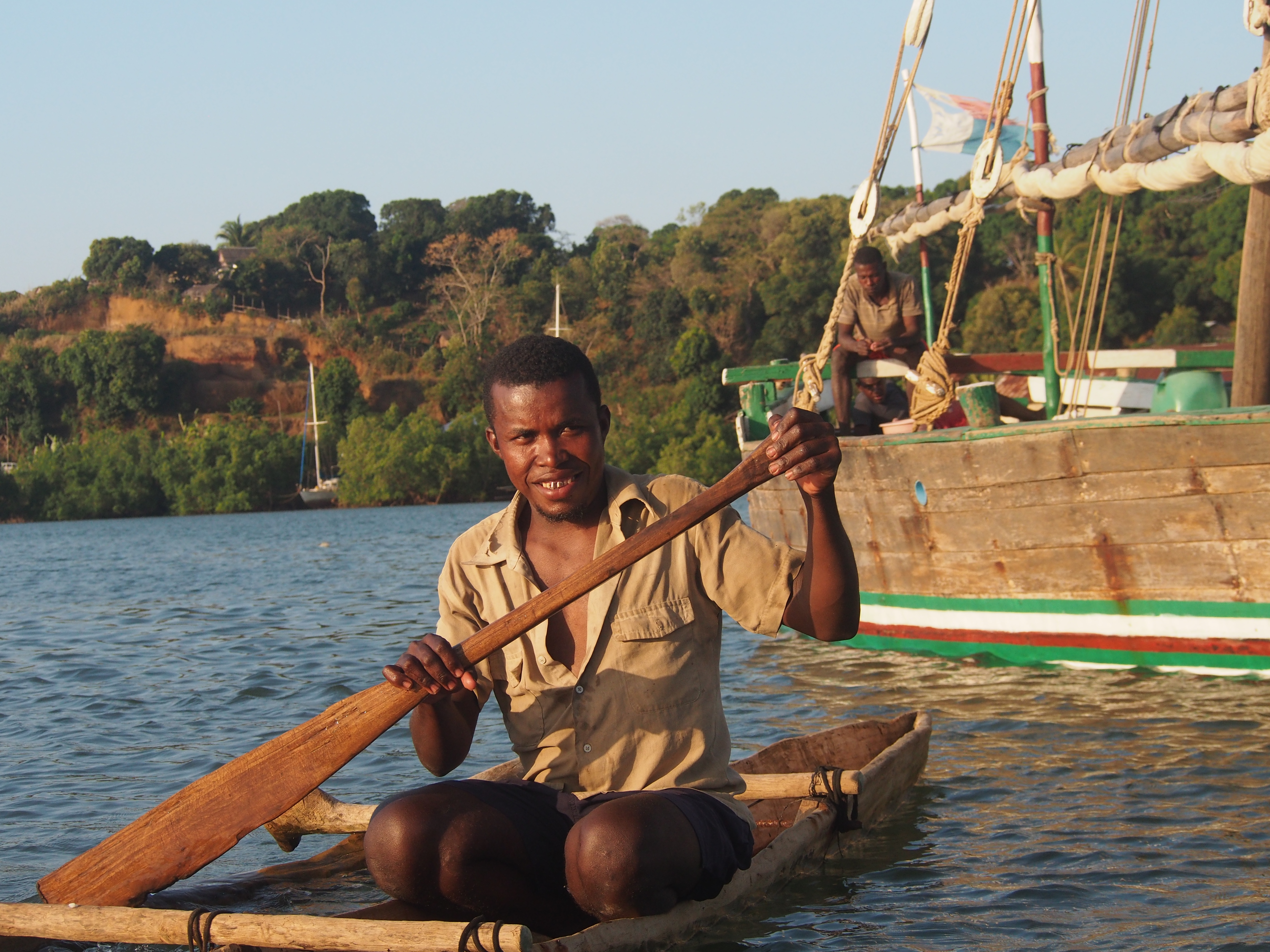
Finally off the boat and going home

Captain in training
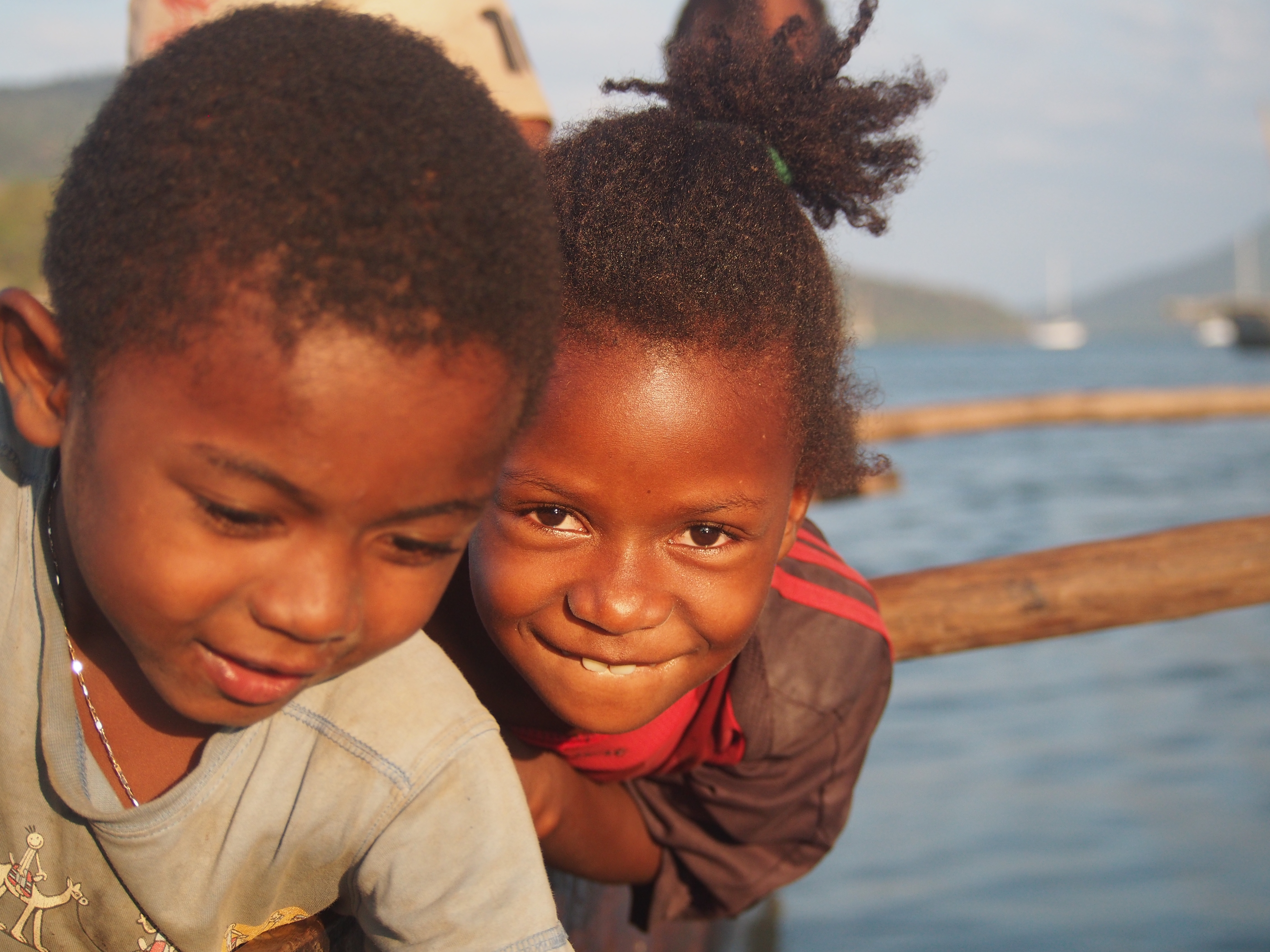
Happy crew
There are few places left in the world today where sail power forms the principal engine to move goods and people. Purely from an esoteric point of view the result of this reliance on sail power provides a principal rhythm in the lifestyle. Nothing can be rushed. All is dictated by the movements of nature and one just has to wait for that moment when the gods have decided things can be moved. Frustrating if you’re a tourist on a 2 week vacation package!
For us it’s a welcome relief from the travails of movement on the wide open seas. Madagascar has given us a chance to kick back and relax other than to repair damage done on our crossing and repair the engine salt water pump.
We have only had a chance to go to one island other than Nosy Be and that was Nosy Komba. There are quite a few tourists who head over to Nosy Komba as there’s a national park and hikes to walk along. The town has taken advantage of the influx of potential customers and uses their skills to produce lovely needlework.
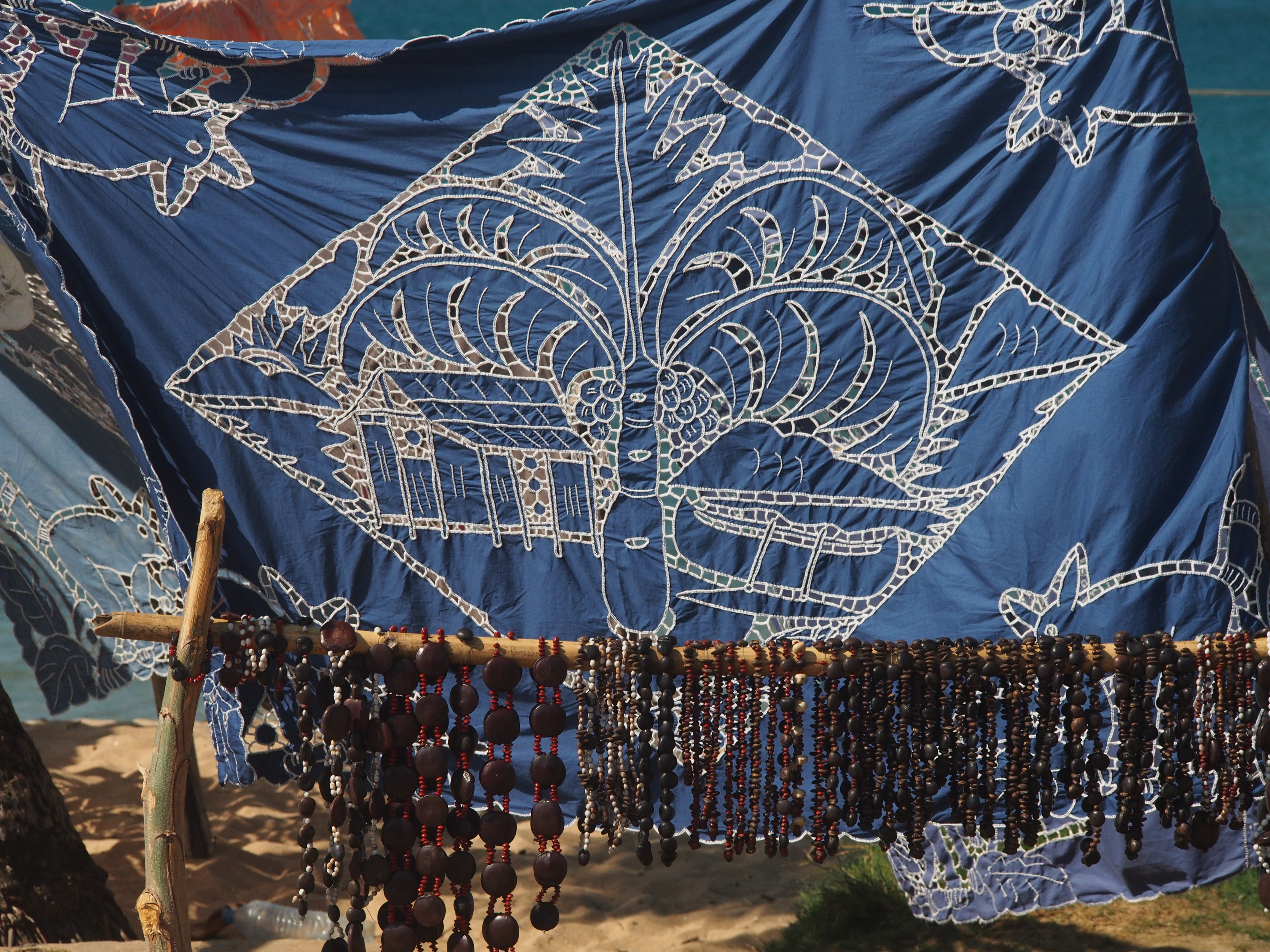
Blues

More items for sale
In the meantime, while everyone else is rushing off to the other beautiful anchorages, we sit at anchor hoping the mechanic will appear with the magical parts. Then…
Memories of the Seychelles
There is no doubt that we loved the Seychelles

However, the Seychelles would not be every sailors favourite island grouping. There are numerous reasons for this. First off, in their winter season the water is not all that clear. The south-east trades blow in with force. The strength of the wind stirs up the sands and the SE swell sweeps around almost every headland and a lot of anchorages are either untenable or simply downright uncomfortable as one rolls from side to side and the boats surge forward with the swell causing the boats to get yanked back by the anchor chain.
So why did we enjoy ourselves so much? I think simply the timing was right. We had been moving constantly since leaving Thailand in January and we arrived in a place with a safe, quiet and convenient harbour for living onboard. The town of Victoria was small enough to get around on our bikes and offered most supplies if one dug around and deep enough. Victoria also had good market, albeit the fish choices were limited. And if one were looking for those special French cheeses, wine and duck confit they were all available at the specialty stores and at special prices.
But what I think really makes the islands of the Seychelles special is the kind of development that has occurred. Granted it’s a major tourist destination but the few large and luxurious resorts are hidden away from sight. Most accommodation is made up of small ‘self-catering’ units. Many of these are located in someone’s backyard or they are clustered together 5-10 on a property. These self catering units are scattered all over the islands so one can choose a place closer to larger settlements or in more secluded areas. Although the focus in the Seychelles is on tourism it still feels accessible and is not an overloaded tourist economy.
The other part of the Seychelles we loved were the national parks with their great trails and vistas from on high overlooking gorgeous bays and beaches.

Marcia taking a trail break
There is always a secluded beach to find with virtually no-one around. And at the end of some of the park trails there’s a shower to cool you down.

Ah, a fresh shower after a long hot walk
Of course, the people make a difference. With only a population of just over 100,000 there are people from all over Asia and Europe who have flocked to the Seychelles for work. There are a huge number of Italians and French and we met and saw many working construction and even policing who came from Nepal, Bangladesh, India.

But we love the kids
Adieu Seychelles. Until another time.
Seychelles to Madagascar
Departed Anse La Mouche, September, 2015 and arrived Hellville, Madagascar September 14, 2015
Summation of damages incurred during this period:
1 – clogged fuel filters –
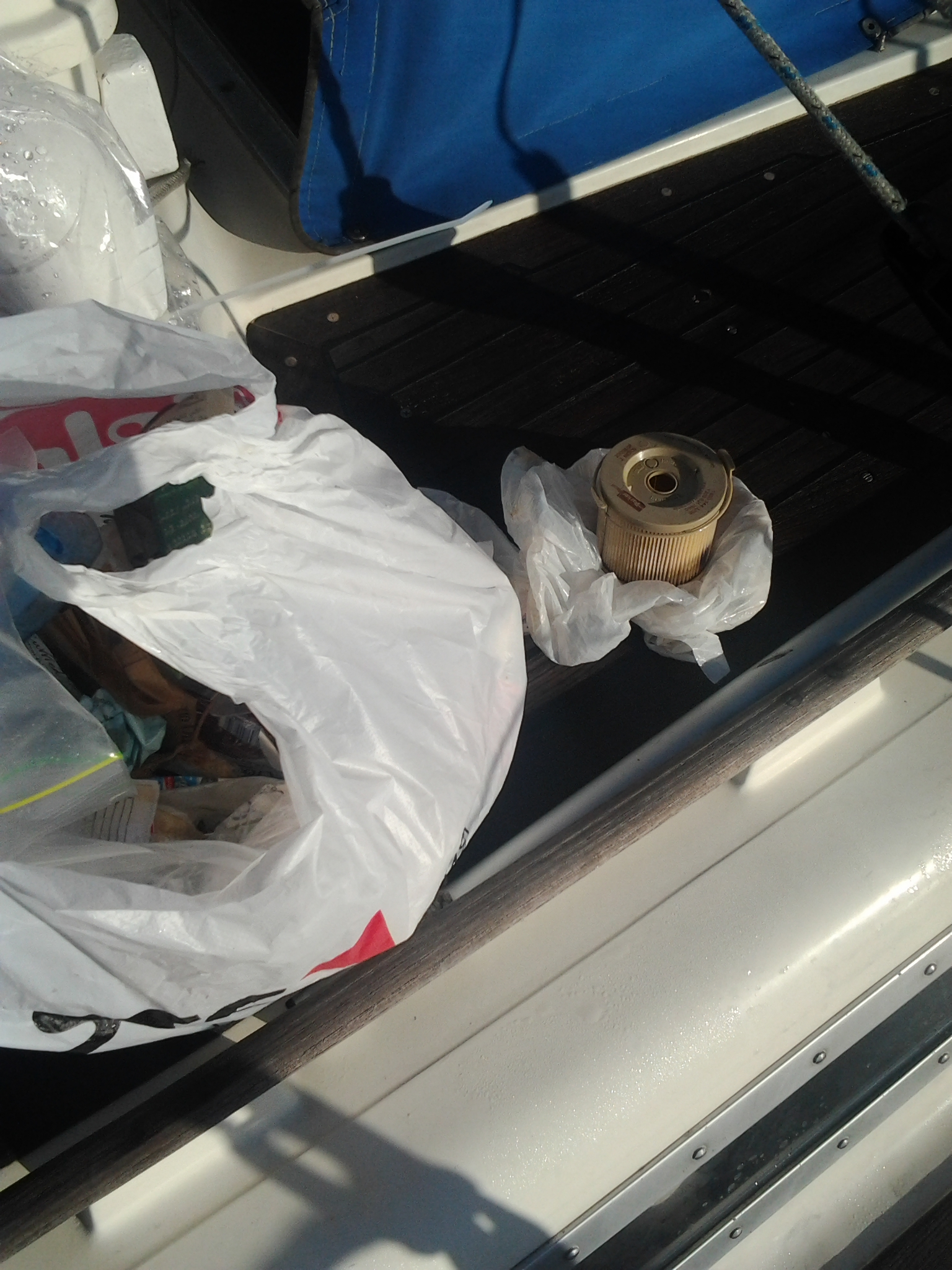
2 – broken forward handrails –

3 – dislodged mainsheet track from mast
4 – bucket lost overboard
5 -torn jib
6 – shredded Canadian flag –

7 – all towels, linen etc salt encrusted –

8 – bent stanchions –

9 – torn drifter –

10 – bruised egos
Neither of us want to repeat this kind of trip.
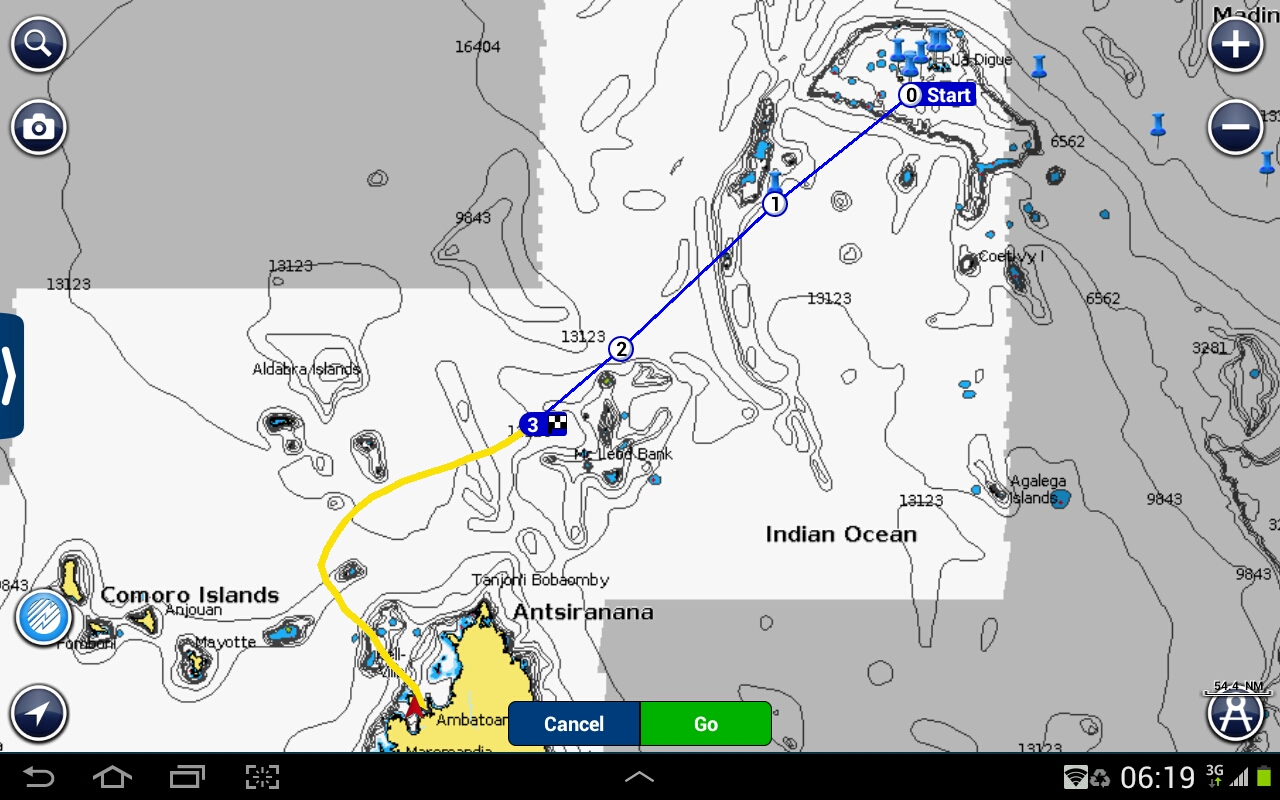
In the winter season the south-east trades blow with a great deal of strength and we witnessed that from our sail around some of the islands in the Seychelles. So, we were not looking forward to what’s well-known as a ‘slog to windward’ to get to Madagascar.
We checked out from Victoria and went to an anchorage to await a propitious weather window in which to start of on the 800 mile jump south, south-west to be exact.
As fate would have it, getting to the anchorage to await the weather window we blew out our mainsail. Yes, a squall, and an older mainsail, caught us off guard and we tore off the leach of the sail. That took a lot of mending and have to say a big thank you to Dave and Marcia on Strider who came to the rescue with a sewing machine. After a number of hours of hard sewing the job was done but then an eye infection put another halt to our plans while I went to the docs. Needless to say with all this happening it took more than a few days.
In company with Strider we headed to the last scheduled anchorage on the west coast of Mahe, Anse La Mouche. On the way there we were motoring in some very choppy seas when the engine stopped – clogged fuel filters. However, due to weather conditions we ran back to an anchorage for the night and tried to effect a change of filters. This didn’t solve the problem as engine must have had an air leak. The following morning we headed up to Anse La Mouche under sail thinking no problem as there has been plenty of wind here for the last three months. Well, the one and only time we have seen no wind happened. We were left bobbing around with no steerage and a non functioning engine. Strider came to the rescue again and towed us the last 2 miles into the anchorage.
The next day we managed to expel the air lock and got the engine going. This left some time for final departure and at least a bit of a break in the constant squalls and incessant rain.
After a few days of hanging around in the bay and after some vicious scrabble games it was time to go. Boat’s ready but we’re not and never will be having an inkling of what this trip would entail. We hanked on a small working jib, double reefed the main and slipped out of Anse La Mouche under the threat of more rain and squalls. We smoothly lifted the anchor and with no engine slid out of the bay and out of the protection (?) of Mahe.
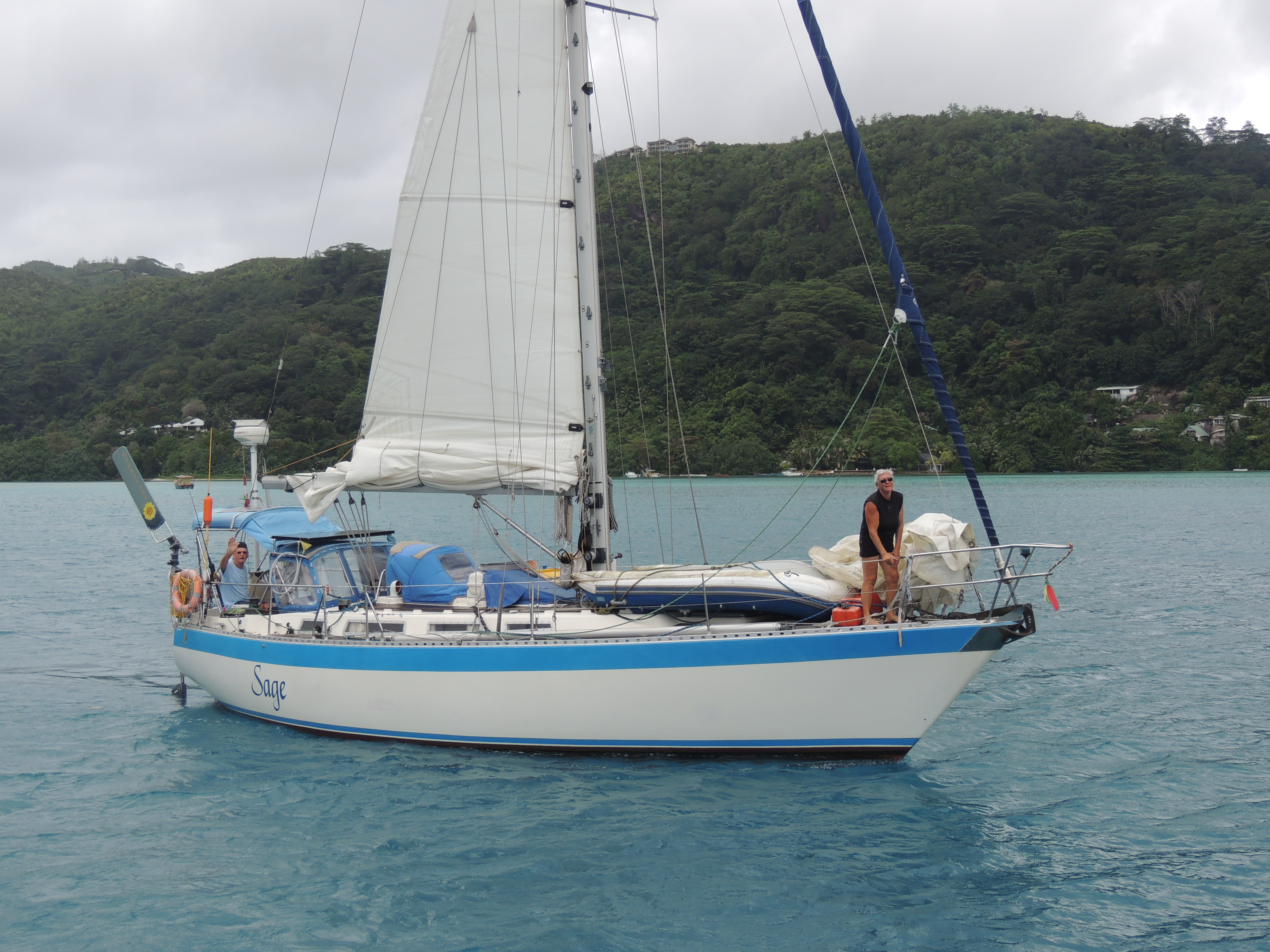
Departing Anse La Mouche (photo by Marcia Reck)

Departing Anse La Mouche (photo by Marcia Reck)
Once clear of Mahe the wind steadied and the squalls dissipated and left us with winds of 20 knots and on a very close reach in order to maintain our course line. Needless to say the seas were rough and movement on board uncomfortable but we were finally on our way.
I won’t go into more details of the actual sail south other than to say we think it was the most difficult sailing trip in all the years we have sailed offshore. The main reason for this is due to the fact it was not downwind sailing. We struggled to keep on course at times where the wind was over 30 knots and where the wind never dropped below 20 knots until we got into the wind shadow formed by Madagascar. And even there the only break we got was a decrease in the wind but we had to tack back and forth for the last 150 miles to get to Hellville, Nosy Be.
Needless to say we had a rough time. We found a tiny portion of the cockpit that was out of the spray but at times with waves crashing over the boat every so often everything eventually got soaked both outside and inside. Once things get salt water on them they never dry in those conditions so eventually the dampness permeates below and one just has to accept putting on damp cool clothing when heading out for ones watch.
The one very dramatic moment came one evening when, just after a watch change, and after the sunset, I was below having fallen asleep, when suddenly the boat made a hugely violent motion and salt water was pouring in on top of me through the dorade vents. Connie was screaming, I was confused but I knew it was imperative to get out on deck and assess the situation. We weren’t hurt, we weren’t sinking, the mast had not come down, we were alive. We lost a few things, broke a handrail, damaged the mainsail track, tore a sail, bent a stanchion and added a few bruises to our battered bodies. Like a lot in sailing we shook ourselves, hoped that this type of incident would not happen again and carried on.
Approaching our destination, Nosy Be, we were not left without incident. Not wanting to try to start the engine until the very last moment of arrival we sailed into an anchorage 5nm from Nosy Be at 0330hrs and anchored in 15m of water. We got up at 0700hrs to be greeted by overcast skies and light rain with little wind. We went to use the windlass and it was frozen. We affected a quick repair and ghosted out of the anchorage. We sailed on to Nosy Be and in the process blew out another sail.
Does this sound like fun!
The two things gained from this experience are:
1 – an increased confidence in Sage to carry on
2 – an incredible respect for our wind-driven self steering system built by Hydrovane. In reality we set our wind vane to work on leaving the Seychelles and virtually never adjusted its settings for the entire trip prior to hitting the Madagascar wind shadow.
In retrospect we made a mistake in choosing the route to the Seychelles from Chagos. We loved the Seychelles but…The problem with the routing from the Seychelles is there are no options other than through the pirate infested waters between the Seychelles and Mombassa. It’s not like the movement of highs and lows where one can heave-to for a day or two and wait for the wind to decrease. The wind blows like this for three + months. Once one makes the decision to leave the only option is to turn around and head back to wait out the season or, if you are lucky watch for a weather window and GO. For us, South Africa beckoned.
Addendum
A big thanks to Dave and Marcia on Strider for their help in repairing our mainsail in the Seychelles. While many things got broken the mainsail stayed up through it all and survived
Sailing the Plateau
Last weekend was Assumption. Here in the Seychells it is just known as ‘The Fete’. Not being Catholic I venture to say it’s just an Italian invention so they could sit down and eat again. Not that I’m complaining. I could sit down and eat anytime but my cardiologist says that’s not a good idea and my wife likes me svelt. Well somewhere along the line I have to make someone happy.
Anyway, here in the Seychelles the real party is on an island called La Digue. It’s a small and quite touristy haven. Most people get around on bikes and there’s always a secluded beach not far away.
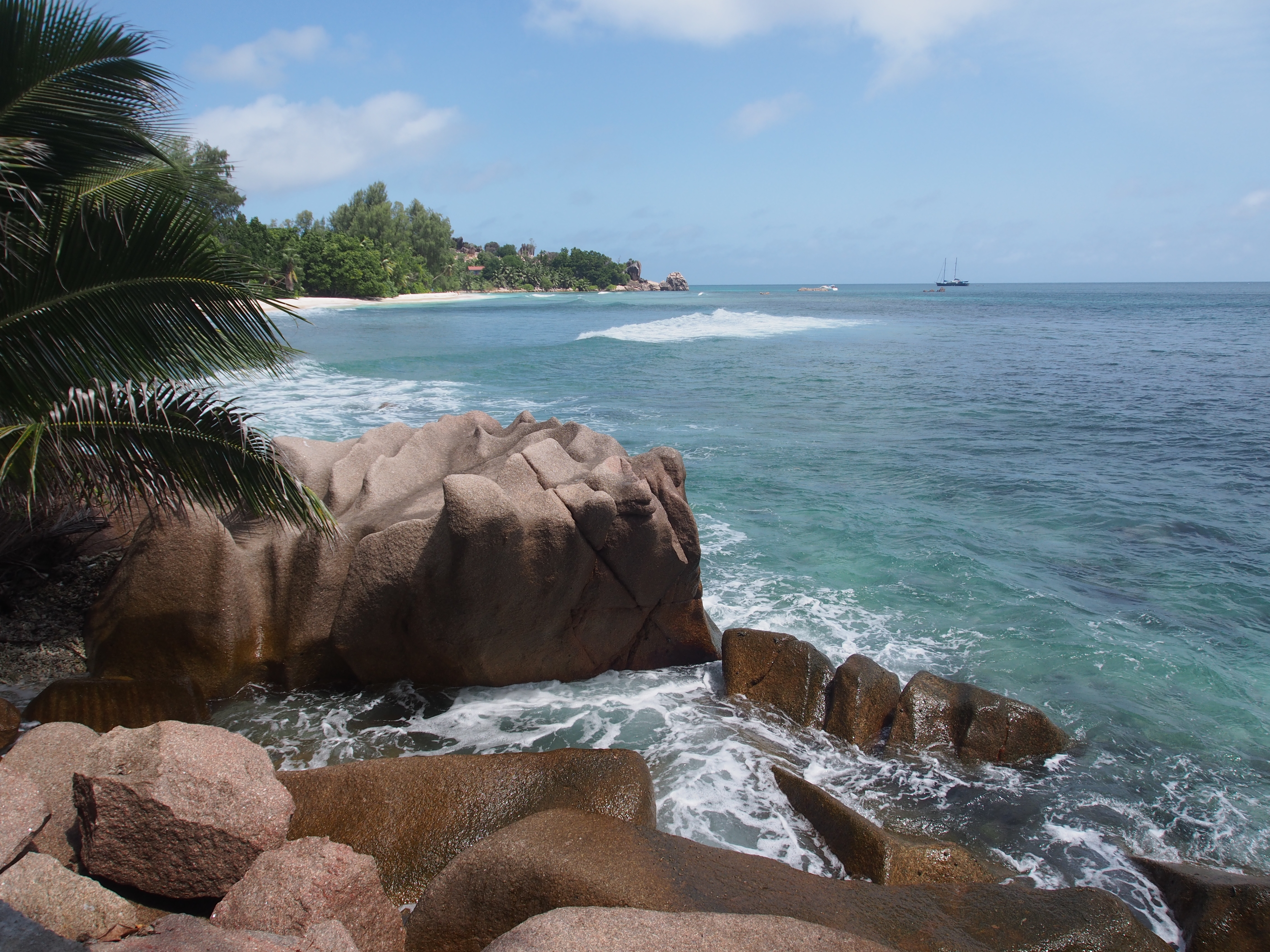
We had been to La Digue several weeks prior to the Feast of the Assumption but the local yacht club was organizing a club race across to La Digue. However, they weren’t staying in La Digue as the harbour would have been chocker block full and with 7 bands scheduled to play within 4 blocks of each other it was decided to end the race in La Digue but anchor for the Friday and Saturday night in Praslin, a neighbouring island.

Nives, our cruising guest, holding a coco de mer in the UNESCO world heritage site on Praslin Island.
The sail over from Victoria to La Digue was wild. Sailing out to the islands from Mahe is commonly called “sailing the plateau”. The reason for this is that the group of islands that make up the majority of the Seychelles are located on an almost circular plateau.
The screen grab below taken from our tablets navigation app by Navionics shows the underwater contours of the plateau. The plateau depth is generally 100-200 ft whereas the ocean around the plateau is upwards of 10,000 feet deep.
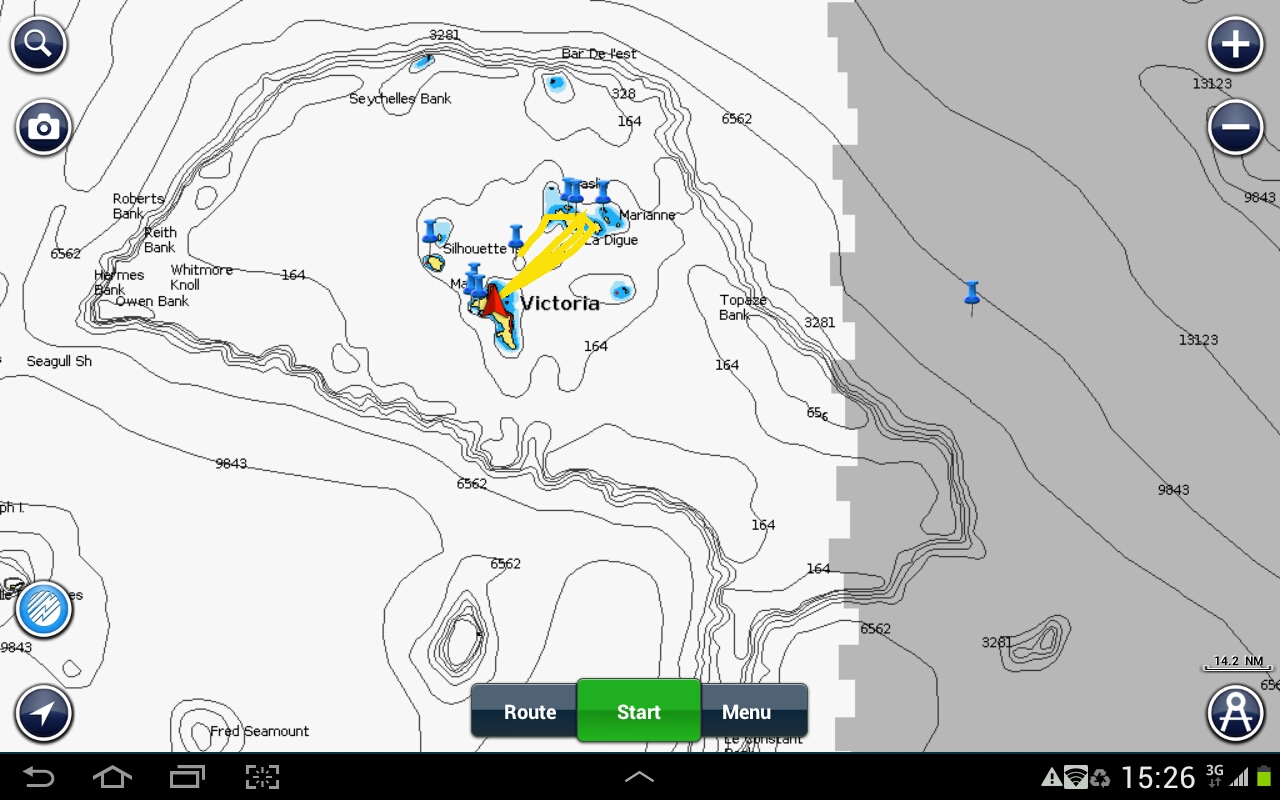
This sharp rise in the plateau gives to wild seas on the plateau and we were not disappointed. We had a jolting 30 miles to cover which took us about 4 hours 15 minutes to get to La Digue but wild and wet it was.
Starting off out of Victoria harbour we thought we had a chance of winning when we saw this boat motoring out to the start line.
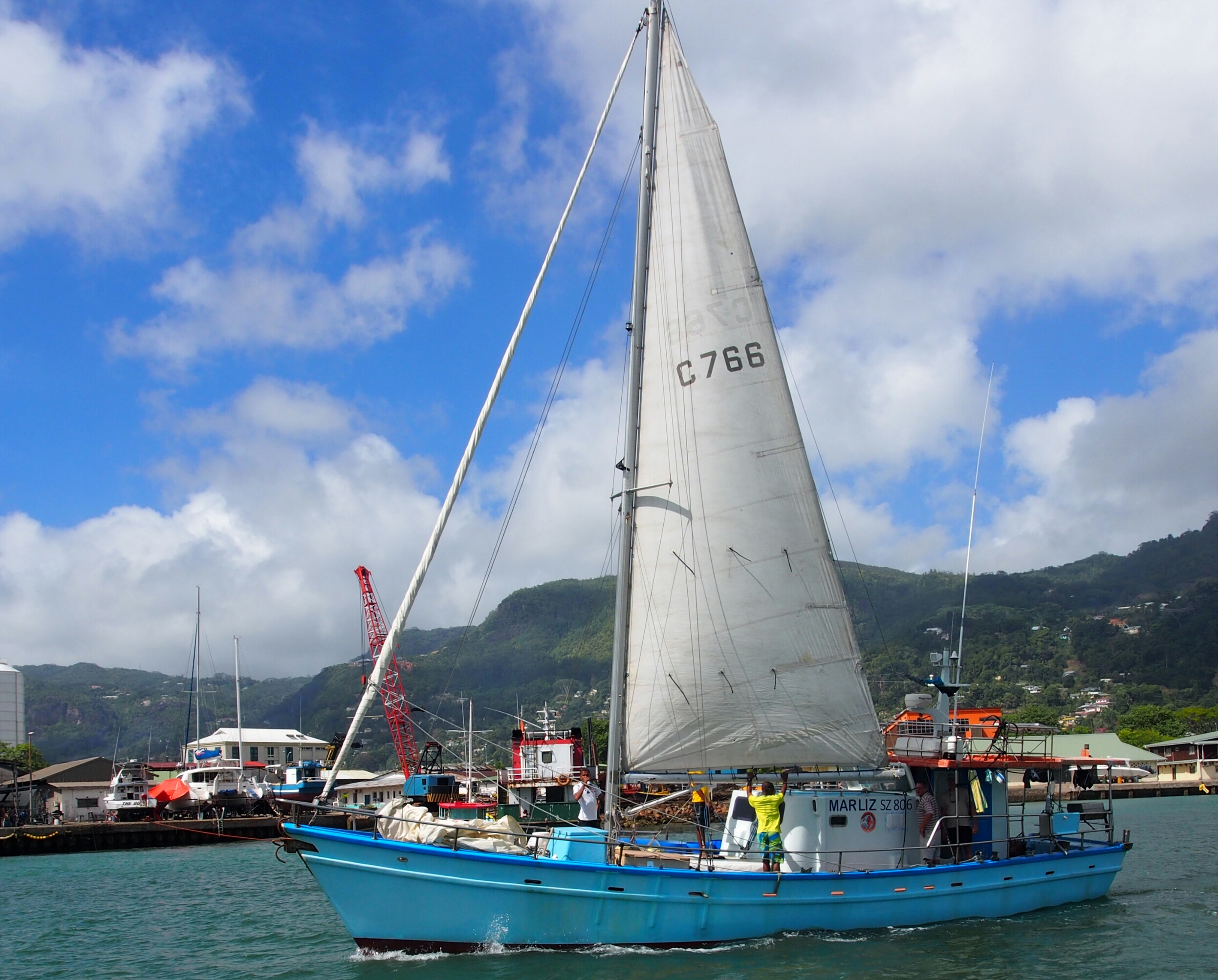
Yes, we thought, a fighting chance and our spirits were lifted. However, they were soon dashed as we watched other boats arriving and saw what the competition was like.
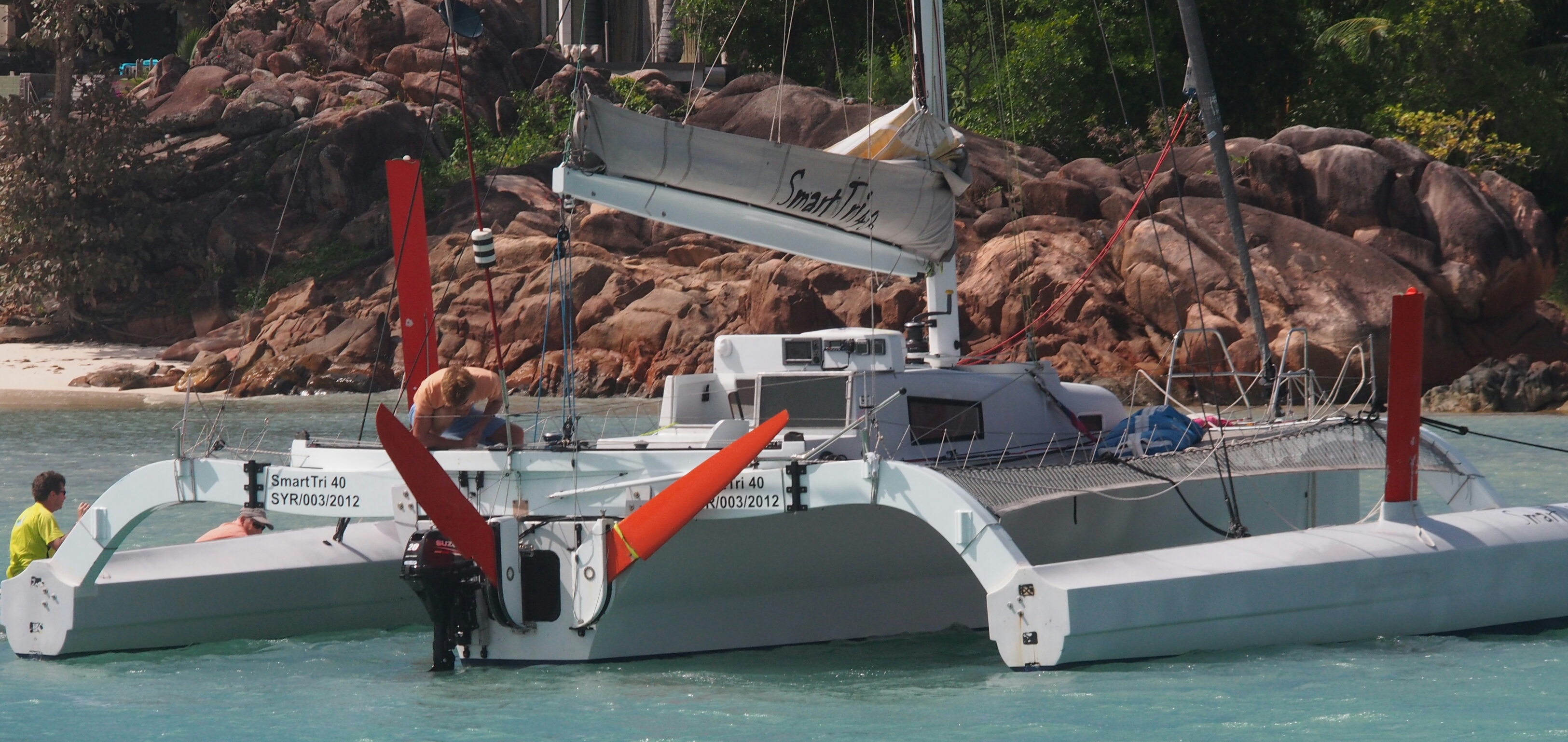
So what are we supposed to do to beat out this South African guy. It wasn’t only once she went screaming by us doing close to 20 knots but twice, once on the way and then of course once on the way back.
However, our spirits were buoyed by this pretty little boat sailed single-handedly by Peter. A real gem built, I think, in 1956 by Abeking and Rasmussen in Germany. Draws 50cm with the centreboard up and sails to windward beautifully but wet.

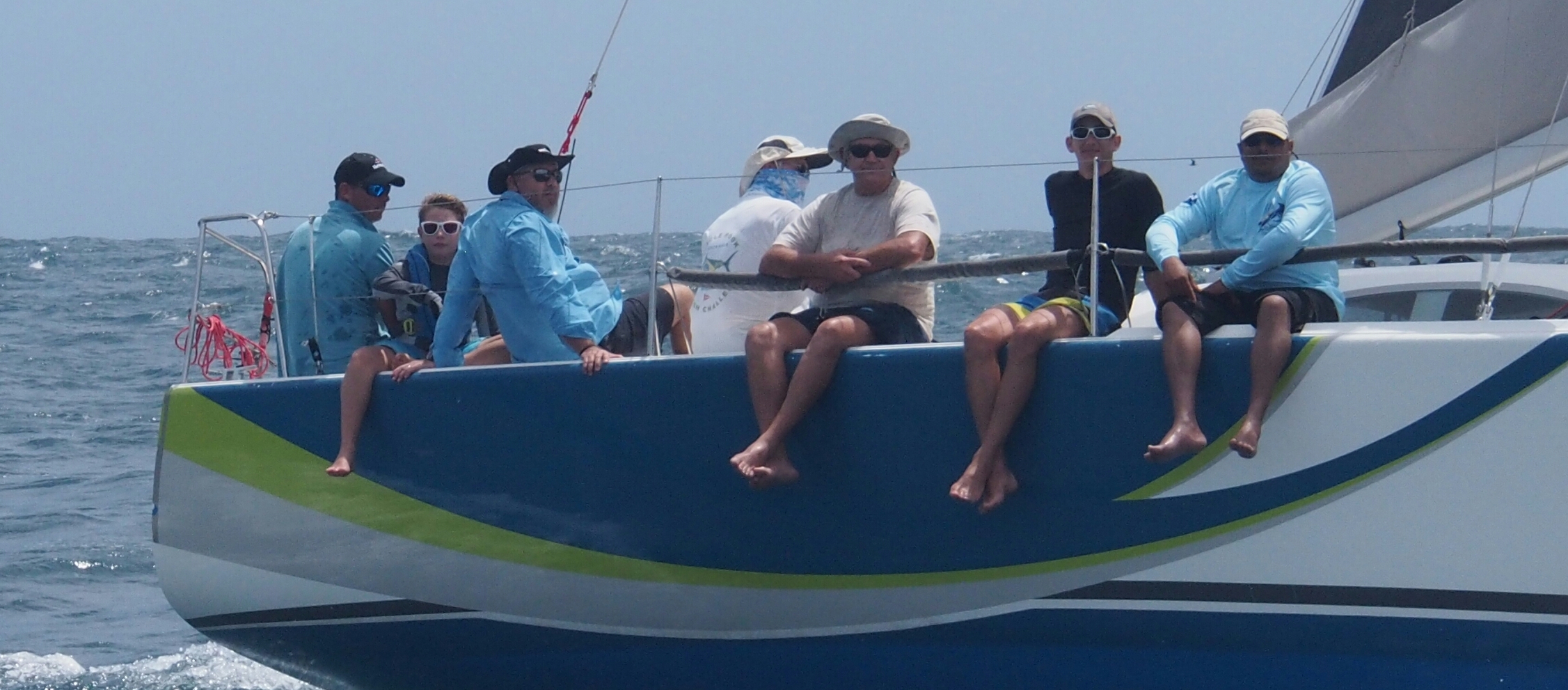
As normal photos of an angry sea are hard to get to show what it’s like but below I can verify these guys were not dry once past the finish line.
It was a great weekend. Meeting people, talking sailing of course and the prerequisite dinner and drinks. We owe a heartfelt thanks to the racing boats of the Seychelles Yacht Club and all the people who welcomed us foreigners and temporary intruders no matter how much we bragged about our fast boat!
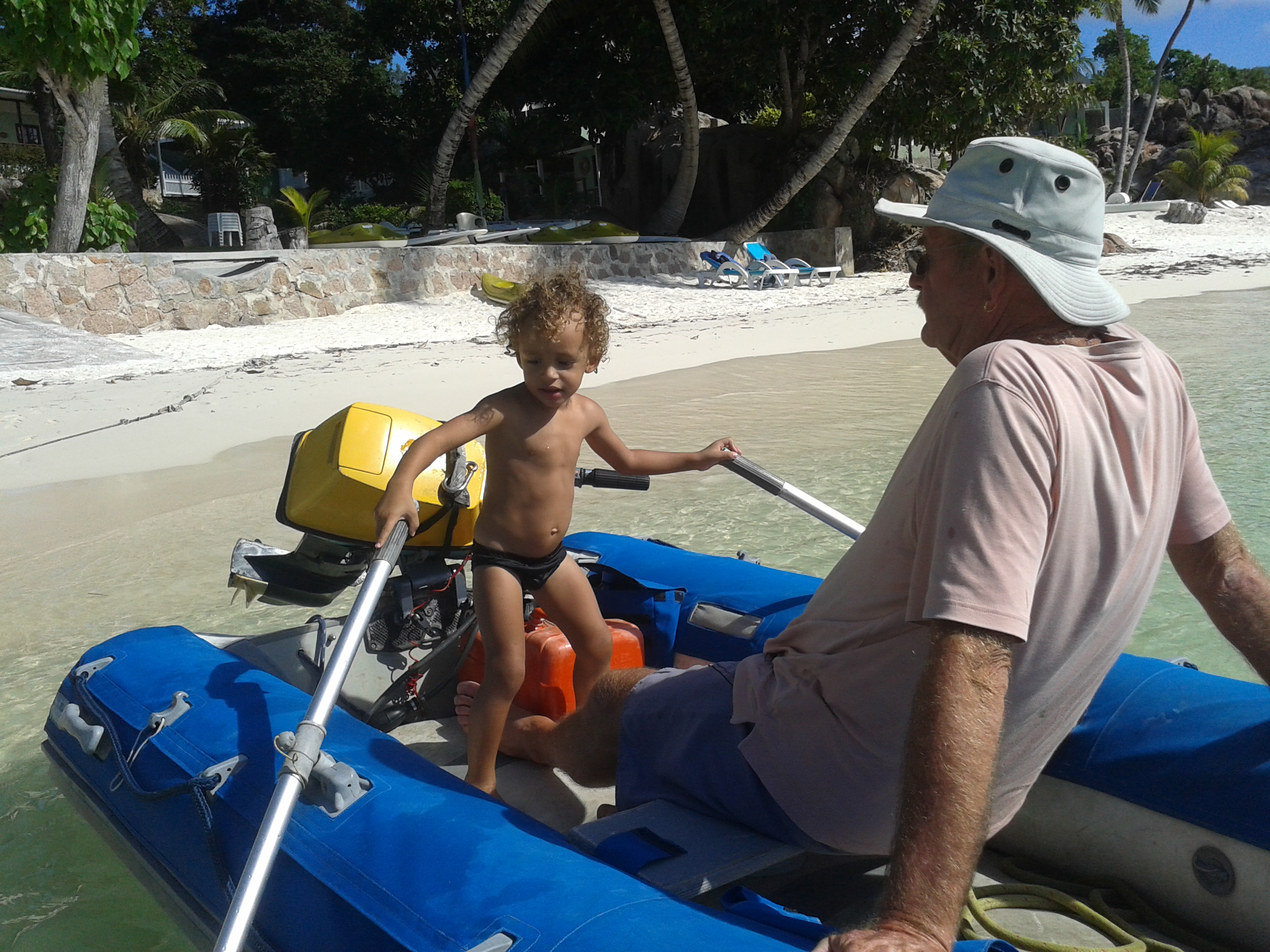
More Pirates
Last seen were these two heading out to sea from the Seychelles on their pirate ship. Only first names are known – Sebastian and Tony
Are the Seychelles Expensive?
For sailors planning on coming to the Seychelles I thought I would give you an update on current expenses you can incur.
The Seychelles can be expensive not only for the food but for all the additional costs a foreign yacht can incur during a three month stay. There are ways around some of these costs but some cannot be avoided. Here is a list of probable costs a yacht can incur.
1 – visits to anchorages located in National Parks – 250 rupees (Cdn $25) /night- avoidable if you stay out of the area of the national parks. As long as one is anchored more than 200 metres from the shoreline of a national park then no fee is applicable unless you go ashore. In some areas there is also a fee of 200 rupees ($20/person) for going ashore
2 – initial clearance fee with the Harbour Master = 300 rupees (Cdn $30) – unavoidable
3 – Seychelles Yacht Club – fee for the use of their dinghy dock, showers and temporary membership = 125rupees/week (Cdn $12.50/week). One can avoid this fee if you are willing to tie up your dinghy elsewhere and not use the SYC facilities.
4 – La Digue – 150 rupees (Cdn$15) for water. One ties med style in the small harbour and a hose is obtainable from the harbour master and this can be used to fill up water tanks, doing laundry and/or washing off the boat. This is a one time use fee and is to be paid on a per use basis
5 – Clearance fees. These are unavoidable. The costs below are for yachts of less than 20 gross tons:
For a visit of between;
0 to 120 hours = 75 rupees/day
120 – 240 hours = 60 rupees/day
more than 240 hours = 50 rupees/day
For our boat 12 metre sailboat, Sage, a Wauquiez 38, and a three month visit, the total cost is 11,220 rupees or Cdn $1,112. These charges really call into question whether the Seychelles wants itinerant cruisers to visit. These charges, in our experience, are, next to the Maldives, the most expensive we’ve encountered. Is it worth it? Come and decide for youselves!
Broke but enjoying ourselves.
Pirate or Fisherman
Talking piracy in this area of the world can lead to real trouble. There are still armed guards on all large fishing vessels and cargo ships unloading here have their rails covered in razor wire. Piracy has decreased in this area due to the efforts of the international community which has been patrolling the area between here and the Red Sea and the east coast of Africa. Found recently in the yacht anchorage was this pirate as per a previous postings.
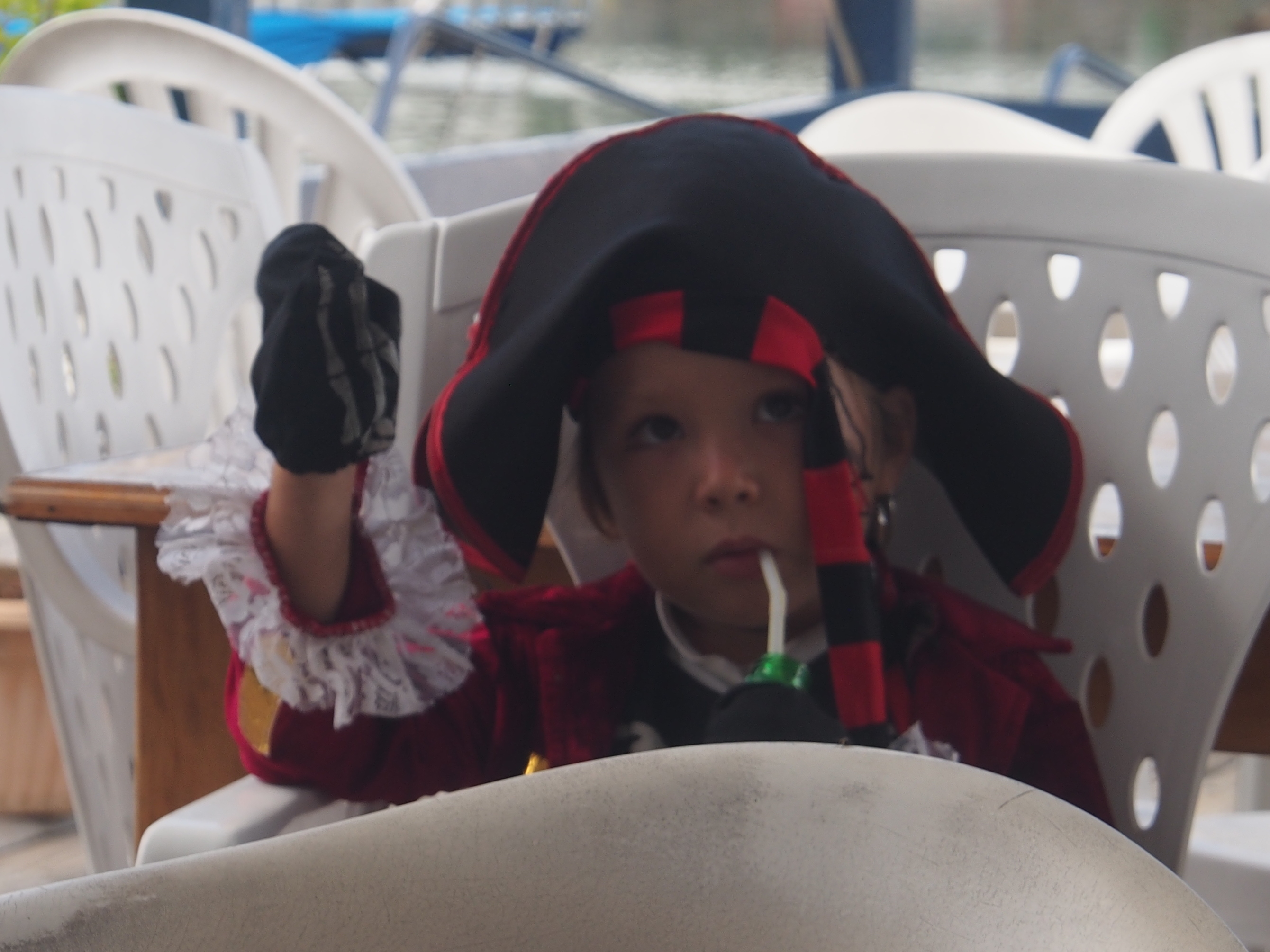
Our own Mexican pirate before he went on a raid
Since the international community here is being quite diligent on following up on piracy this particular pirate, named Rio, was captured and spent some time in rehabilitation.
The results of his rehabilitation have been very positive and he was recently seen, with his ex-accomplice, in a local fishing tournament in which he won a prize – see picture below.

Rio with his trophy for the smallest fish caught in the tournament
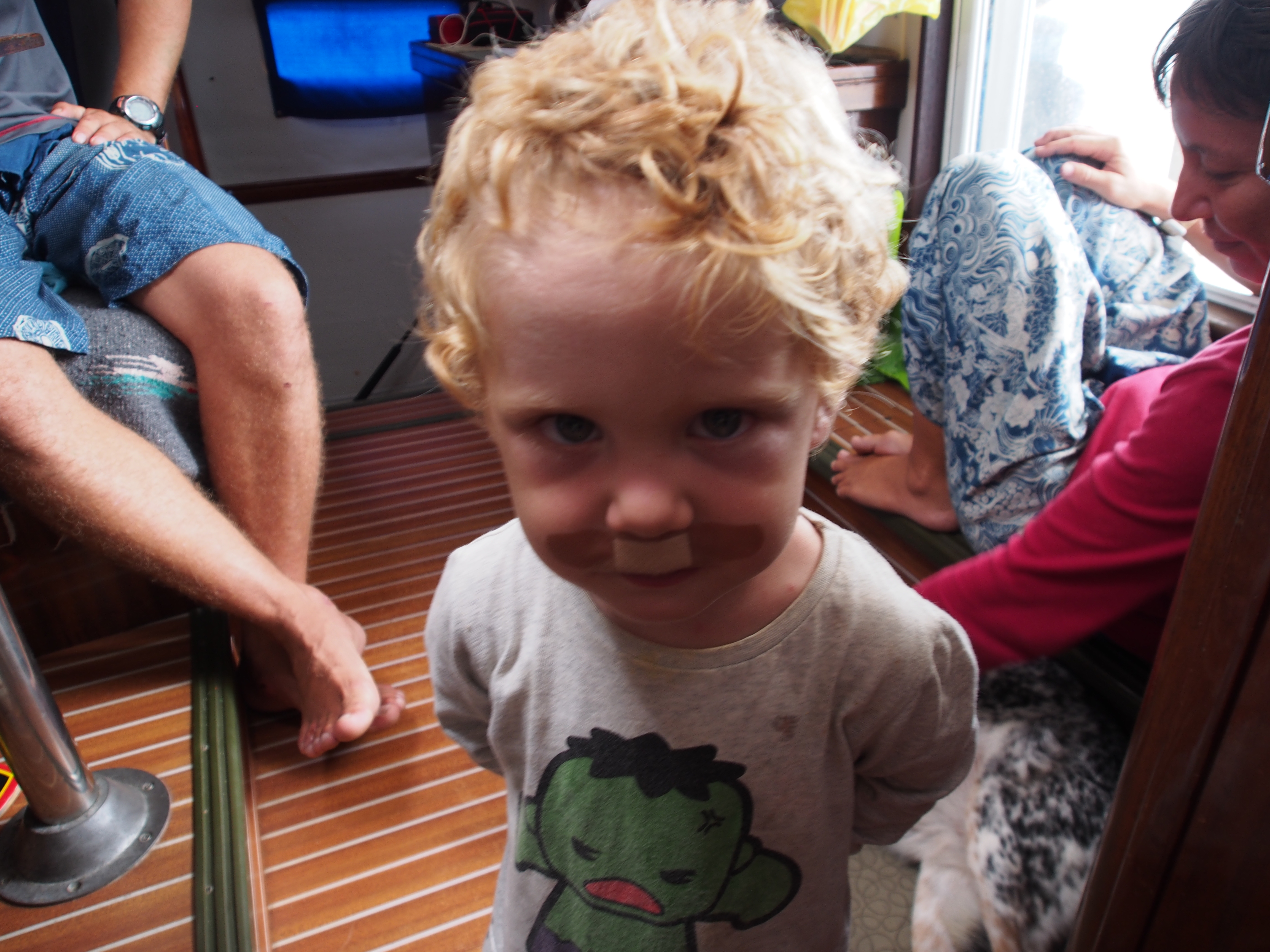
Rio, the ex-pirate’s accomplice – Ben. Ben is now roaming the seas having failed rehabilitation. Warning – approach with caution. Dangerous and armed. He has a very beguiling face but can turn violent in a moments notice.
I guess all is well that ends well. Rio and his accomplice were last seen heading south to Madagascar and we are hoping the owners of the vessel he signed on with know of his past. We hope to catch up with this lot in Madagascar or South Africa.
 Sage on sail